When a Judge Stops Trusting CBSA, Ottawa Needs a Removal-Order Failure Ledger
A removal order should not become a courtroom maybe. Publish the custody handoff, delay and enforcement receipts.
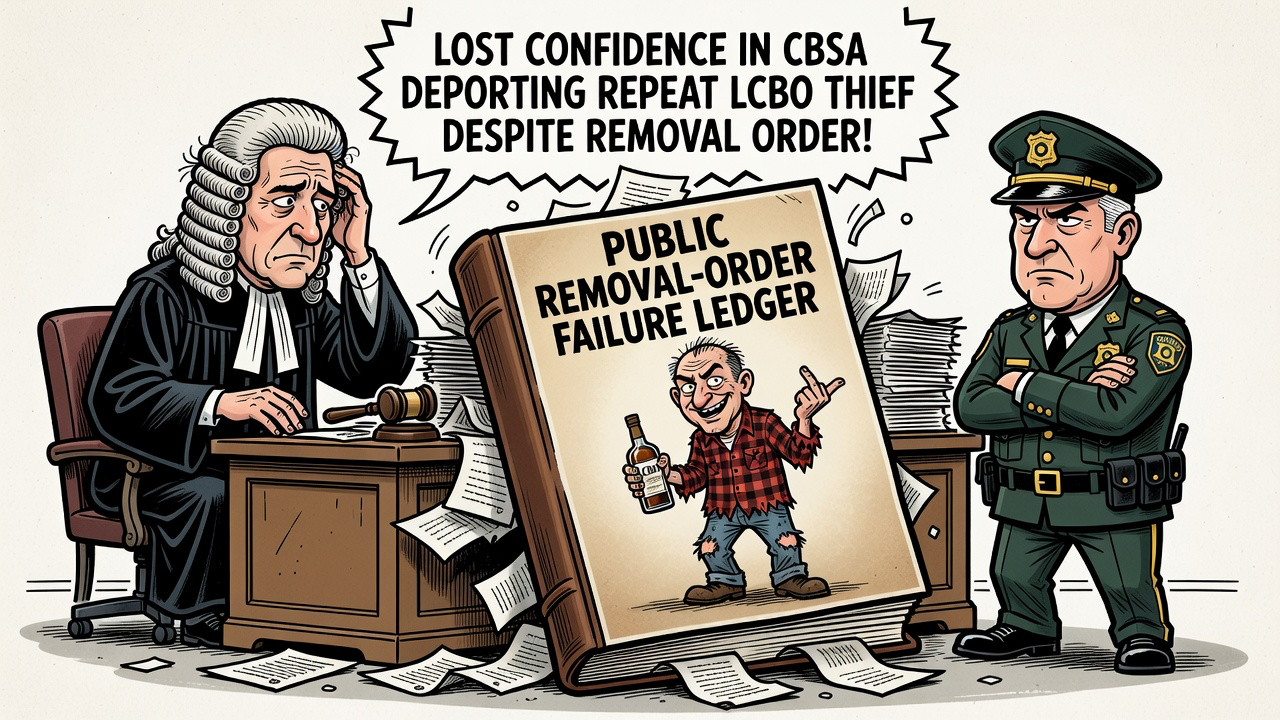
An Ontario sentencing decision has turned a routine retail-theft file into a serious federal accountability question. According to National Post reporting syndicated by Unpublished.ca, Justice Michael K. Wendl rejected a jointly proposed 90-day sentence for Manjeet Singh and imposed 12 months instead after concluding the justice system could not simply assume CBSA would remove him from Canada.
The facts reported from the decision are blunt. Singh had been under a removal order since October 2022. He was also in custody for about 45 days in 2024 and more than five months in 2025 on serious criminal charges, yet the judge said CBSA still had not removed him. Wendl wrote that he had “no confidence” CBSA would actually deport Singh, and said future courts may need evidence before treating immigration consequences as an established sentencing factor.
Singh pleaded guilty to two LCBO theft counts and one probation breach. The Hamilton incidents involved 39 bottles of alcohol worth $3,268.30, none recovered. He was already barred from LCBO stores and, according to the reports, had similar theft convictions involving LCBO and Home Depot locations. This is not a debate about one bottle, one desperate mistake, or one paperwork glitch. It is a test of whether a final removal order means anything when a repeat offender is repeatedly inside systems that could identify him.
A conservative accountability standard can hold two ideas at once. Canada must follow due process, respect court orders, and protect people with lawful claims. But once appeals and legal barriers are exhausted, enforcement must be timely and auditable. Otherwise immigration consequences become theatre: useful in submissions, uncertain in practice, and ultimately paid for by victims, police, courts, retailers and taxpayers.
Ottawa likes to announce border bills, stronger tools and enforcement statistics. This case asks a narrower question: when a named person has a removal order and is sitting in custody, what exactly prevents the federal government from acting? If the answer is a legal barrier, publish the category. If it is resources, publish the backlog. If it is a handoff failure between jail, court, police and CBSA, publish the fix.
Canadians do not need reckless rhetoric. They need a removal-order failure ledger: monthly public data on criminality-priority cases, custody handoff misses, average time from enforceable order to removal, reasons for delay, warrants issued and cleared, and ministerial performance targets. A government worthy of trust would not wait for judges to say they have lost confidence. It would prove, with receipts, that final decisions are enforced.
- Unpublished.ca / National Post: Judge gives repeat LCBO thief a harsher sentence because he doubts CBSA will deport him
- The Epoch Times: Judge Hands Repeat LCBO Thief Longer Sentence, Citing Doubts CBSA Will Deport Him
- CanLII case page cited in reporting: R. v. Singh, 2026 ONCJ 377
- Reddit discussion lead: r/canada discussion
This article relies on reported court facts and argues for transparent federal enforcement reporting. It does not allege wrongdoing by any individual CBSA officer, court official or minister beyond the documented public-administration failure requiring accountability.