Carney’s Saudi Partnership Needs the Receipts Before the Victory Lap
The Saudi partnership may be strategic. But Canadians should not be asked to applaud defence, AI and pension-fund engagement with an authoritarian monarchy before Ottawa publishes the terms.
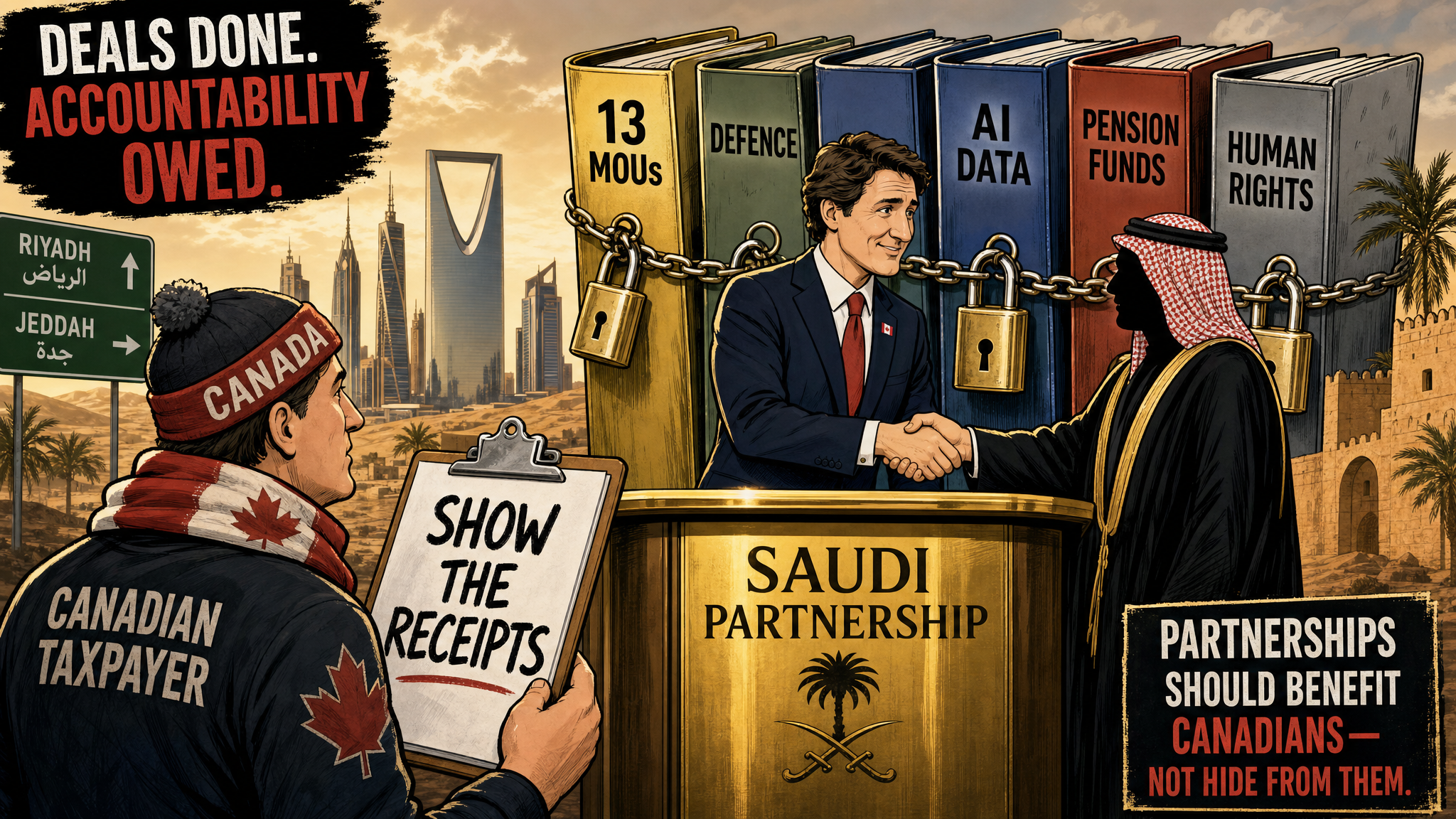
Prime Minister Mark Carney’s Saudi Arabia visit is being sold as a hard-nosed economic reset. The Prime Minister’s Office says Canada and Saudi Arabia signed 13 commercial agreements and memoranda of understanding worth more than $1 billion across health technology, mining, infrastructure and defence. The joint statement says the July 8 to 10 visit was the first by a sitting Canadian prime minister to Saudi Arabia in 26 years.
That is exactly why the receipts matter. When a government announces a new partnership with a regime whose human-rights record remains a live concern, the accountability standard should rise, not fall. CityNews, citing Canadian Press reporting, noted criticism from experts who said Ottawa should be clearer about expectations for the trip and reported concerns about repression of dissent and the continuing travel ban on Raif Badawi.
Carney can argue, as many governments do, that Canada has to engage countries with different systems. Fine. Engagement is not a blank cheque. If the deal is in Canada’s interest, the government should be able to publish the list of the 13 agreements, identify the parties, state the dollar value of each, and separate binding commitments from promotional MOUs.
The defence language deserves special scrutiny. PMO says the two countries agreed to deepen defence and security co-operation, work toward a defence-cooperation MOU, and establish a resident Canadian Defence Attaché in Riyadh to increase bilateral engagement and defence-sector exports. That may benefit Canadian firms, but Canadians deserve to know what safeguards apply before arms, dual-use technology or security services are marketed under a federal banner.
The AI and energy language raises another set of questions. PMO says the countries discussed collaboration on energy and artificial intelligence. If Canadian expertise, data systems or infrastructure partners are being drawn into Saudi projects, Ottawa should disclose the data-security rules, export-control screens, ownership safeguards and any taxpayer-backed financing or diplomatic support attached to those opportunities.
The pension-fund angle is the most politically sensitive. PMO says Carney will lead a delegation of Canadian pension funds to Saudi Arabia to explore long-term investment opportunities in sectors including energy and AI. Pension managers are supposed to act for beneficiaries, not as props in a prime ministerial trade narrative. Canadians should know which funds are involved, whether any public mandate was requested, and what risks have been disclosed to contributors and retirees.
Trade can be useful. Diplomacy can be necessary. But Conservative accountability means insisting that national interest is proven with documents, not slogans. Publish the Saudi ledger now: the agreements, the safeguards, the human-rights agenda, the pension-fund delegation, and every dollar of public exposure.
- Prime Minister of Canada: Prime Minister Carney deepens partnership with Saudi Arabia across trade, education, technology, and critical minerals
- Prime Minister of Canada: Joint Statement by the Prime Minister of Canada and the Crown Prince and Prime Minister of Saudi Arabia
- CityNews / The Canadian Press: Carney in Saudi Arabia seeking economic partnership amid human rights concerns
- CityNews video: Canada needs to engage with Saudi Arabia despite differences: Carney
This article focuses on the July 2026 Saudi Arabia visit and the public accountability questions created by the official trade, defence, AI, energy and pension-fund language.