Carney’s Defence Bank Needs a Public Liability Ledger
A Canada-led defence bank may sound like strategic leadership. Without a public ledger, it could become a new place to park taxpayer risk outside ordinary budget scrutiny.
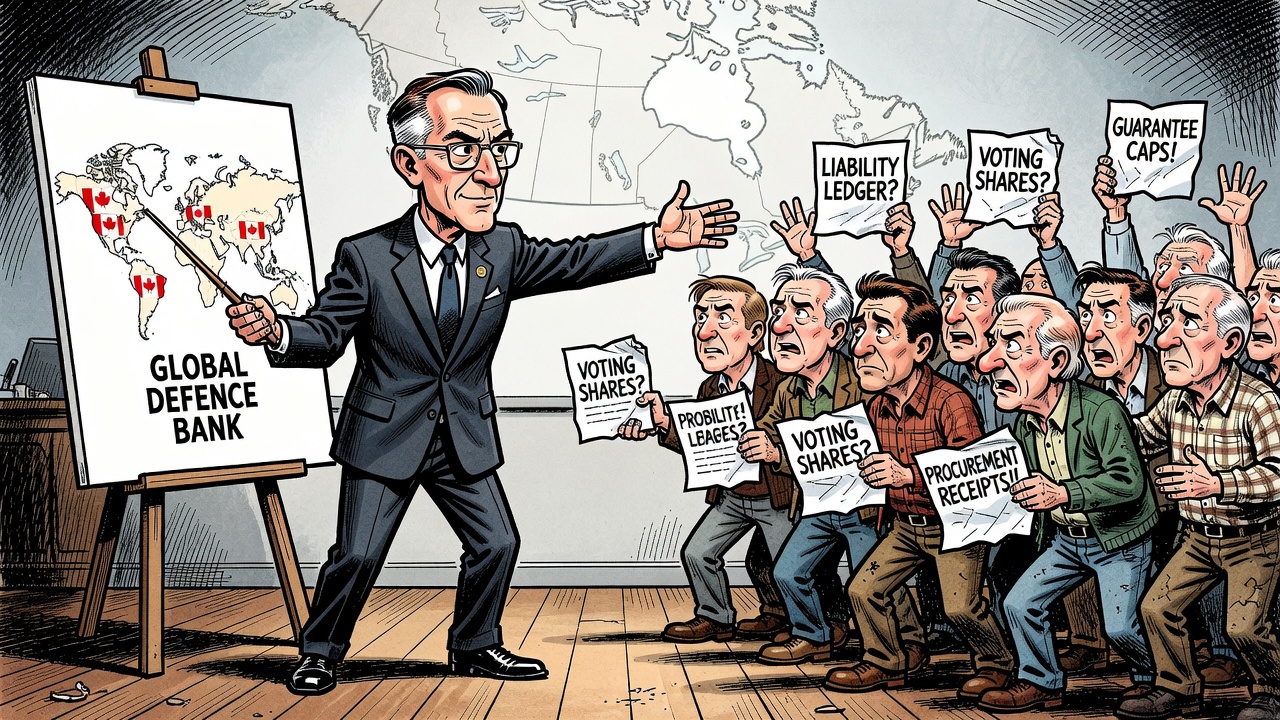
Prime Minister Mark Carney is trying to turn Canada into the headquarters country for a new Defence, Security and Resilience Bank. The Prime Minister’s Office said on July 7 that Albania, Belgium, Greece, Latvia, Luxembourg, Romania, Türkiye and Ukraine had committed to supporting the Canada-led bank, with Canada selected as the future headquarters host. One day later, Carney and U.K. Prime Minister Keir Starmer said from Ankara that the bank and Britain’s Multilateral Defence Mechanism are “highly complementary” and should develop coherently.
That is a big institutional promise. It is also exactly the kind of promise that requires a plain taxpayer-risk ledger before the ribbon-cutting starts. Multilateral finance has a way of making liabilities look technical, shared and distant. Canadian families still end up paying when capital calls, guarantees, subsidized loans or procurement commitments turn political ambition into real exposure.
Ottawa’s public case is straightforward: allies need more defence industrial capacity, Ukraine and NATO partners need financing tools, and Canada can help organize the effort. Those goals can be defensible. But Conservative accountability starts with the question government prefers to answer last: how much public money, public credit or public risk is Canada putting on the table?
Reuters reporting, republished by Investing.com, said Canada wanted more countries behind the initiative before announcing founding nations and had aimed for roughly 10 backers around the NATO summit. Euronews reported that no G7 economy other than Canada had signed up, while major European military spenders such as Britain, Germany and France were holding back. If that remains the political reality, Canadians deserve to know whether Canada is leading a durable coalition — or underwriting a boutique institution while larger allies wait on the sidelines.
The procurement risk is just as important as the balance-sheet risk. A defence bank can steer cheap financing toward factories, contractors and politically favoured projects. If Canadian firms benefit, say so. If foreign firms benefit from Canadian-backed lending, say that too. Publish the eligible sectors, the expected borrowers, the due-diligence rules, the anti-corruption screens, and the rules for ministers, officials and connected advisers who may have ties to defence, banking or infrastructure interests.
Carney’s government wants credit for seriousness on defence. Seriousness is not measured by creating another international acronym. It is measured by audited numbers, enforceable limits and Parliament’s ability to say no before taxpayers are committed. Publish the Defence Bank ledger now — or admit Canadians are being asked to sign a defence-finance invoice they have not been allowed to read.
- Prime Minister of Canada: Eight countries commit to supporting Canada-led Defence, Security and Resilience Bank
- Prime Minister of Canada: Joint statement by Prime Minister Carney and Prime Minister Starmer
- Investing.com / Reuters: Canada wants more backers for global defence bank, foreign minister says
- Euronews: A World Bank for defence? The lender that Europe’s big powers have yet to join
This article focuses on the public fiscal, procurement and governance questions raised by Canada’s proposed Defence, Security and Resilience Bank.