Ottawa’s AI Data-Centre Gold Rush Needs a Public Power, Water and Subsidy Ledger
AI infrastructure may be strategic. But if taxpayers, ratepayers and communities are being asked to absorb the risk, the Carney government should show the receipts before celebrating the boom.
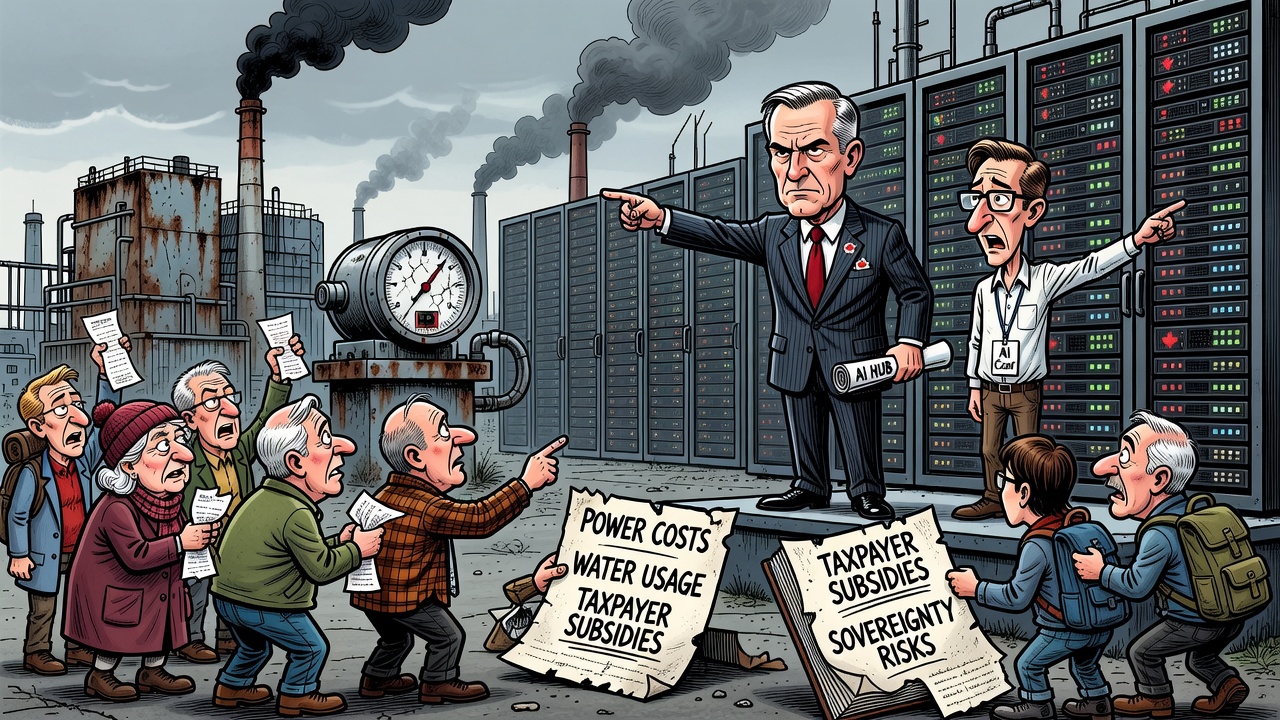
Ottawa is now selling Canada as a destination for artificial-intelligence data centres. That may sound modern and ambitious, but Canadians should hear the other half of the pitch: these projects need enormous electricity, raise local water and land-use concerns, and can leave public costs hidden behind private-sector headlines.
Global News, citing Canadian Press reporting on an access-to-information release, reported that a federal pitch deck for AI Minister Evan Solomon listed about 337 megawatts of existing AI data-centre capacity in Canada and more than 20 gigawatts of projects “under planning or development.” Solomon’s office pushed back, saying the figure was a point-in-time snapshot of proposals at different stages and that most of that proposed capacity is not expected to proceed.
That clarification is useful. It is not enough. If the government is assembling investor decks around a data-centre buildout, Parliament and the public deserve the same project-by-project ledger investors get: proposed capacity, power source, water plan, public subsidy, tax treatment, municipal infrastructure cost, ownership, data-sovereignty safeguards and expected Canadian access to the compute.
The Meta announcement in Alberta shows why. AP reported that Meta plans to invest more than US$9.1 billion in its first Canadian AI data centre in Sturgeon County, powered by a natural-gas-fired plant involving Pembina Pipeline, Morgan Stanley Infrastructure Partners and Kineticor Asset Management. Global reported the project as a $13-billion data centre and cited Alberta’s claims about construction jobs, permanent jobs and local infrastructure investments.
Those are large numbers. But they are not a substitute for public due diligence. AP also reported that Alberta’s grid cannot support multiple large AI data centres, so the province is prioritizing projects that build or secure their own generation. That means energy policy, emissions policy and industrial policy are being fused into one file — exactly the kind of file that attracts lobbying, subsidies and rosy job claims.
Ottawa’s own releases say Canada is pursuing “sovereign AI infrastructure,” including work with TELUS on a proposed large-scale B.C. project and a federal AI Sovereign Compute Infrastructure Program. Conservatives should not oppose Canadian compute capacity on reflex. We should oppose letting foreign hyperscalers, politically connected utilities or subsidized consortiums write the terms in private.
Build the capacity if the numbers work. But publish the ledger first. Canadians should not discover after the ribbon-cutting that the “AI future” came with higher power bills, gas-plant carveouts, water fights, hidden tax breaks and data controlled somewhere else.
- Global News / The Canadian Press: Canadian government proposing ‘massive’ increase in AI data centre capacity
- AP News: Meta plans billions for first AI data center in Canada
- Global News: Meta to build $13 billion data centre in Alberta
- Government of Canada: Government of Canada and TELUS advance work to build sovereign AI infrastructure
- Government of Canada: Canada launches national initiative to build large-scale AI supercomputing capacity
This article focuses on the July 8 data-centre capacity and Meta Alberta developments, not a general repeat of prior AI-strategy coverage.