Ottawa’s Online-Control Stack Needs One Public Safeguards Ledger
Protecting children, fighting crime and countering misinformation are serious goals. That is exactly why Ottawa must publish the guardrails before three online powers harden into one black box.
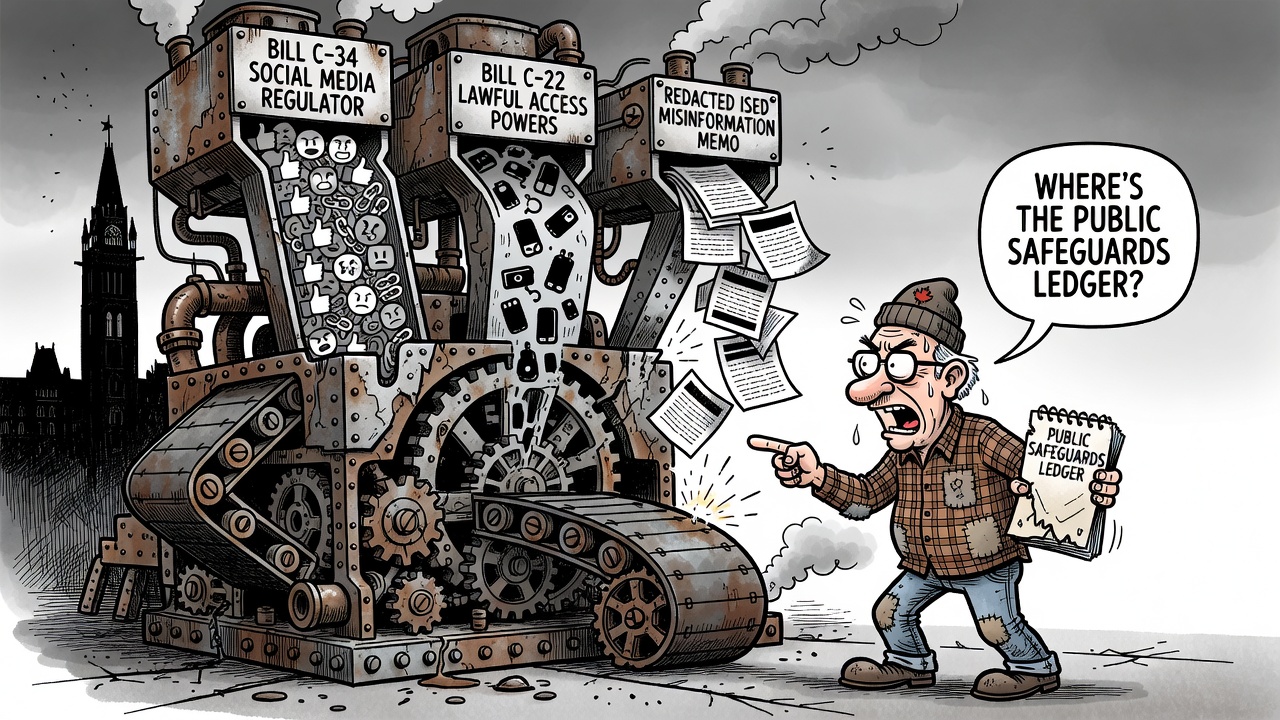
Ottawa now has three online-control files moving at once. Canadian Heritage says Bill C-34, the Safe Social Media Act, would regulate social media and AI chatbot services, impose duties around harmful content, and create a Digital Safety Commission of Canada. Public Safety says Bill C-22 would standardize lawful-access capability obligations for electronic service providers, backed by compliance tools and administrative monetary penalties. Parliament lists C-22 as the Lawful Access Act, 2026, now past third reading in the House and awaiting Senate work.
Layer a third story on top: reporting based on Access to Information material says Innovation, Science and Economic Development Canada prepared a 35-page strategy that included monitoring online narratives and possible legal escalation over allegedly false or misleading posts. The available reporting does not prove that Ottawa has sued any named Canadian. It does show why vague authority and heavy redactions are a dangerous combination.
The Liberal answer will be familiar: this is about children, crime, terrorism, exploitation and foreign threats. Some of those harms are real. No serious conservative should pretend child sexual exploitation, violent extremism or espionage are free-speech abstractions. But real harms do not cancel the need for measurable limits. They raise the bar for discipline.
C-34 promises public Digital Safety Plans and a regulator. C-22 promises warrants, Intelligence Commissioner review, annual reporting and no direct government access or backdoor mandate. Civil-liberties critics, including CCLA and Citizen Lab researchers, still warn that surveillance-capability regimes can reach too far, especially when technical obligations, metadata and fast-tracked review collide. Canadians should not have to choose between government press releases and activist worst-case scenarios. They need a common scoreboard.
That scoreboard should answer basic questions: Who decides what crosses the line? Was a judge involved? Was a ministerial order used? Could the provider disclose the demand? Did the target receive notice? Was there an appeal? Did any demand affect encryption, private messages or lawful political criticism? How many files were later withdrawn?
The conservative accountability position is not “do nothing online.” It is: use clear law, prove necessity, minimize intrusion, publish results and punish abuse. If Ottawa wants new power over platforms, providers and posts, it owes Canadians one public safeguards ledger before the online-control stack becomes too large to audit.
- Canadian Heritage: Bill C-34 / Safe Social Media Act backgrounder
- Public Safety Canada: Lawful access and Bill C-22 background
- Parliament of Canada: Bill C-22 LEGISinfo page
- Canadian Civil Liberties Association / Citizen Lab researchers: Analysis of Bill C-22 concerns
- iPhone in Canada, citing Blacklock’s Reporter/ATIP material: Report on ISED online-post monitoring/legal-escalation memo
This article distinguishes official government claims from civil-liberties analysis and media reporting. It does not allege that any specific Canadian, outlet or platform has been sued under the reported ISED strategy.