Carney’s Senate Patronage Firewall Just Failed Its First Test
The issue is not whether partisan Canadians may serve. It is whether a prime minister can rewrite the appointment rules and immediately use them to reward an insider.
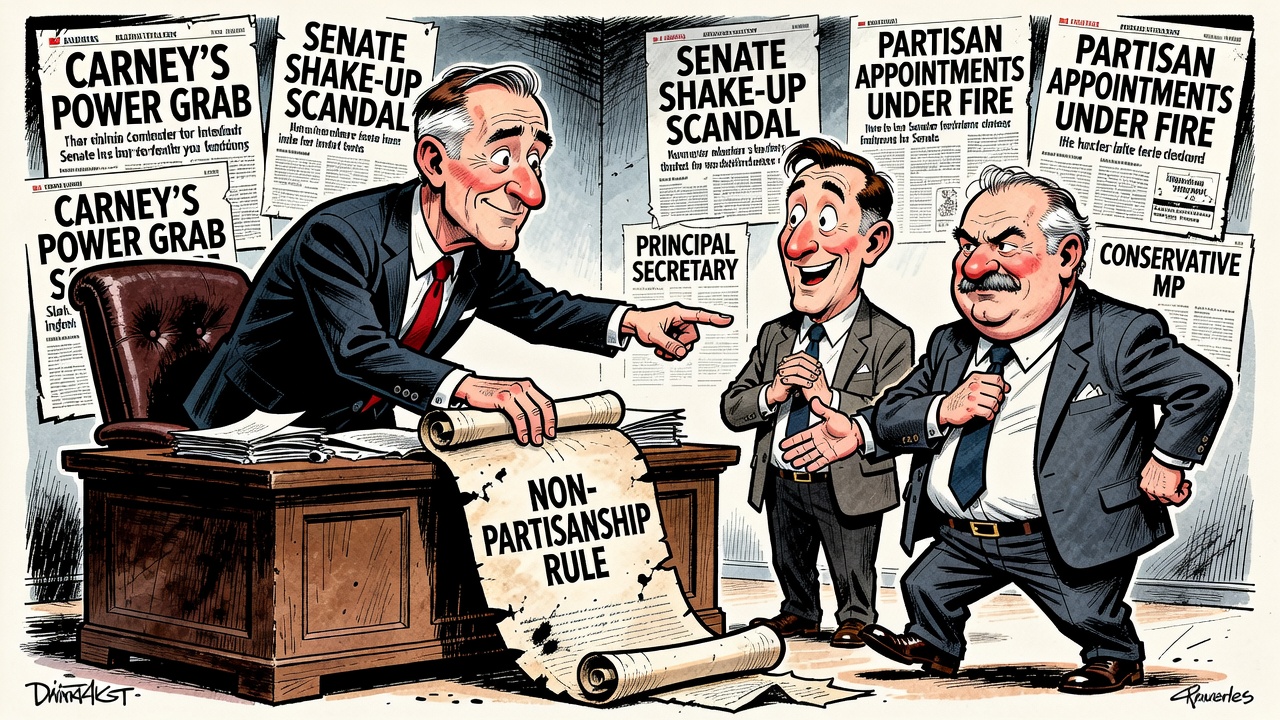
Prime Minister Mark Carney’s first Senate appointment package arrived with a flashing accountability warning. On July 7, the PMO announced four prospective senators: Richard Martel for Quebec, Dr. Rodney Ouellette for New Brunswick, Thomas Pitfield for Quebec and Geeta Tucker for Manitoba. In the same release, Carney’s office said the government is removing the non-partisanship criterion from the Senate appointment process.
That is not a housekeeping change. It reverses a key premise of the post-2016 Senate appointment system: that an advisory process should push the upper chamber away from direct party patronage. Carney now says partisan service can bring useful legislative experience. Fair enough. But if the rule changes on the same day the prime minister names his own principal secretary to the Senate, Canadians are entitled to ask whether the firewall was modernized — or simply lowered.
Thomas Pitfield is not a random technocrat discovered by an arm’s-length process. The PMO biography says he served as Carney’s principal secretary, advising on artificial intelligence, innovation, productivity and the digital economy. Canadian Press reporting adds that Pitfield is a longtime Liberal strategist, co-founder of Canada 2020, involved in Liberal campaign digital operations, and married to Liberal MP Anna Gainey.
The Martel appointment raises a separate democratic concern. Martel was a sitting Conservative MP from Quebec, first elected in 2018 and re-elected several times. His appointment will trigger a byelection in Chicoutimi—Le Fjord. Canadian Press reported he is the fifth Conservative MP to leave the opposition benches since the last election, including four who crossed the floor to sit with the Liberals.
None of this proves wrongdoing. A Conservative MP can accept a Senate seat. A Liberal strategist can have expertise. A prime minister can advise the Governor General on appointments. But power that is legal can still be corrosive when it is opaque. The Senate already suffers from a legitimacy problem because unelected lawmakers can amend, delay and shape legislation without facing voters. Filling seats through a newly partisan lens makes transparency more important, not less.
Carney’s brand is competence, modernization and serious government. Then serious government should be able to show its work. Did Pitfield apply through the same process as other Canadians? Was the Independent Advisory Board involved? Why was the non-partisanship rule removed before these names were announced? Were discussions held with Martel before the appointment, and did anyone in PMO consider the House math or byelection consequences?
Conservatives should not defend the old Trudeau system as perfect. They should defend the public’s right to see how powerful appointments are made. If Carney wants an explicitly partisan Senate pipeline, Canadians deserve explicit receipts.
- Prime Minister of Canada: Senate appointment process release, July 7, 2026
- Prime Minister of Canada: Thomas Pitfield biographical note
- Global News / Canadian Press: Carney names principal secretary and Conservative MP to Senate
- Canadian Press via larongeNOW: Details on Pitfield, Martel and appointment fallout
This article argues for transparency around appointments. It does not allege that any appointee is legally unqualified or that any appointment is unlawful.