Ottawa’s Four-Day Office Order Needs a Public Desk-Capacity Ledger
If the Carney government wants four days in office, it should publish the desk, cost and productivity receipts.
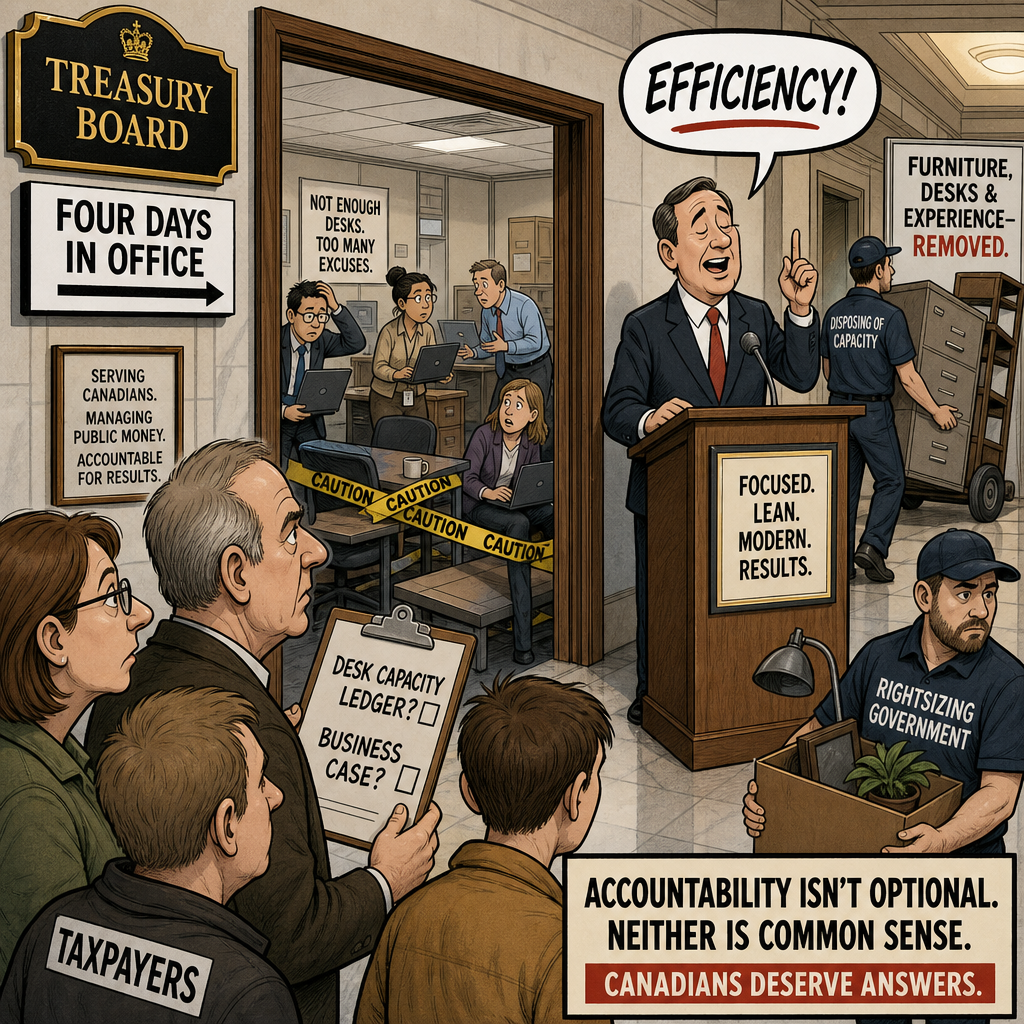
Ottawa’s return-to-office order hit its receipt test on day one. Treasury Board says hybrid-eligible federal employees are required to work on-site four days per week as of July 6, 2026, after executives moved to five days per week on May 4. But the government’s own public explanation admits the obvious operational problem: while many organizations have enough space, others “may need added capacity,” and deputy ministers may stagger implementation to match “workplace realities.”
That is not a minor footnote. Global News and The Canadian Press reported Monday that thousands of public servants are starting the new schedule while a lack of office space is delaying the return in some departments. Immigration, Refugees and Citizenship Canada said most employees will remain at three days on-site until enough office space is secured. Health Canada and the Public Health Agency of Canada cited localized regional space challenges. Employment and Social Development Canada said some locations still need more space. Global Affairs Canada pointed to a multi-year renovation project and said many National Capital Region employees, plus some regional employees, will remain at three days until enough workspace is available.
A conservative accountability standard does not require pretending offices are useless. Some work is better in person. Some teams need secure rooms, direct supervision, training, or rapid collaboration. But a government that orders a national workplace change while departments openly acknowledge capacity gaps must show the business case before calling the policy efficient.
The problem is credibility. Treasury Board says increased on-site presence is about organizational performance, stronger teams and serving Canadians. It also says assigned seating for the majority of employees will be achieved “over time” for some organizations. That phrase should make taxpayers pause. If the government is still reconfiguring floors, adding capacity and asking PSPC to make adequate workspaces available “as quickly as possible,” then the policy was announced before the full operating plan was ready.
Federal unions are not neutral observers, and their claims should be tested too. PSAC calls the mandate an insult to workers and says legal action is on the table. PIPSC says it has filed grievances and an unfair labour practice complaint, arguing for a presence-with-purpose model based on operational need. Fine: publish the evidence and let Canadians judge. If four days in office improves service delivery, reduces delays, protects data, strengthens training and saves money, Treasury Board should be eager to prove it.
Until then, this looks like another Ottawa management order built around slogans instead of receipts. The standard should be simple: no national mandate without a national ledger. Canadians deserve to know whether the government has desks for the workers it is ordering back, what those desks cost, and what measurable service improvement taxpayers are buying.
- Global News / The Canadian Press: Federal employees now working four days a week seeing less office space
- Government of Canada: On-site presence in the public service
- Government of Canada: Message to deputy heads: Update on Increased On-site Presence
- PSAC: Government’s 4-day office mandate an insult to workers
- PIPSC: RTO4: Our advocacy, your rights, and what comes next
This article argues for transparent public administration. It does not allege wrongdoing by any individual public servant, manager, union representative or minister.