Ottawa’s Censorship Memo Needs Public Receipts Before Anyone Sues Social Posts
If Ottawa contemplated legal action over “false and misleading” posts, Canadians deserve the unredacted authority, thresholds and safeguards.
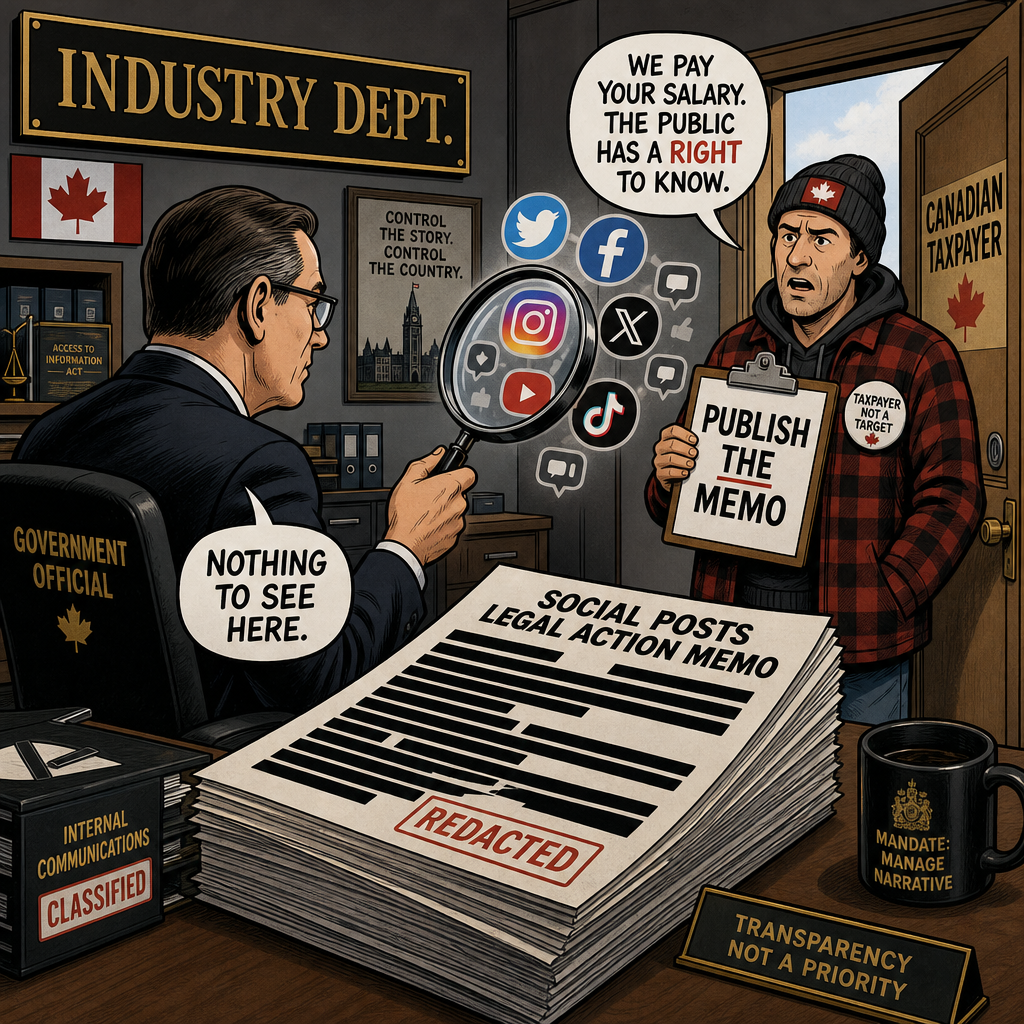
Blacklock’s Reporter posted a narrow but serious accountability story on July 3: Industry Minister Mélanie Joly’s department, in an Access to Information memo, contemplated “legal action” against users on Facebook, Twitter, LinkedIn and other social media sites that it suspected of spreading “false and misleading information.” Blacklock’s said the memo was 35 pages, censored, and did not explain what action federal lawyers would take.
That is the problem. A government department does not get to float legal pressure against online speech and then hide the legal theory behind black bars. The public excerpt says the strategy sought to uphold the integrity of, and public trust in, government information. Integrity matters. Public trust matters. But public trust is not strengthened when Canadians are told only that unnamed users, on major platforms, may face some undefined “legal action” for speech the department considers false or misleading.
Canada is not a country without limits on expression. The Charter allows only reasonable limits prescribed by law that can be demonstrably justified in a free and democratic society, and section 2(b) protects freedom of thought, belief, opinion and expression, including freedom of the press and other media of communication. That means any state response to alleged misinformation must be clear, lawful, proportionate and open to challenge.
The Access to Information Act is supposed to enhance accountability and transparency, promote an open and democratic society, and enable public debate on federal institutions. A heavily censored memo about potential legal action over social media speech lands directly inside that purpose. If the redactions protect legitimate solicitor-client advice or operational details, say so precisely. But the public still deserves the rules of the road.
This is not an argument for governments to ignore foreign interference, fraud, impersonation, or coordinated bot campaigns. It is an argument against vague state power. If someone commits an existing offence, use existing law and prove the case. If Ottawa believes it needs a new power to police false claims about government information, bring it to Parliament, publish the Charter statement, define the harm, and let Canadians debate it in daylight.
The standard should be simple: no censorship memo without a public ledger. Before any department threatens users over social posts, Canadians need to know who decides what is false, what law authorizes action, what safeguards protect lawful criticism, and whether politicians and departments would be held to the same standard they want to impose on everyone else.
- Blacklock’s Reporter: Would Sue Over Social Posts
- Government of Canada: The Honourable Mélanie Joly
- Justice Laws Website: Access to Information Act — Purpose
- Department of Justice: Charterpedia — Section 1, Reasonable limits
- Department of Justice: Charterpedia — Section 2(b), Freedom of Expression
This article relies on Blacklock’s public excerpt and official Government of Canada legal and ministerial sources. It does not allege that legal action has been taken against any named user, platform or outlet.