Carney’s Roberts Bank $10B Needs a Cost-Bridge Ledger
A port expansion can be pro-trade and still require hard receipts before taxpayers are asked to underwrite the bill.
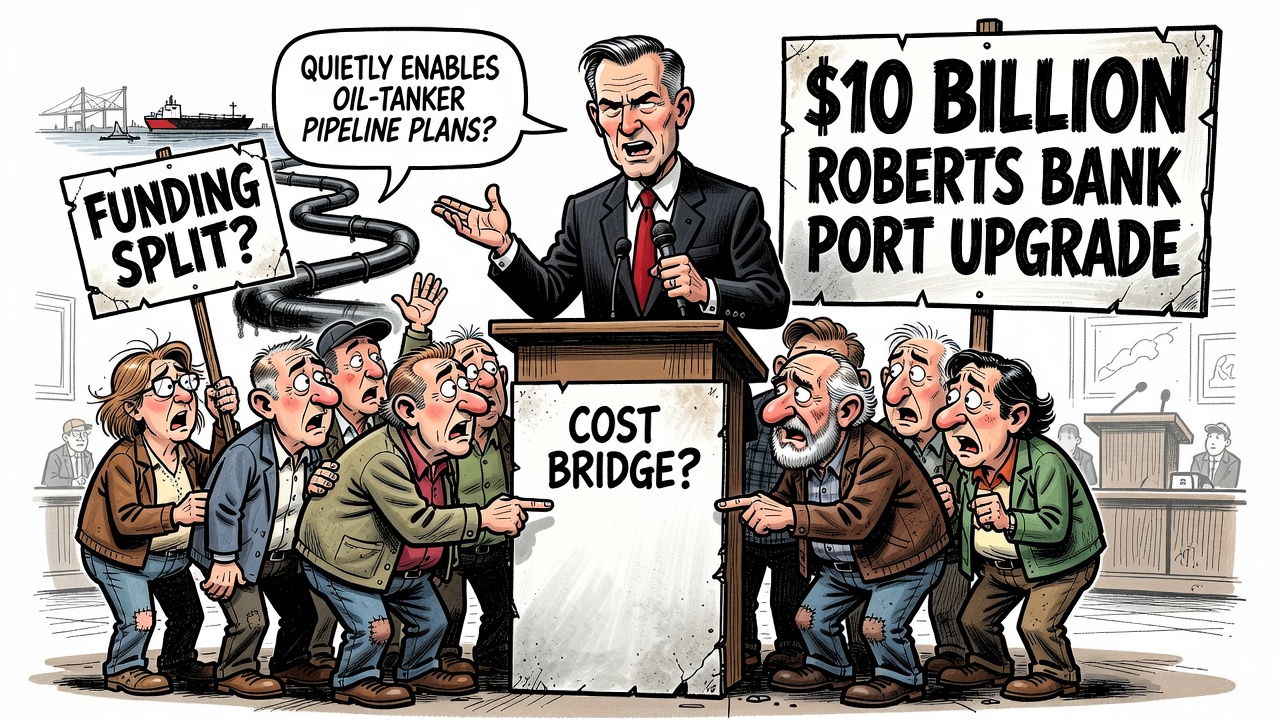
Prime Minister Mark Carney’s new Canada-B.C. prosperity agreement puts a giant number beside a familiar promise: $10 billion in major infrastructure upgrades at Roberts Bank Terminal. Ottawa says the work will expand capacity, unlock more than $100 billion in new trade capacity and add about $3 billion a year to Canada’s economy.
That may be a serious trade objective. The Port of Vancouver is a national artery, and bottlenecks are real. But the accountability problem starts with the jump in scale. iPolitics reported the Vancouver Fraser Port Authority had previously pegged Roberts Bank Terminal 2 at roughly $3.5 billion. Carney’s answer was not a final investment decision; he called the $10 billion figure an order-of-magnitude sighting, with scope to be refined through the Major Projects Office.
That is exactly when taxpayers need the ledger, not after the political announcement hardens into a blank cheque. If the new number reflects container capacity, bulk cargo, rail links, environmental protection, Indigenous participation, or other associated infrastructure, Ottawa should publish the cost bridge line by line.
The pipeline angle makes disclosure even more important. Canadian Press reporting carried by CityNews said Roberts Bank is the endpoint for Alberta Premier Danielle Smith’s proposed pipeline route, and that Alberta’s submission says the terminal would need to handle large oil tankers and two new loading berths. It also reported Carney did not mention that connection when speaking with Premier David Eby.
That omission matters. Canadians can debate whether the country needs more tidewater access for energy exports. Conservatives have long argued Canada should stop landlocking its resources. But support for export infrastructure is not support for hiding the public cost, the environmental liability, or the real purpose of a $10 billion port package behind softer language about “trade capacity.”
Ottawa’s own backgrounder says Canada and B.C. will work with the port authority, proponents and First Nations on Lower Mainland logistics, including Roberts Bank, rail links and associated Port of Vancouver development. Good. Put the proponents, timelines and risk allocation in public view.
Carney wants to brand this as nation-building. Fine. Nation-building projects deserve nation-level transparency: a business case, a cost bridge, a funding agreement, spill-risk assumptions, public/private return estimates, and a clear answer on whether Roberts Bank is being upgraded for general trade, a pipeline terminal, or both. Before taxpayers are told to celebrate $10 billion, they should be allowed to see what they are buying.
- Prime Minister of Canada: Carney announces Canada-B.C. Cooperative Prosperity Agreement
- Prime Minister of Canada: Canada-B.C. Cooperative Prosperity Agreement backgrounder
- iPolitics: B.C. secures billions in federal funding
- CityNews / The Canadian Press: Alberta pitches new pipeline to B.C. coast
This article supports disclosure before commitment. It does not claim Roberts Bank has a final approved scope, final cost, final funding model or final investment decision.