Carney’s NATO Defence Math Needs Receipts
A serious defence promise needs a public ledger, not a private talking point.
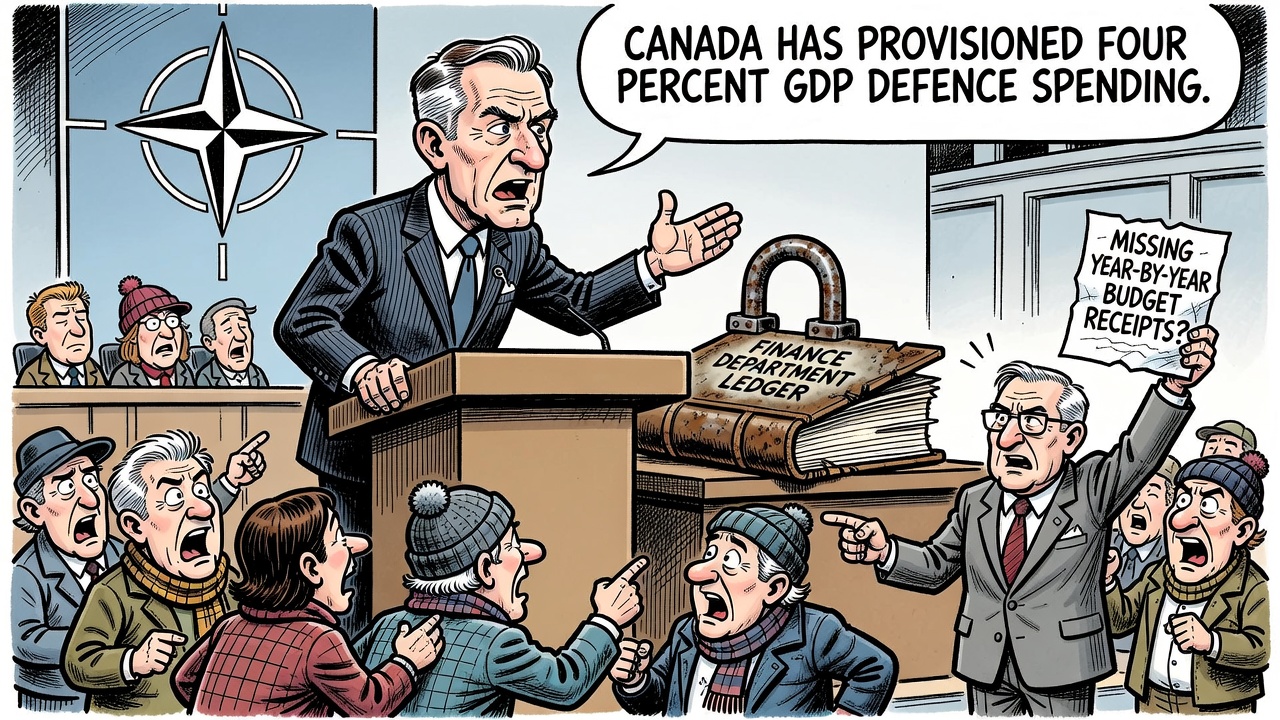
Canada should spend what is necessary to defend itself, rebuild the Canadian Armed Forces, protect the Arctic and meet serious NATO obligations. Conservatives should not apologize for that. But the first rule of a serious defence buildup is also the first rule of responsible government: show the math before spending the money.
That is why Prime Minister Mark Carney’s NATO claim deserves a receipt test. At CANSEC on May 27, Carney said Canada had achieved NATO’s 2% defence-spending target, was already meeting NATO’s 1.5% critical-defence-infrastructure target, and that the fiscal framework was already “provisioned” to reach 4% of GDP in total defence spending by the end of this decade. Those are massive claims. They are not campaign bumper stickers. They imply tens of billions of dollars in annual federal choices.
Global News reported Friday that Finance Minister François-Philippe Champagne’s office refused to release the data supporting Carney’s assertion. Asked for Budget 2025 or Spring Economic Statement numbers to back the prime minister up, Finance reportedly said it was not in a position to pre-empt future announcements and offered no additional detail beyond Carney’s statement.
That answer is not good enough. If the spending is already “provisioned,” then it should already exist somewhere: in a fiscal table, a year-by-year bridge, a departmental plan, a capital profile, a cash-versus-accrual reconciliation, or a classified annex with at least public totals. If it does not exist in publishable form, Canadians are being asked to trust a giant fiscal promise without the ledger.
The Parliamentary Budget Officer’s June outlook underlines the problem. It says the current fiscal outlook includes Budget 2025 and the Spring Economic Update, but because of limited information it does not account for the government’s NATO commitment to raise defence expenditures to 3.5% of GDP by 2035. In February, the PBO estimated that moving core defence spending from 2.0% to 3.5% of GDP by 2035 would require about $33.5 billion per year in additional cash spending over the next decade, with core defence spending reaching $159.1 billion in 2035-36.
Those numbers may be affordable if Parliament makes hard choices and the money actually buys capability. They are not affordable if Ottawa hides the baseline, blurs infrastructure categories, books announcements twice, or pretends debt charges do not count.
Carney wants to arrive at NATO as the adult in the room. Fine. Adults bring the spreadsheet. Before another summit speech, the Liberals should publish the defence-spending table Canadians paid for and Parliament needs to scrutinize.
- Global News: Liberals refuse to provide proof of Carney’s NATO defence spending claims
- Prime Minister of Canada: May 27 CANSEC defence speech
- Parliamentary Budget Officer: Economic and Fiscal Outlook — June 2026
- Parliamentary Budget Officer: Fiscal Implications of Meeting NATO’s 5% Commitment
This article supports stronger defence capability and NATO credibility. It argues that major spending commitments require transparent fiscal tables, parliamentary scrutiny and debt-impact receipts.