Carney’s Condo Plan Has a July 7 Receipts Test
The July 7 meeting is the test: will Parliament get the receipts, or only the talking points?
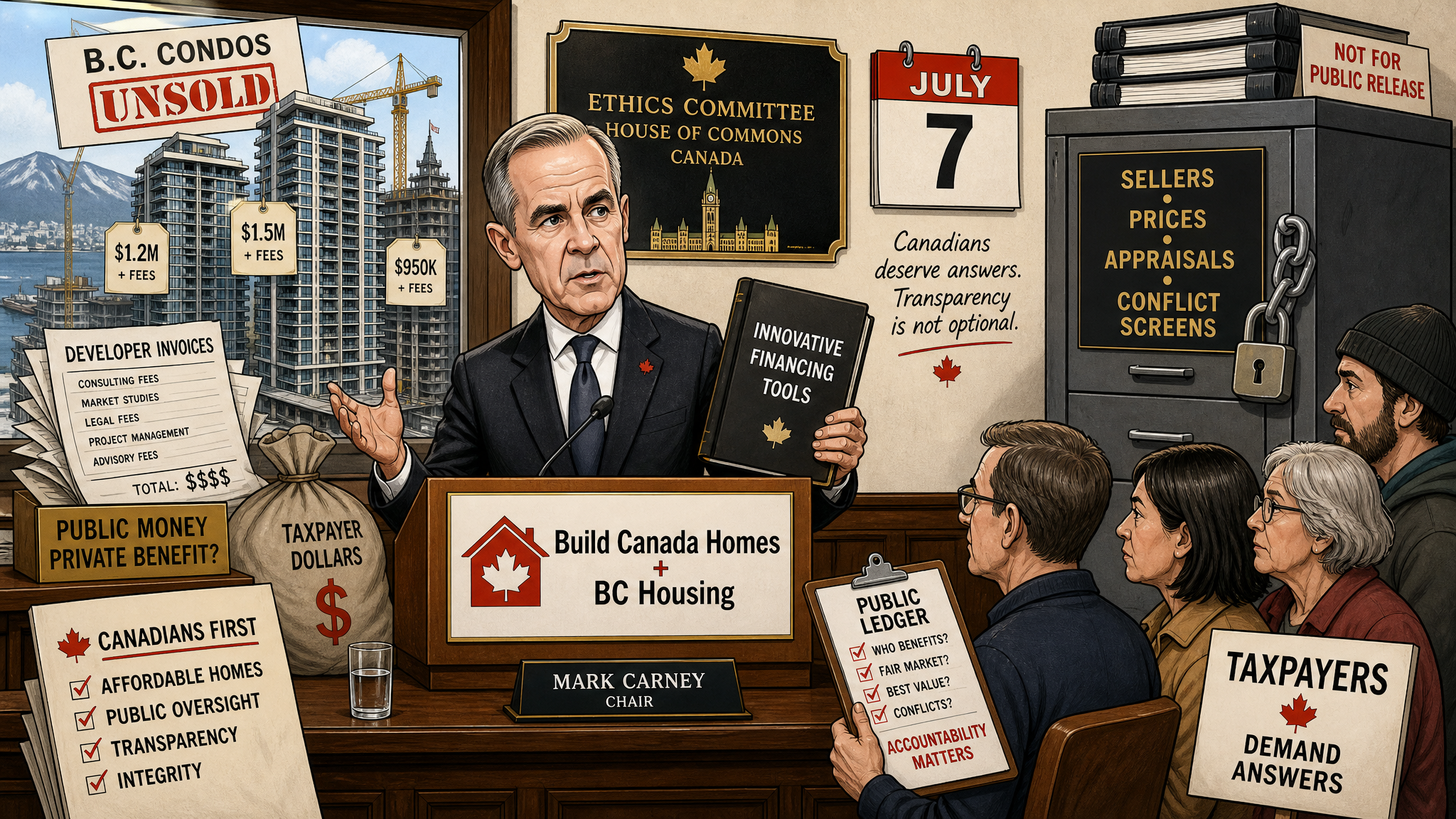
The federal-B.C. condo conversion plan is no longer just a housing announcement. It is now a committee accountability test with a date on the calendar.
The Prime Minister’s Office announced on June 18 that Ottawa and Victoria would create a Canada-British Columbia Partnership on Condo Conversion, using Build Canada Homes and BC Housing to “leverage innovative financing tools” and convert more than 2,200 vacant condo units in priority growth areas into affordable homes. The same announcement included more than $5 billion for B.C. local infrastructure over 10 years, nearly $1.6 billion in federal money matched by B.C. up to $3.2 billion for lower development charges, and a $284 million transfer to reduce construction barriers.
Those numbers demand disclosure before they demand applause.
The Bureau reported July 2 that ethics committee chair John Brassard agreed to convene a July 7 meeting tied to Pierre Poilievre’s June 26 request for scrutiny of the condo plan. The key point is procedural but important: a meeting notice is not an investigation. Whether the committee studies the matter, calls witnesses or compels documents depends on a committee where the governing side now has the numbers to stop or narrow the probe.
Carney and B.C. Premier David Eby defended the plan in Vancouver this week. The Canadian Press, carried by Global News, reported Eby compared the approach to buying something “on liquidation,” said Vancouver units were not planned because “the numbers just don’t work,” and argued that below-construction-cost purchases could create affordable housing faster. Carney said purchases would occur only if opportunities made sense and would not happen if the market shifted.
Fine. Then prove it on paper.
A liquidation bargain has a price tag. A public housing intervention has beneficiaries. A program touching developers, lenders, land values and federal financing has conflict risks whether or not anyone has proven wrongdoing. Conservatives should not need to allege corruption to demand a ledger. The standard for public money is disclosure first, trust second.
The committee should therefore ask one clean question: will Canadians see the transaction file before any deal is locked in? If the government is truly buying distressed inventory at a discount and turning it into durable affordability, the documents will strengthen its case. If taxpayers are being used to cushion developers from a market correction, the documents will expose that too.
Carney calls this a housing solution. Eby calls it liquidation logic. Parliament should call it what it is: a public-money file that needs witnesses, documents and conflict screens before the cheque clears.
- Prime Minister of Canada: Canada and British Columbia forge new partnership to accelerate homebuilding, lower costs, and build new local infrastructure
- The Bureau: Ethics Committee Will Meet Tuesday on Carney's Condo Bailout
- Global News / The Canadian Press: B.C.’s Eby compares condo plan to “liquidation” at below construction costs
- Global News: Poilievre asks ethics committee to probe plan to buy unsold B.C. condos
This follow-up is distinct from the June 30 condo-ethics post: the new hook is the July 7 committee meeting and whether MPs pursue documents, witnesses and conflict-screen records.