Record Foreign Bond Buying Is Not a Fiscal Plan
A crowded bond auction is not a blank cheque. Publish the risk ledger.
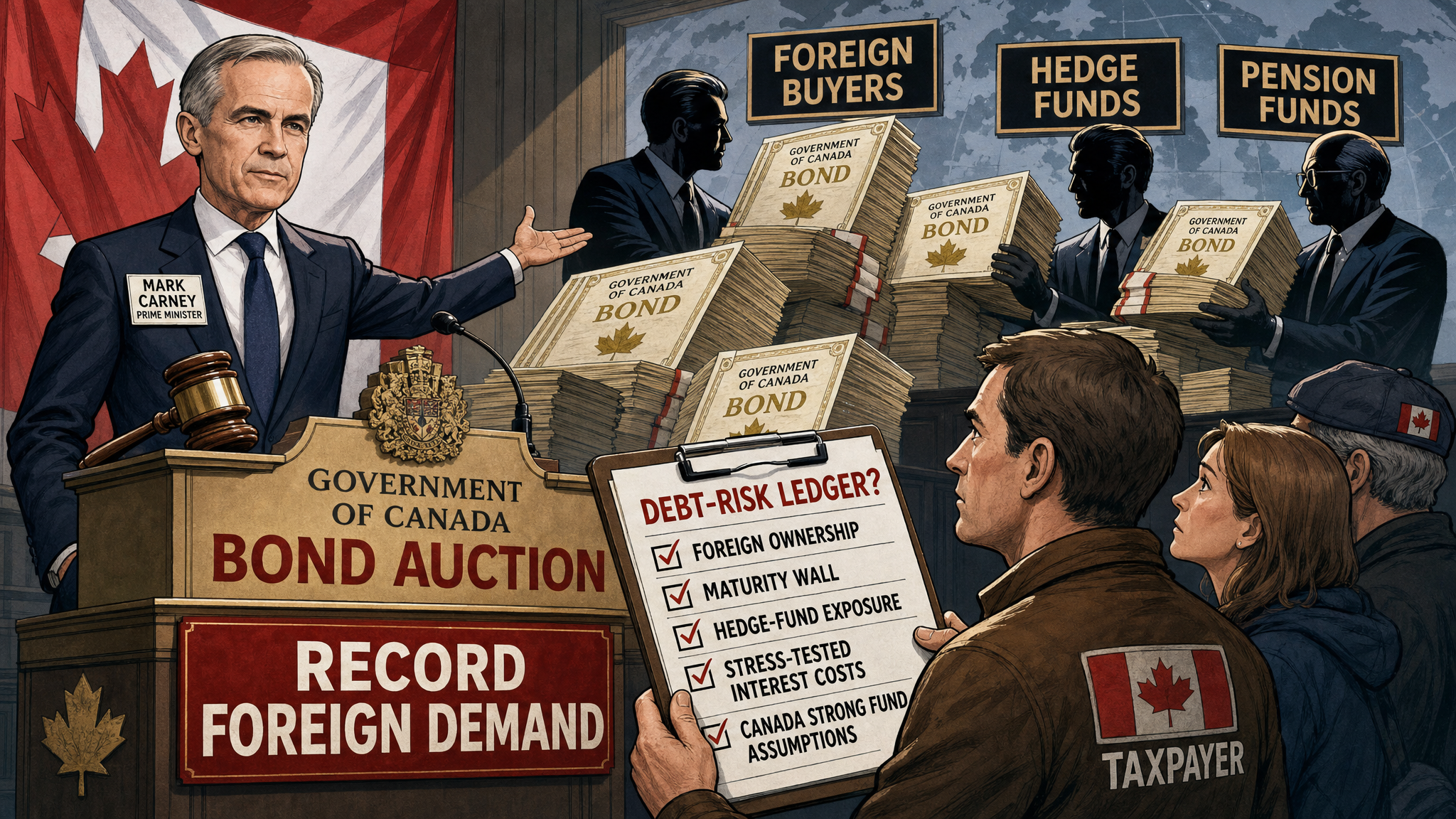
Record foreign demand for Canadian government debt is not a fiscal plan. It is a warning label attached to Carney’s borrowing agenda.
Statistics Canada reported on June 16 that foreign investors acquired $46.9 billion of Canadian securities in April 2026, producing a $58.3 billion net inflow. The standout number was government debt: non-resident investors bought an unprecedented $38.5 billion of Canadian government bonds in April, including a record $27.7 billion of federal government bonds. StatCan said foreign investment in federal government bonds had reached $47.8 billion for 2026 year to date.
That can look like confidence. It can also look like dependence.
Reuters, in a June 30 report carried by MarketScreener, said foreign investors’ share of outstanding Government of Canada bonds had climbed to an all-time high of 43 per cent. Strong demand can help keep borrowing costs lower while Ottawa issues debt for Carney’s projects. But the same buyer base that lowers the price of borrowing on the way in can raise volatility when global investors change their minds.
This is where the government’s sales pitch needs a ledger, not a slogan.
The Bank of Canada’s 2026 Financial Stability Report warns that high and rising sovereign debt issuance means investors must absorb more debt, that term premiums have risen since 2021, and that liquidity can be stressed when leveraged investors pull back. The report also notes that hedge funds can provide liquidity but may reduce leverage quickly if market conditions deteriorate, transmitting stress into higher borrowing costs.
Carney’s own Canada Strong Fund message framed the new vehicle as Canada’s first sovereign wealth fund, designed to invest alongside private capital in major national projects. The Associated Press reported in April that the fund would start at C$25 billion and target energy, infrastructure, mining, agriculture, technology and related industrial projects.
If Ottawa wants to borrow into that agenda while celebrating record foreign purchases of federal debt, taxpayers deserve to know the risk structure. How much new issuance is short-term versus long-term? How much is held by stable reserve managers, pensions and insurers, and how much by fast-moving leveraged funds? What happens to program spending if interest costs jump 100 or 200 basis points? Which Canada Strong Fund projects depend on cheap refinancing?
None of that is anti-market. It is basic conservative accounting.
The danger is not that foreigners bought Canadian bonds. The danger is that Liberals will treat market appetite as permission to spend first and disclose later. A government with discipline welcomes buyers, publishes risk, and tells taxpayers what breaks if conditions change. A government running on vibes points to a crowded bond auction and calls it proof that the plan is working.
Record demand may buy Carney time. It does not buy him trust. Publish the debt-risk ledger.
- Statistics Canada: Canada's international transactions in securities, April 2026
- Reuters via MarketScreener: Foreign investors buy record amounts of Canadian government debt, lowering Carney's borrowing costs
- Bank of Canada: Financial Stability Report 2026
- Prime Minister of Canada: Prime Minister Carney's message on the Canada Strong Fund
- Associated Press: Canada's incoming PM Mark Carney says he'll create a sovereign wealth fund
This is a market/debt-risk follow-up, distinct from earlier fiscal-anchor and Canada Strong Fund firewall posts.