Carney’s Climate U-Turn Needs an Emissions Ledger
If Ottawa is replacing the old climate plan with an oil, gas, LNG and pipeline pivot, Canadians deserve the old path, the new path and the costed trade-offs.
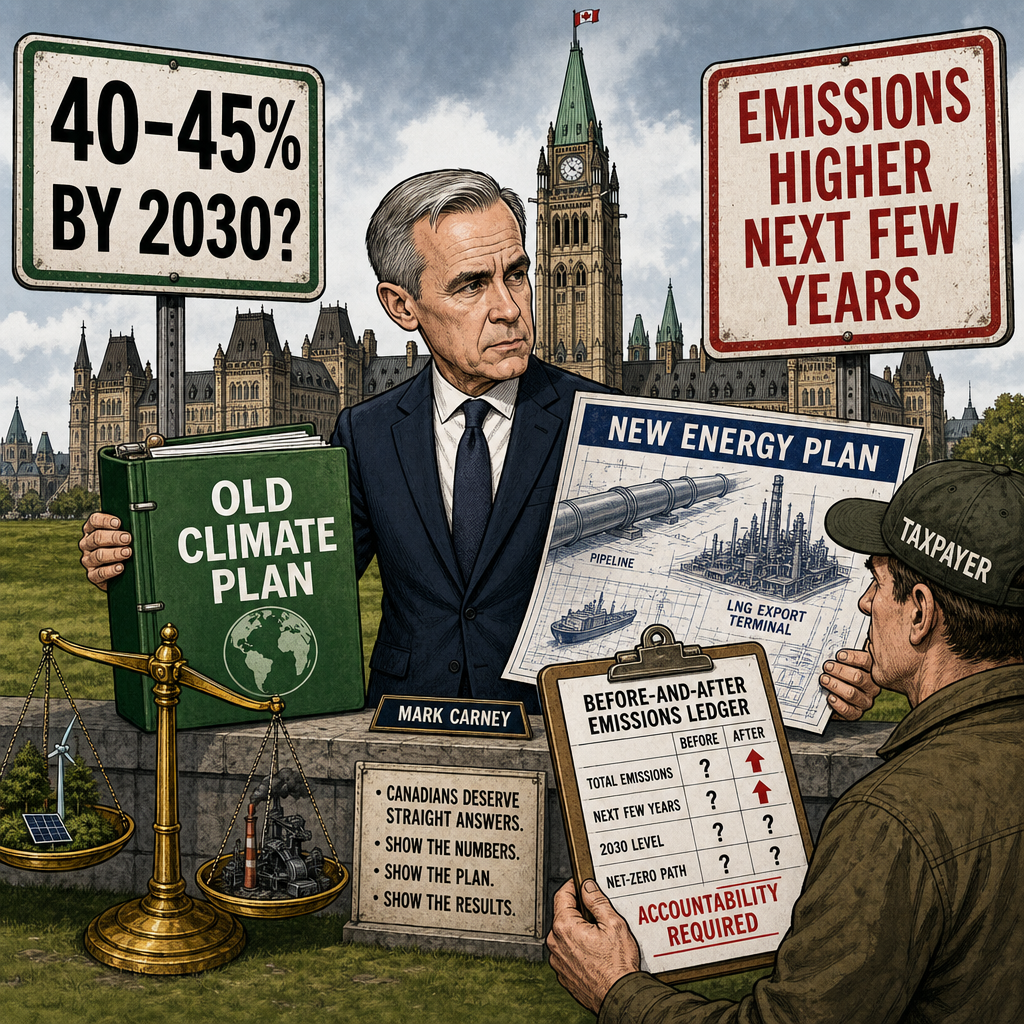
Mark Carney has finally said the quiet part out loud: Canada’s emissions will be higher over the next few years than projected under the previous Liberal climate plan. That is not a minor communications adjustment. It is a direct before-and-after test for a prime minister who built much of his public brand around climate finance, net zero and expert management.
Global News reported that Carney made the admission in a June 30 pre-recorded “Forward Guidance” video released ahead of Canada Day and his Edmonton visit. The same report says Canada’s Paris commitment remains a 40 to 45 per cent reduction from 2005 levels by 2030, but Carney has not explained how the country still gets there after accepting higher near-term emissions.
The numbers were already a problem before this pivot. Global reported that a December 2025 federal progress report showed Canada’s best-case scenario reaching only a 28 per cent reduction from 2005 levels by 2030. In plain English, Ottawa was not on track even before Carney started calling the inherited plan too expensive, too divisive and unsustainable over the long term.
Conservatives should be careful here. The accountability case is not that Canada must freeze Alberta, punish workers or pretend global demand for conventional energy disappears overnight. Carney is right that national unity, affordability and energy security are real issues. A country that cannot build, export or keep regions inside the federation has a credibility problem of its own.
But that is exactly why the receipts matter. Ottawa cannot spend years selling Canadians one climate pathway, then pivot to oil, gas, LNG, a possible second West Coast oil pipeline and a heavy dependency on carbon capture, while asking voters to trust that the target somehow survives. Trust is not an emissions model.
The Carney government should publish a before-and-after emissions ledger: the old Trudeau-era projection, the new Carney projection, annual sector-by-sector emissions through 2030, the expected effect of every cancelled or weakened policy, the projected effect of pipeline and LNG expansion, and the exact amount of emissions Ottawa expects the Pathways carbon capture project to offset.
It should also publish the affordability modelling. If the old plan was too expensive for Canadians, show the household cost by province and income group. If the new plan is cheaper, show where. If the trade-off is higher emissions now for theoretical reductions later, put the dates, tonnes and dollars in public.
Carney’s climate U-turn may be defensible. It may even be overdue. But a competent government does not replace one failing plan with another black box. It publishes the ledger, admits the trade-offs and lets Canadians judge the receipts.
- Global News: Carney says energy plan will unify Canada but “emissions will be higher”
- Global News video: Carney says Canada’s emissions will be higher than projected over “next few years”
- MarketScreener / Dow Jones: Canada’s Carney pushes environmental-policy pivot amid energy uncertainty
- Government of Canada: 2030 Emissions Reduction Plan
This article argues for public accounting of climate-policy trade-offs. It does not assume the old plan was effective or the new plan is automatically wrong; it asks Ottawa to publish the evidence.