Carney’s China Reset Needs a Tariff Ledger
A new pea-starch tariff is the receipt Ottawa cannot spin away.
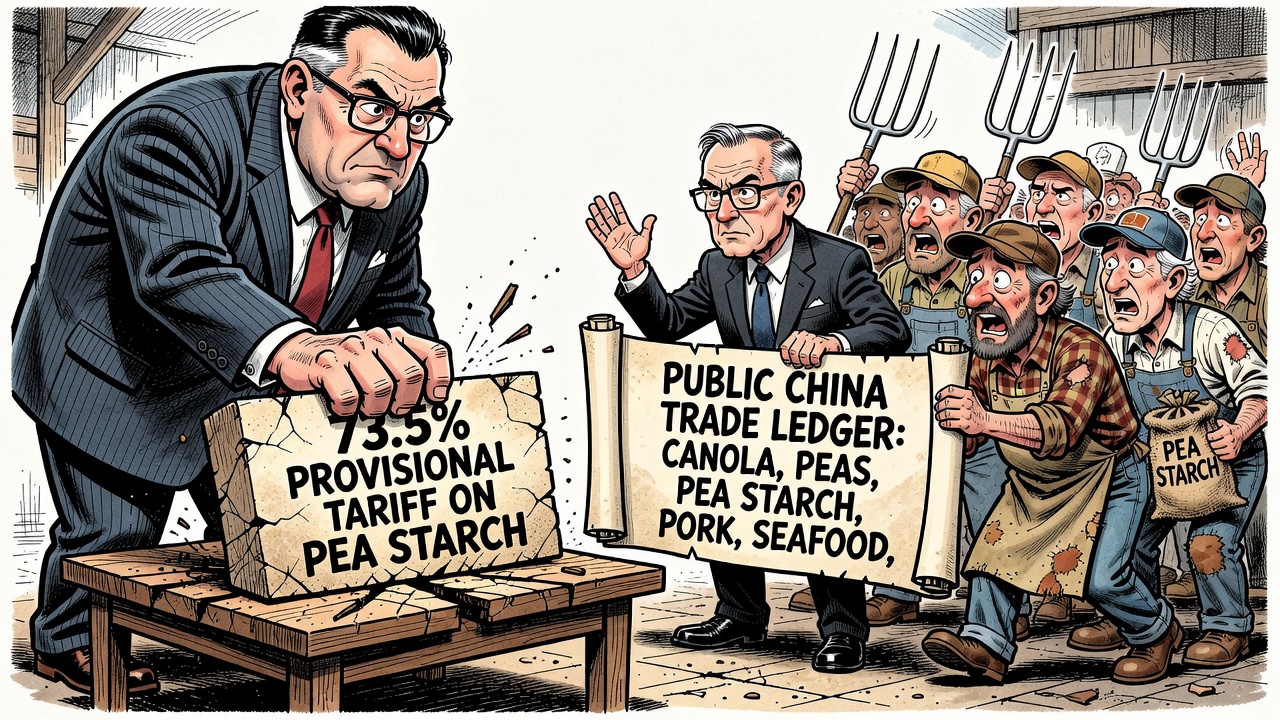
China’s latest trade move is narrow in product name but broad in political meaning. On June 30, Beijing announced provisional anti-dumping measures on Canadian pea starch, with importers required to provide customs deposits starting July 1. The reported rate is 73.5 percent.
That is not a rounding error for processors, growers or rural communities tied to Canada’s pulse and plant-protein economy. It is also not an isolated accounting detail Ottawa can bury under diplomatic language about a “reset” with Beijing.
China’s Ministry of Commerce says its preliminary investigation found Canadian pea starch was dumped into the Chinese market and caused material injury to domestic industry. Xinhua confirms the investigation was launched on August 12, 2025, and says the new provisional measures will be implemented through deposits at customs.
Reuters, carried by Global News, puts the decision inside a wider dispute that began after Ottawa levied tariffs on Chinese electric vehicles. RealAgriculture notes the pea-starch investigation was launched the same day China imposed a preliminary anti-dumping tariff on Canadian canola seed, and it connects the latest measure to Canada’s expanding plant-protein processing sector.
There may be technical trade-law arguments on both sides. If Canadian exporters are accused of dumping, the proper response is evidence, not slogans. But the federal government’s job is to protect Canadian interests with clarity. Farmers and processors should not have to decode a series of piecemeal announcements to learn whether their market access is secure.
That is why Carney’s China reset needs a public tariff ledger. Ottawa should publish a product-by-product dashboard covering canola, peas, pea starch, pork, seafood, beef, EVs and any other affected sector. For each line, Canadians should see the Chinese measure, the Canadian countermeasure, the effective date, the expiry or review date, the dollar value at risk, the communities affected, the promised relief, and the status of negotiations.
Conservatives should be careful not to pretend China trade is simple. Canada needs markets. Farmers need buyers. Processors need predictable rules. But predictability is exactly what is missing when one agricultural barrier is suspended, another is lowered, another stays unresolved, and a new 73.5 percent deposit suddenly lands on pea starch.
The Liberal habit is to sell diplomacy as atmosphere: better meetings, warmer language, improved relations, a more adult tone. For people who ship real goods, atmosphere does not pay the invoice. Access does.
If the China reset is working, the government should be eager to show the ledger. If it is not working, farmers deserve to know before the next product gets caught in the retaliation cycle. Either way, Canadian agriculture needs receipts, dates and enforceable outcomes — not another press release asking rural Canada to trust Ottawa’s instincts.
- Global News / Reuters: China slaps 73.5% preliminary tariff on pea starch from Canada
- Xinhua: China to impose provisional anti-dumping measures on Canadian pea starch imports
- RealAgriculture: China hits Canadian pea starch with anti-dumping tariff
This article argues for a public China trade ledger covering tariff rates, dates, affected products, relief promises and measurable market-access outcomes for Canadian agriculture.