Carney’s South Africa Call Needs a Public Ledger
When Ottawa says “partnership,” taxpayers should ask a simple question: which commitments, subsidies, loans, exporters and timelines are attached?
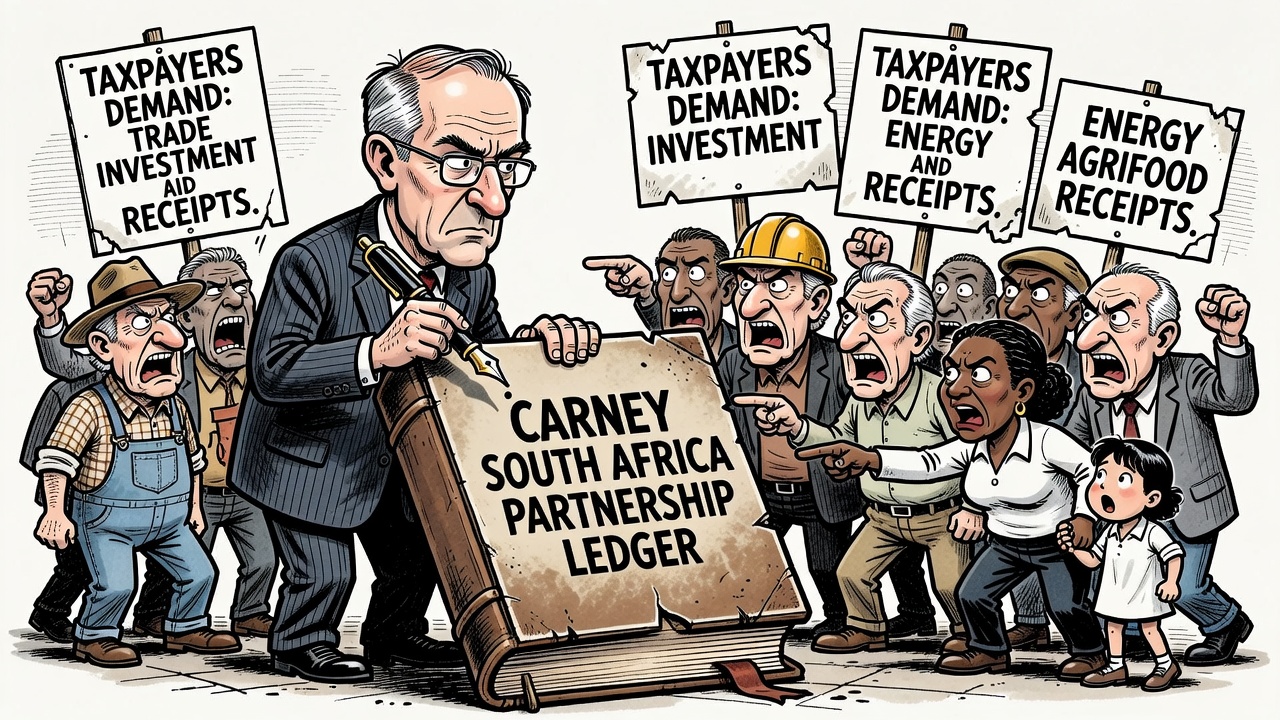
Prime Minister Mark Carney spoke with South African President Cyril Ramaphosa on June 27. The official readout was brief, but the policy footprint behind it is not. The leaders discussed Canada-South Africa relations and ways to advance partnerships on trade, investment and energy. They also welcomed growing agriculture and agrifood cooperation, including a South African delegation expected to visit Saskatchewan in the coming weeks.
That is exactly the kind of sentence Ottawa likes: friendly, strategic and almost impossible to audit. It may be perfectly reasonable for Canada to build commercial ties with one of Africa’s largest and most diversified economies. But a serious government should not ask Canadians to accept “partnership” as a substitute for disclosure.
The existing relationship already involves real money and real policy exposure. Global Affairs Canada says two-way merchandise trade with South Africa totalled $2.91 billion in 2024, while two-way services trade reached $713 million in 2023. It also says Canadian investment in South Africa stood at $523 million in 2024, and South African direct investment in Canada jumped to $1.87 billion.
Energy deserves special scrutiny. Canada’s own country page says Ottawa provided $165 million in international assistance to South Africa in 2023-24, largely driven by Just Energy Transition investments to reduce coal dependence and expand clean energy. That includes a $120 million sovereign loan and technical assistance, plus other climate and development programming.
Maybe those files advance Canadian interests. Maybe they help Canadian firms sell clean technology, engineering, mining services or infrastructure expertise. Maybe they support a democratic partner through a difficult energy transition. But if public money, sovereign loans or export-finance tools are involved, taxpayers deserve the ledger before the press release victory lap.
The same goes for agrifood. A South African delegation heading to Saskatchewan could be useful for farmers, processors, exporters and provincial officials. It could also involve market-access asks, inspection rules, subsidies, promotional spending, travel costs, memoranda of understanding or preferred industry access. Canadians should not have to guess which companies and agencies are at the table.
Carney’s Liberals often govern by glossy abstraction: resilience, partnership, clean growth, diversification. Conservatives should insist on a better standard. Publish the delegation itinerary. Publish the federal officials involved. Publish the companies, lobbyists and Crown corporations consulted. Publish any aid, loan, guarantee, procurement or export-credit commitment being discussed. Publish the metrics that will let Canadians know whether this relationship produced jobs and value at home.
A phone call is not a scandal. A partnership is not a problem by itself. The problem is Ottawa’s habit of treating vague diplomatic language as though it were accountability.
If Carney wants Canadians to support deeper ties with South Africa, he should start by showing them the books.
- Prime Minister of Canada: Prime Minister Carney speaks with President of South Africa Cyril Ramaphosa
- Global Affairs Canada: Canada-South Africa relations
This article does not allege wrongdoing by Canadian or South African officials. It argues that trade, energy, agrifood and public-finance commitments should be disclosed clearly before they are marketed politically.