CRA’s $18M Chatbot Still Needs the Wrong-Answer Ledger
Before Ottawa pushes more AI into tax service, it should publish the receipts: cost, accuracy, transcripts policy and taxpayer protection when official digital guidance is wrong.
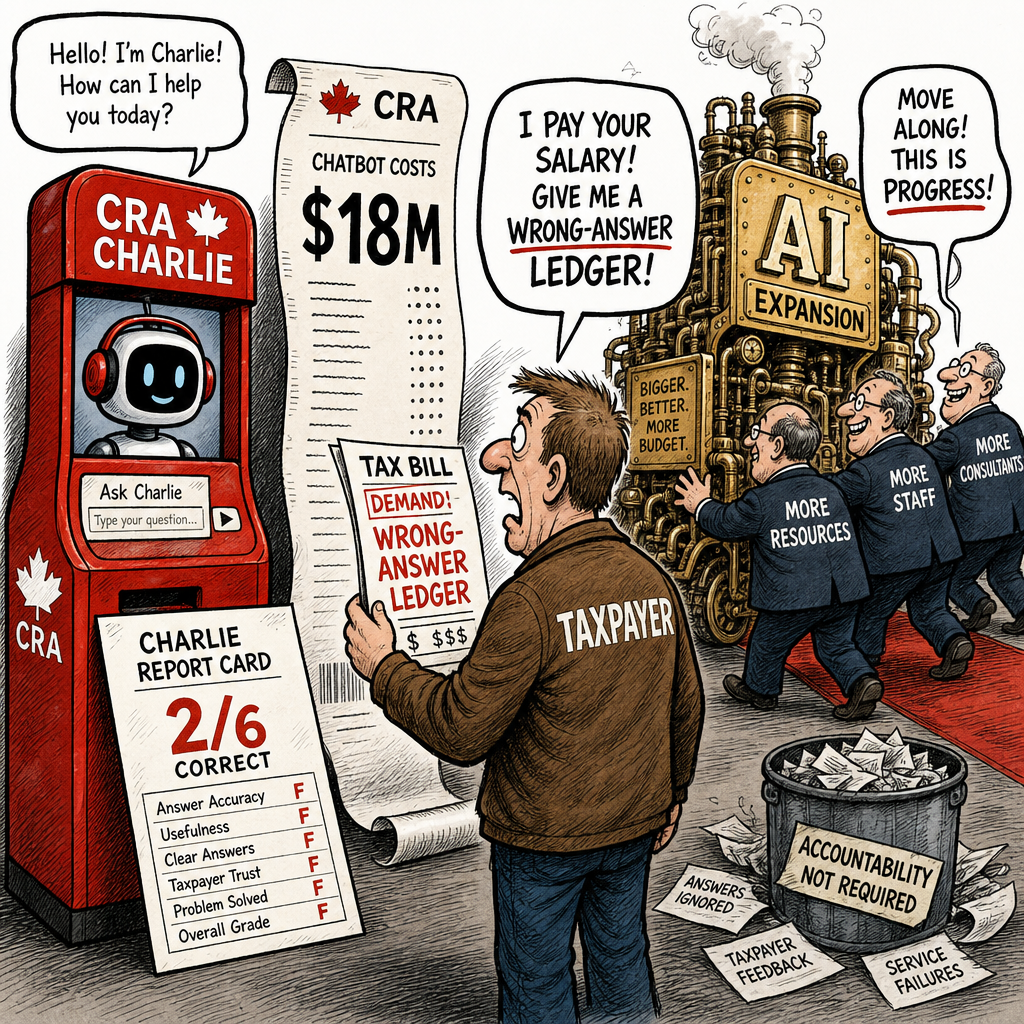
The Canada Revenue Agency has an AI problem that is bigger than one chatbot. The Auditor General tested Charlie, CRA’s virtual assistant, with six tax-related questions. Charlie gave accurate answers to only two. Other publicly available web-based conversational AI tools answered five of six accurately.
That finding would be bad enough if Charlie were a cheap experiment tucked away in a lab. It was not. National Post reporting, republished by Yahoo Canada, says documents tabled in Parliament showed taxpayers paid more than $18 million since 2018–19 to develop and operate Charlie. The same report says users had started more than seven million conversations and asked more than 18 million questions.
CRA now says it is moving deeper into automation, not stepping back. Its 2026–27 departmental plan says the agency is integrating AI, robotic process automation and GenAI tools, has started more than 200 AI projects, and will expand AI use to speed access to information through access-to-information channels and My Account. Its corporate business plan says CRA will expand AI across service, fraud detection, tax debt management and compliance, while the GenAI chatbot beta has expanded from 6,000 to more than 14,000 webpages.
That is exactly why a wrong-answer ledger is needed before the next rollout. CRA should publish the full cost table for Charlie, the internal and independent accuracy tests, the topic-by-topic failure rates, the transcript-review policy, the vendor and consultant costs, and the rules for correcting errors after taxpayers receive misleading official guidance. Redactions may be needed for privacy. Secrecy over performance is not.
The timing is not academic. On June 16, the Taxpayers’ Ombudsperson reported major service problems: contact-centre information described by complainants as incomplete, inaccurate or unclear, processing delays beyond CRA service standards, and complex T1 adjustments taking up to 50 weeks against a 20-week standard. Canadian Press reporting the same day said the ombudsperson’s office saw a 27 per cent year-over-year jump in complaints, driven mainly by CRA service delays, while Ottawa plans to scale pre-filled tax returns from one million Canadians next year to 5.5 million by 2029.
Conservatives do not need to oppose better technology. Taxpayers should welcome tools that are accurate, audited and fair. But the Liberal accountability test is simple: do not automate confusion, hide the receipts, and then punish citizens for believing the government’s own answers. Publish the wrong-answer ledger before CRA expands the machine.
- Auditor General of Canada: Canada Revenue Agency Contact Centres report
- National Post via Yahoo Canada: CRA spent $18M on Charlie chatbot
- Canada Revenue Agency: 2026–27 Departmental Plan
- Canada Revenue Agency: Summary Corporate Business Plan 2026–27 to 2028–29
- Taxpayers’ Ombudsperson: 2025–26 annual report release
- Canadian Press via Investment Executive: Tax code simplification and automation report
This article supports useful digital service improvements while demanding independent accuracy testing, cost disclosure and taxpayer-protection rules before CRA expands AI use.