24 Sussex Needs a Cost Ceiling Before the Design Contest Runs
A national residence can be restored. A blank cheque should not be.
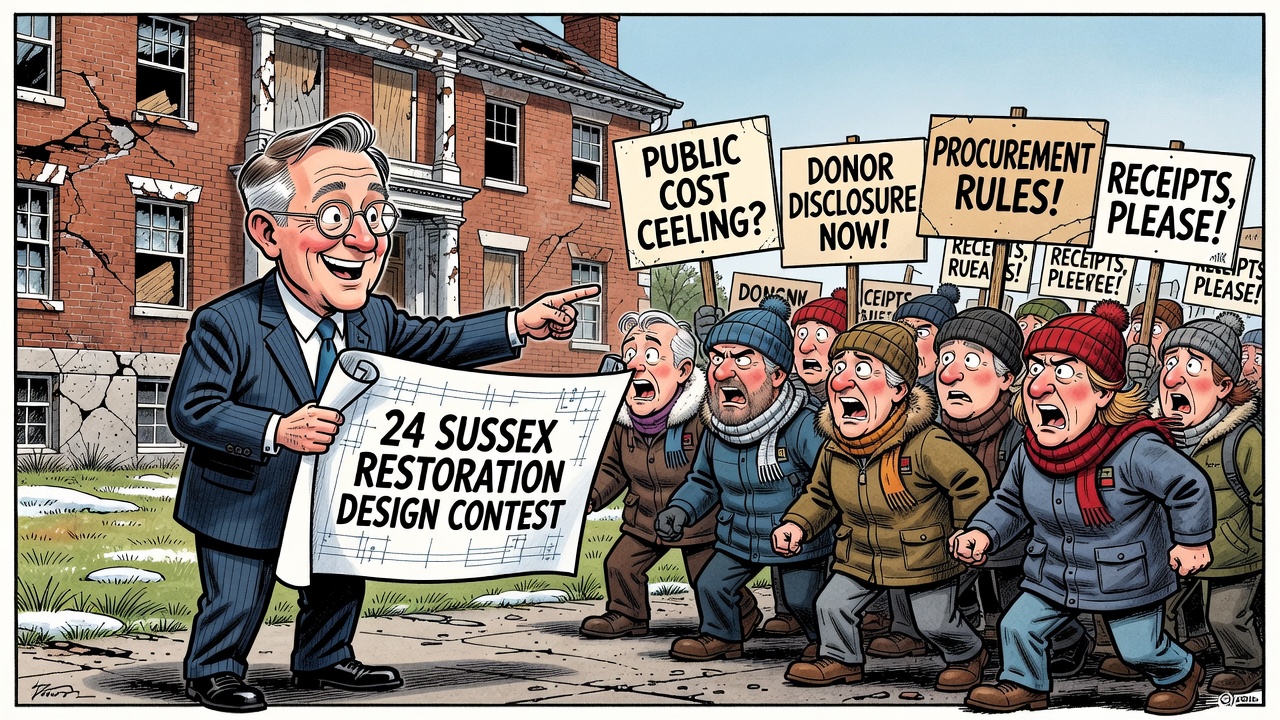
Prime Minister Mark Carney has finally chosen a path for 24 Sussex Drive: a national design-and-build competition to rehabilitate and modernize the prime minister’s official residence, with a winning proposal expected by Canada Day 2027. The government says the project should restore the property as a secure, accessible, sustainable and functional residence and working venue while preserving its heritage character.
That basic goal is not outrageous. A G7 country should be capable of maintaining an official residence without letting it decay into a political punchline. The National Capital Commission says the building was closed in 2022 for health and safety reasons, and that a $4.3 million abatement and decommissioning project removed hazardous materials, obsolete systems and stored heritage fabric. Its own public page says a 2021 condition report put the main residence in critical condition and identified $36.6 million in deferred maintenance — a figure that did not include new code and legislative requirements.
The government’s answer is private fundraising. The Rideau Hall Foundation is supposed to lead a national, non-partisan campaign with the goal of raising all or most of the cost. Canadian Press reporting says Carney declined to provide a renovation estimate because the budget is part of the competitive process, while also saying donor lists would be public, donations would be capped and the federal government would cover security costs in the meantime.
That is still not enough. If a private fundraising vehicle is attached to a prime ministerial residence, Canadians deserve the rules before the cheques start arriving: donor names, donation caps, corporate and union limits, foreign-money bans, lobbyist and contractor restrictions, conflict screens, audit rights, procurement firewalls and a plain disclosure of whether donors receive any access, recognition or tax treatment.
There is also a public-spending test. Before the design competition shapes expectations, Ottawa should publish the maximum public contribution, the line between “security” and “restoration,” the lifecycle maintenance plan, the heritage requirements, the accessibility and sustainability costs, and the criteria that would stop or rescope the project. If taxpayers are expected to backstop overruns, they should know that now — not after a glamorous design is already politically locked in.
Conservatives do not need to pretend 24 Sussex has no value. Heritage Ottawa and other advocates are right that neglecting federal heritage can be wasteful too. But stewardship is not the same as sentimentality. The Liberal government has a long record of programs becoming more expensive, more opaque and more consultant-friendly than promised. The repair for that reputation is simple: publish the ceiling, publish the donor rules, publish the procurement guardrails, and let Canadians judge the project before the contest becomes a blank cheque with a heritage label.
- Prime Minister of Canada: Prime Minister Carney announces national competition to restore official residence at 24 Sussex Drive
- National Capital Commission: 24 Sussex Drive
- CityNews / The Canadian Press: PM Carney says 24 Sussex to be restored with fundraising campaign, design competition
- Rideau Hall Foundation: Restoring 24 Sussex: A National Project for Future Generations
- Heritage Ottawa: 24 Sussex Drive
This article supports responsible stewardship of public heritage assets while arguing for hard taxpayer, donor-disclosure and procurement safeguards before the restoration process advances.