Embassy Reopening Receipts Before Tehran or Caracas
Engagement is not endorsement. But engagement with hostile regimes needs receipts before the flag goes back up.
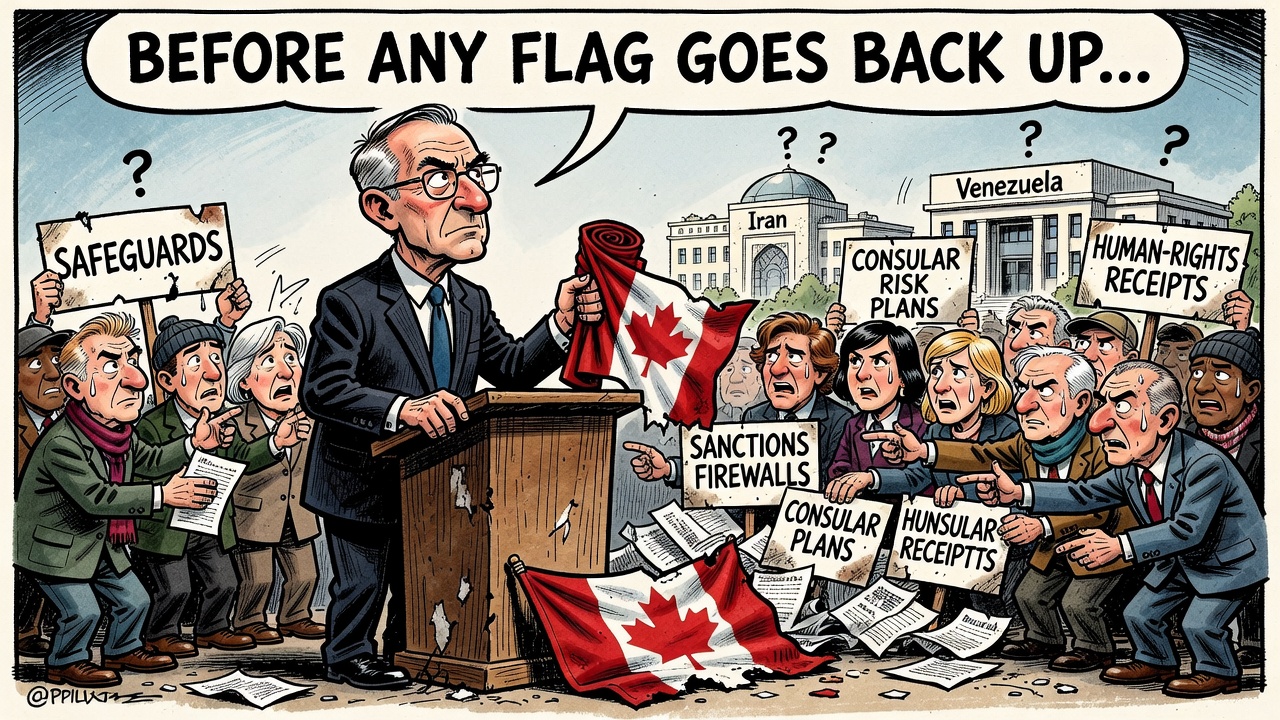
Prime Minister Mark Carney is now openly arguing that Canada should consider restoring diplomatic presence in Iran and Venezuela. His case is practical: without people on the ground, Canada has less capacity to help citizens, gather information, respond to crises and deal directly with governments Canadians may still need to confront.
That argument cannot simply be dismissed. Consular access matters. Canadians do get trapped in dangerous places. Diplomatic channels can be useful precisely because the other side is hostile, authoritarian or unstable. But the conservative accountability standard is also straightforward: before Ottawa reopens an embassy in Tehran or Caracas, it should publish the safeguards.
Iran is not a normal diplomatic file for Canada. Ottawa severed relations with Tehran in 2012. Families of Flight PS752 victims still deserve justice and transparency. The Islamic Revolutionary Guard Corps is listed by Canada as a terrorist entity. Iranian-Canadian dissidents and diaspora communities have repeatedly raised concerns about intimidation and foreign influence. If Carney wants a different approach, he owes Canadians more than a slogan about engagement.
Venezuela is also not a routine posting. Canada suspended operations at its embassy in Caracas in 2019 after the Maduro regime refused to renew Canadian diplomats’ visas. A reopened mission would have to operate inside a system with severe human-rights, security and rule-of-law concerns. Humanitarian need does not erase the risk that diplomatic privileges, visas, contracts or public legitimacy can be exploited by an authoritarian government.
So publish the reopening test. For Iran, that means written red lines on PS752, the IRGC listing, sanctions enforcement, hostage diplomacy, staff security, intelligence risk and diaspora protection. For Venezuela, it means public benchmarks on consular access, staff safety, democratic legitimacy, sanctions compliance, aid delivery and limits on regime privileges. For both, it means a plain-language explanation of who recommended the change, what Global Affairs assessed, what security agencies warned, and what would cause Canada to walk away.
There is also a process problem. Reporting this week noted mixed public signals between Global Affairs and the Prime Minister’s comments. That gap should be explained. Canadians should not learn foreign-policy pivots by parsing contradictions between bureaucratic statements and a leader’s press conference.
Carney may be right that Canada needs more eyes and ears in hard places. But the harder the place, the stronger the guardrails must be. Engagement with Tehran or Caracas should not proceed on trust-me diplomacy. Put the safeguards, sanctions firewall and diaspora-protection plan online first. Then Canadians can judge whether the government is protecting citizens — or normalizing regimes without enough receipts.
- Associated Press: Canada PM Carney says country should reopen embassies in Iran and Venezuela
- Global News / The Canadian Press: Carney says Canada should reopen embassies in Iran and Venezuela
- Iran International: Canada PM floats reopening embassy in Iran despite earlier denial
- Prime Minister of Canada: Statement by the Prime Minister on Venezuela’s earthquake
This article argues for published safeguards and measurable red lines before any Canadian diplomatic reopening in Iran or Venezuela.