Carney’s Conflict Screen Has Triggered 17 Times. Canadians Still Can’t See the Log.
Seventeen times the alarm rang. The problem is that Canadians are still being asked to trust a conflict system they cannot properly audit.
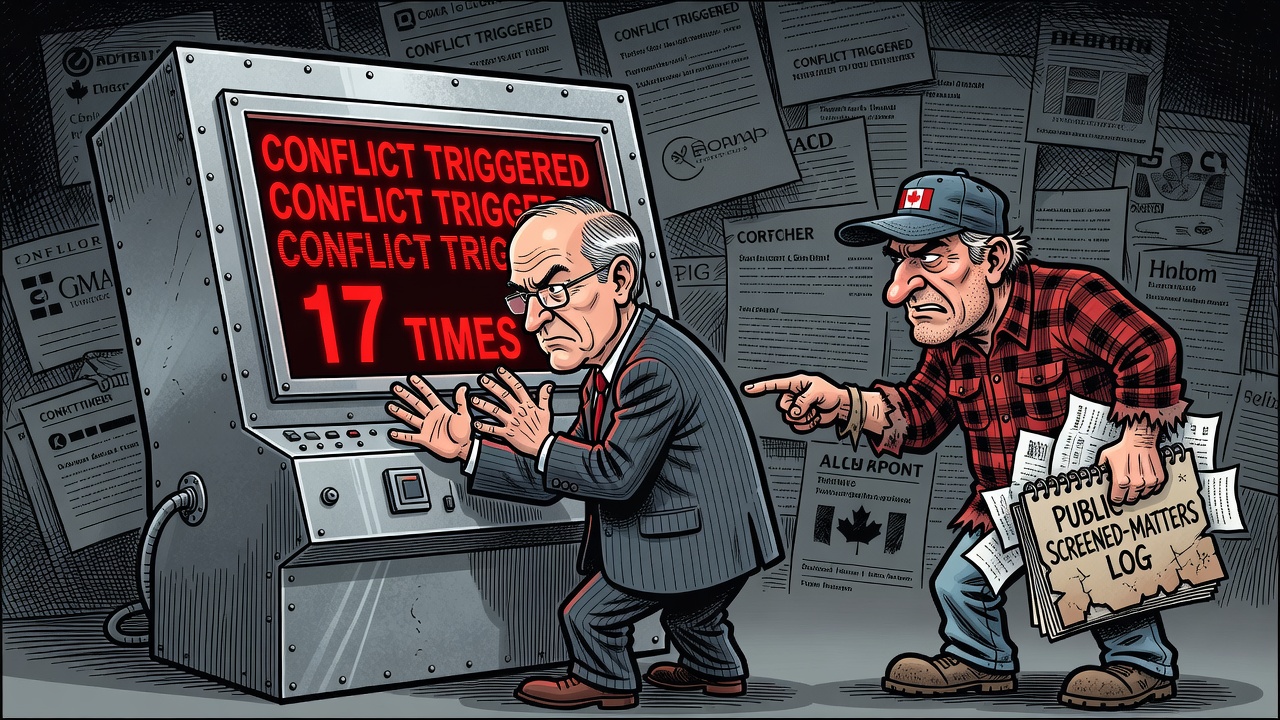
Prime Minister Mark Carney’s conflict-of-interest screen is no longer a theoretical safeguard. According to the Journal de Montréal, a Privy Council Office letter from mid-May says the screen had already been triggered 17 times. That is the headline Canadians should sit with: a conflict mechanism created because of the prime minister’s private-sector ties has reportedly been activated again and again, while most of the underlying details remain out of public view.
The public case for the screen has always been simple: Carney had a major pre-government career in finance, including Brookfield, so an internal firewall would keep him away from files where his interests or past affiliations could raise conflict concerns. But a firewall is only useful if citizens can see enough to know when it was used, what file was affected and who made the decision instead.
The House ethics committee’s Conflict of Interest Act review shows why the design matters. It records that Carney agreed to an additional conflict screen in July 2025 covering Brookfield Asset Management, Brookfield Corporation, Stripe and related entities, with the final list reaching 103 companies. The same report also notes that the screen does not automatically stop the prime minister from being made aware of matters of general application or broad-class impact unless the screened entities are disproportionately affected.
That exception may be administratively convenient, but it makes transparency more important, not less. “General application” is where huge policy value often hides: financial regulation, housing finance, infrastructure priorities, industrial tax credits, carbon markets and government-backed investment. If a file affects a whole sector but still has a meaningful impact on a screened company, Canadians need more than a private assurance that everything was handled properly.
The Journal de Montréal report says Powell Energy Inc. was named in the Privy Council Office response and that the screen was also applied when the government announced its intention to give mortgage insurers more room. Bloc ethics critic Luc Thériault told the paper that 11 of the 17 applications still lacked public detail. That is exactly backwards. The more often a prime minister’s conflict screen is triggered, the stronger the public reporting should become.
None of this proves that Carney broke the law. It proves that the public architecture is too opaque for a prime minister with unusually deep financial-sector connections. Conservatives should be precise here: the demand is not gossip, punishment or conspiracy. The demand is a dated public screened-matters log that lists the subject category, affected sector or company, alternate decision-maker and reason for withholding any detail.
Carney’s government cannot ask Canadians to trust a black box because an internal alarm supposedly worked. If the alarm rang 17 times, publish the receipt.
- Journal de Montréal: Les libéraux méprisent la transparence: 17 alertes de conflits d’intérêts contre Mark Carney
- House of Commons ETHI: Conflict of Interest Act review report
- Global News / Canadian Press: Mark Carney sets ethics screen amid Brookfield concerns
- Democracy Watch: Critique of the Carney ethics-screen disclosure process
This article does not allege that the Prime Minister violated the Conflict of Interest Act. It argues that repeated use of a conflict screen requires public, auditable disclosure.