Carney’s Foreign-Influence Registry Gap Is Now the Receipt
If Ottawa can move quickly on diplomacy with governments named in interference warnings, it can move quickly on the public registry meant to expose foreign influence.
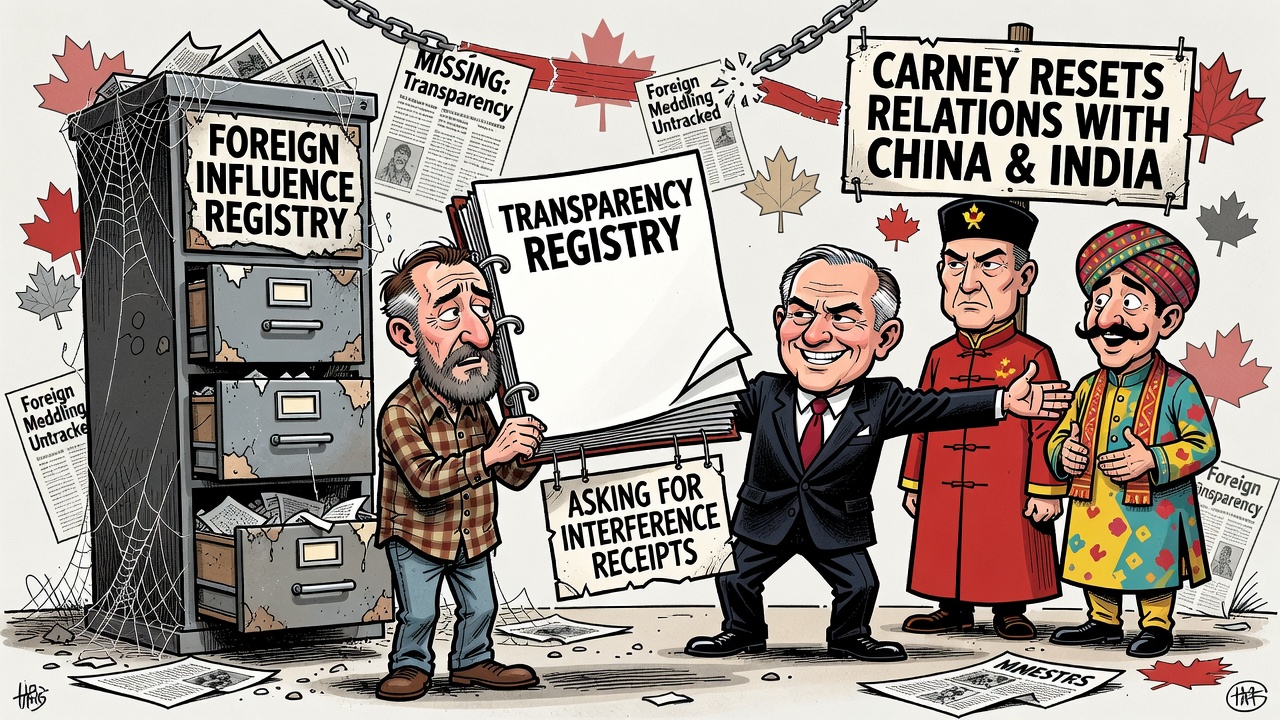
Canada has spent years telling citizens that foreign interference is a serious threat. Yet the most basic transparency tool promised after those warnings still is not operating in public. Global News reported on June 18 that, six months after draft rules were released, Canada still lacks an operational public database for agents working on behalf of other states.
That is not a minor paperwork delay. The Foreign Influence Transparency and Accountability Act was introduced in 2024 to close a gap exposed by allegations of foreign meddling in Canadian politics. Public Safety Canada said in March that the law creates an independent commissioner and a registry, and that proposed implementation regulations were published in the Canada Gazette on January 2 for a 30-day comment period. Canadians are now entitled to ask a simple question: after the consultations, where is the registry?
The delay looks worse because the threat has not gone away. Global Affairs Canada briefing material for the Procedure and House Affairs committee described foreign-interference concerns involving the People’s Republic of China, including operations aimed at MPs, critics of the Chinese Communist Party, pro-democracy activists and families abroad. Global News also reported that Canada’s security community has repeatedly flagged China and India as active foreign-interference actors, while Prime Minister Mark Carney has pursued improved relations with both governments.
Conservatives do not need to oppose diplomacy to demand transparency. Canada should talk to difficult governments when national interests require it. But diplomacy without daylight is exactly why a registry matters. If foreign governments, state-linked organizations or their agents are trying to shape Canadian policy, diaspora politics or public debate, voters should not have to rely on leaks and committee scraps to know who is acting for whom.
Civil-society groups have made the same point. According to Global News, 33 organizations signed a June 11 letter urging Carney’s government to finalize the FITAA regulations and complete Anton Boegman’s appointment as Canada’s first Foreign Influence Transparency Commissioner. The House of Commons Procedure and House Affairs committee also scheduled a June 16 meeting specifically on the “Update on the Implementation of the Foreign Influence Transparency Registry.” In other words, this is not an obscure file. Parliament knows. Advocates know. Diaspora communities know.
The Liberal government’s answer cannot be “very soon” forever. If foreign interference is serious enough to justify public inquiries, national-security briefings and new offices, it is serious enough to justify a working registry now. Finalize the regulations. Install the commissioner. Publish plain-language guidance. Fund the office properly. Then report publicly on registrations, exemptions, enforcement actions and timelines.
Carney’s government wants Canadians to trust it while it resets sensitive relationships abroad. Trust is earned with receipts. On foreign influence, the receipt is the registry — and the page is still blank.
- Global News: Canada still doesn’t have a foreign influence registry, and advocates are worried
- Public Safety Canada: Minister Anandasangaree names proposed Foreign Influence Transparency Commissioner
- House of Commons PROC: Update on the Implementation of the Foreign Influence Transparency Registry
- Global Affairs Canada: PROC briefing material on foreign election interference
- iPolitics: Foreign-influence registry on the parliamentary agenda
This article does not allege that any specific Canadian official is acting for a foreign government. It argues that Ottawa should finish the public transparency system it already promised.