Bill C-22 Left the House Without a Recorded Vote
The Senate should not rubber-stamp expanded lawful-access powers without recorded votes, public amendments and hard privacy safeguards.
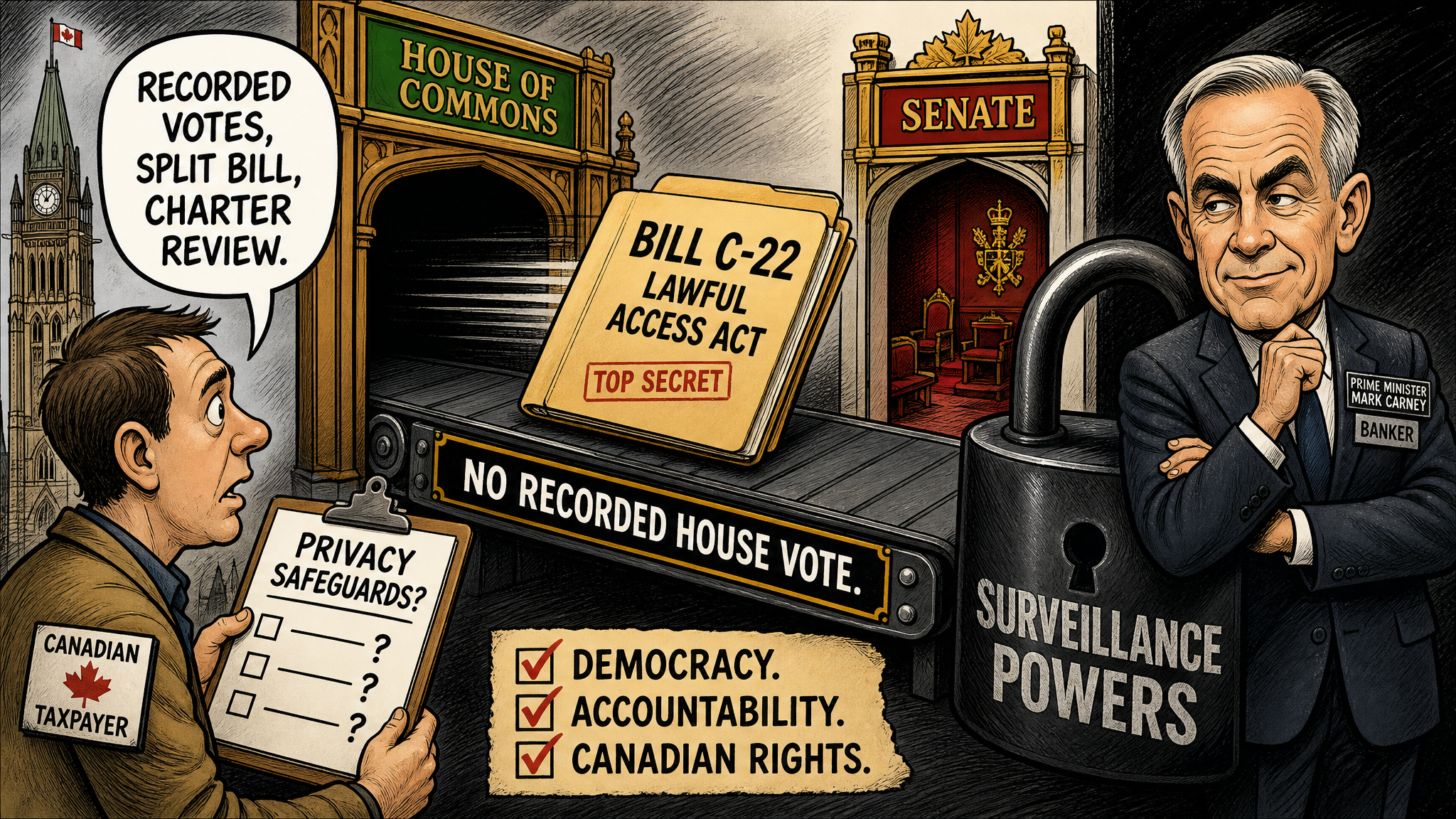
Bill C-22 is no longer just a committee-stage warning. Parliament’s LEGISinfo page now lists the Lawful Access Act, 2026 as a House government bill sponsored by the Minister of Public Safety, with committee consideration, report stage and third reading all completed on Thursday, June 18, 2026. The current status is awaiting first reading in the Senate, with no Senate second-reading activity yet.
The most important receipt is buried in plain sight: under recorded votes, LEGISinfo says there are currently no recorded House of Commons votes for the bill. That does not mean the House did nothing; the page also says third reading was agreed to. It means Canadians are left without a recorded division showing which MPs put their names beside a major expansion of lawful-access powers.
That is not good enough. Conservatives should be serious about policing, national security and timely lawful access when courts authorize it. But seriousness cuts both ways. If Ottawa wants broader digital powers, it must accept broader public accountability. MPs should not be able to wave through a bill of this scale while the public record fails to attach names to the final House decision.
The Canadian Bar Association’s submission gives senators a clear reason to slow down. The CBA says Bill C-22 creates two different lawful-access regimes and should be split so Parliament can debate them properly. It says the government has not provided evidence that the expanded powers are necessary. It warns that Part 1 reduces judicial oversight, allows confirmation-of-service demands without prior judicial authorization, permits non-disclosure periods up to a year, and uses low reasonable-suspicion thresholds for some orders. It also says Parts 1 and 2 risk violating Charter section 8 protections against unreasonable search and seizure.
Industry warnings are not hypothetical politics either. Global News reported that Signal, DuckDuckGo and VPN providers were among firms warning they could limit or remove Canadian services if the bill goes ahead in its current form, citing privacy, encryption and compliance concerns. Whether one accepts every industry objection or not, that is a major competitiveness and privacy alarm bell.
The Senate should now do what the House did not visibly do: put Bill C-22 on the record. Hold recorded votes. Publish the amendment table. Separate the narrower subscriber-confirmation powers from the broader technical-capability regime. Release a plain-language Charter and privacy analysis. Require public transparency reporting for ministerial orders and demands, with legitimate security redactions only where necessary.
Public safety does not require parliamentary fog. If the Carney government believes Bill C-22 is necessary, it should welcome named votes, exact safeguards and public receipts. If it cannot defend those basics, the Senate should not pass the bill as written.
- Parliament of Canada LEGISinfo: Bill C-22, Lawful Access Act, 2026 status and recorded-votes section
- Canadian Bar Association: The new lawful access bill is better, but C-22 still needs work
- Global News: Signal, DuckDuckGo among firms weighing Canada exit over lawful access bill
- Government of Canada: Lawful access backgrounder
This article supports judge-authorized investigative tools where they are precise, necessary and auditable. It does not claim Bill C-22 is law or that it creates unrestricted warrantless access; it argues the Senate should require recorded votes and enforceable privacy safeguards before passage.