May Housing Starts Are the Receipt Carney’s Housing Plan Can’t Spin Away
The promise is homes. The receipt is starts, completions and permits that actually turn into supply.
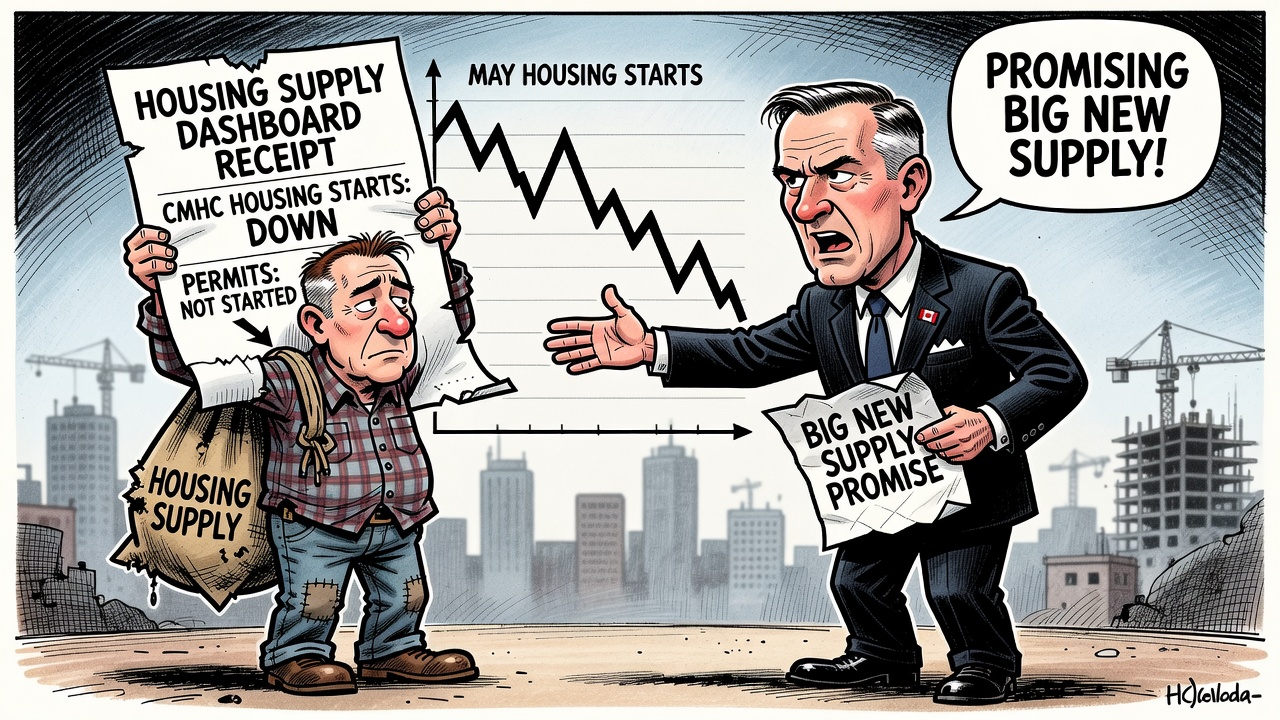
Ottawa’s housing announcements should now face one plain test: are more homes actually starting construction fast enough to match the political promise?
CMHC’s May 2026 numbers are not a victory lap. The agency reported that Canada’s six-month housing-starts trend was virtually flat in May, up just 0.5% to 258,010 units. The monthly seasonally adjusted annual rate moved the other way, falling 6% to 261,377 units from 278,380 in April. In centres with at least 10,000 people, actual starts were down 5.2% year over year: 22,633 in May 2026 versus 23,879 in May 2025.
That is the number Ottawa should not be allowed to bury under slogans. A permit is not a home. A funding announcement is not a home. A federal press conference is not a home. For a family priced out of the market, the only supply that matters is construction that starts, finishes and becomes a place to live.
This is where the Carney government needs a conservative accountability standard. If Liberals want credit for fixing housing, they should publish a monthly national dashboard that ties federal spending and policy changes to starts, completions, permitting backlogs, population growth and prices. Not a glossy “progress” page. A ledger.
The dashboard should show the gap between promised supply and actual starts by province and major city. It should show how many permitted units are stuck before shovels hit the ground. It should separate rentals, condos, single-family homes and non-market units. It should disclose whether federal dollars are producing net new construction or simply rebranding projects that were already moving. And it should compare new supply against demand pressure, including immigration targets, household formation and vacancy rates.
The point is not to pretend Ottawa controls every crane in Canada. Provinces, cities, builders, lenders and labour markets all matter. But the federal government has spent years making national housing promises, using national housing money and claiming national housing credit. With that comes national accountability.
May’s CMHC release is a warning light. Toronto actual starts fell 12% year over year and Vancouver fell 7%, while Montreal rose 18%. That uneven picture is exactly why Canadians need local receipts rather than national spin. If Ottawa’s plan is working, show where, how many homes, at what cost and when families can move in. If it is not working, stop selling the announcement as the outcome.
Carney’s housing test is not whether ministers can say “supply” in every speech. It is whether the supply shows up in the starts data, the completions data and the monthly bill taxpayers are paying. Publish the dashboard. Let Canadians see the receipts.
- CMHC: Housing starts and construction data — May 2026
- CMHC: Monthly housing starts and construction data tables
- Canadian Press via Yahoo Finance: CMHC reports annual pace of housing starts down six per cent in May
- MarketScreener: Canadian housing starts fall 6% in May
This article uses CMHC’s May 2026 housing-starts release as an accountability benchmark. It argues for public month-by-month reporting on starts, completions, permitting backlogs, federal spending and demand pressures.