The Dental Plan Was Sold at $13B. Now the Bill Is Reported Above $18B.
A flagship Liberal program may be running billions above its launch price tag. Canadians deserve the costing table before Ottawa calls it compassion.
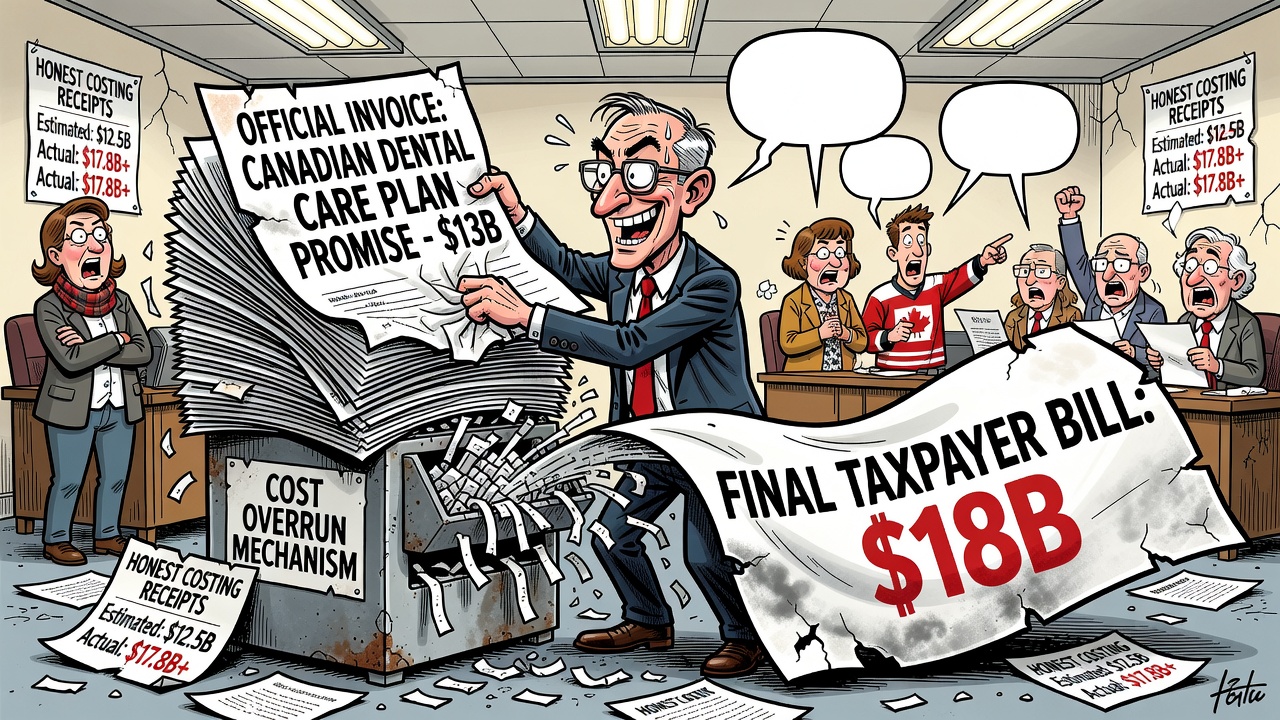
The Canadian Dental Care Plan was sold to voters with a clear number. Budget 2023 proposed $13.0 billion over five years, starting in 2023-24, plus $4.4 billion ongoing, to build the program. The Prime Minister’s Office promoted the same figure days later and said the plan would eventually provide dental coverage for up to nine million Canadians.
Now the bill appears to be moving. Blacklock’s Reporter says the Department of Health estimates patient fees under the Canada Dental Care Plan will cost taxpayers more than $18 billion over five years — roughly one-third above the original $13-billion figure. If that reporting reflects the current departmental estimate, this is not a rounding error. It is a multi-billion-dollar gap between the launch price and the working bill.
Supporters of public dental coverage can believe the program is worthwhile. That does not excuse sloppy costing. In fact, the opposite is true: if Ottawa wants Canadians to trust a permanent entitlement program, it has to prove the budget was honest, the assumptions were realistic, and the overruns are explained before they become automatic annual spending.
The accountability question is straightforward. What changed between the $13-billion promise and the reported $18-billion-plus Health estimate? Was uptake higher than expected? Were dental fees underestimated? Did administrative costs, Sun Life delivery costs, eligibility expansion, provincial coordination, or co-payment assumptions shift? Did Ottawa build in enough contingency for a program advertised as serving millions of people?
This is the pattern Canadians have seen too often from Liberal spending announcements: headline number first, hard ledger later. A sympathetic policy is announced with a politically digestible price tag. The program becomes emotionally difficult to challenge. Then, after the commitments are locked in, taxpayers discover the real cost curve is steeper than the press conference suggested.
A conservative accountability standard does not start by arguing that no low-income senior, child, person with disabilities, or uninsured worker should ever get help with dental care. It starts by insisting that compassion funded by taxpayers must still be budgeted honestly. Every dollar Ottawa overspends without explanation is a dollar borrowed, taxed, or diverted from another public need.
Health Canada and Finance should publish a reconciliation table now: the original five-year costing, the current five-year forecast, utilization assumptions, fee schedules, administrative costs, claims paid to date, expected annual growth, and the basis for the $4.4-billion ongoing estimate. If the program’s cost has increased, say so plainly. If the Blacklock’s number is incomplete or context-dependent, release the documents that prove it.
Dental care may make for warm government advertising. But budgets are not slogans. Ottawa promised Canadians a $13-billion plan. If the working bill is now above $18 billion, taxpayers deserve the receipts before the Liberals ask for another round of applause.
- Blacklock’s Reporter: Overspend Billions On Dental
- Budget 2023: Chapter 2 — Investing in Public Health Care and Affordable Dental Care
- Prime Minister of Canada: Getting Canadians the dental care they need
- Finance Canada: Budget 2024: helping more Canadians access affordable dental care
This article distinguishes the policy debate over dental coverage from the fiscal-accountability question. It relies on official federal releases for the original $13B five-year promise and on Blacklock’s current reporting for the reported Health Department $18B-plus five-year estimate.