Carney’s $963K Flight-Food Bill Still Needs the Menu Receipts
Parliament got a total for Prime Minister aircraft catering. Taxpayers still need the itemized menu, passenger counts, reimbursements and invoices.
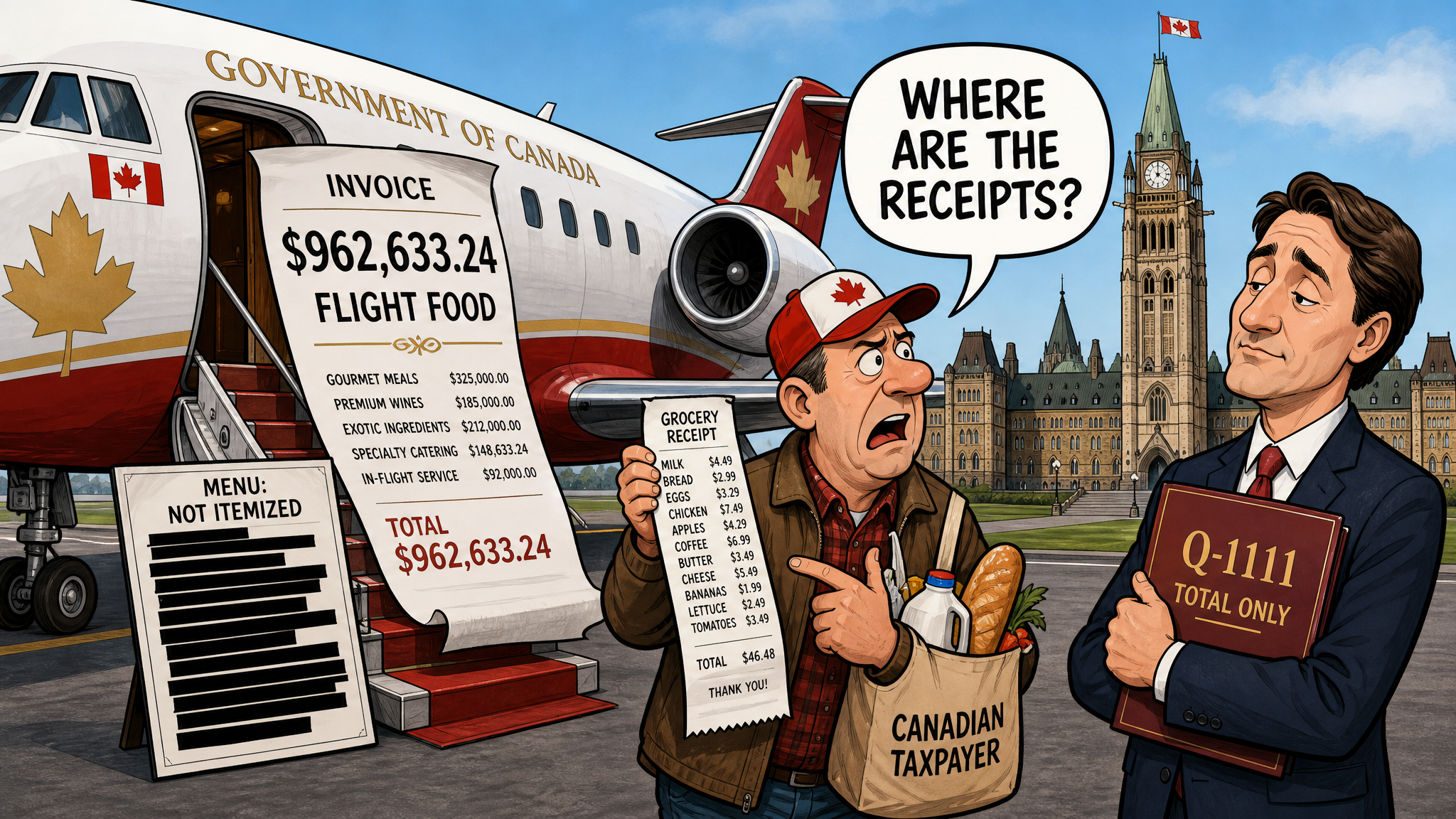
Prime Minister Mark Carney’s government has now given Parliament a total for in-flight food and catering on government aircraft. What taxpayers still do not have is the part that makes a receipt useful: the itemized receipt.
The paper trail starts with Order Paper Question Q-1111. Conservative MP Scot Davidson asked for the details of meals, beverages and other catering served onboard government aircraft transporting the Prime Minister since Carney was sworn in, including dates, origins, destinations, passenger counts, total catering bills, specific menu items, quantities and per-item costs. The House of Commons page shows the question and a June 10, 2026 response.
According to Rebel News, citing the Department of National Defence response to Q-1111, the total food and catering bill for official trips between March 2025 and March 2026 was $962,633.24. Rebel reported that the largest single catering charge was $175,248.48 for a January 2026 trip with stops in Vancouver, Beijing, Doha and Zurich, while a November 2025 trip through Greece, the United Arab Emirates, South Africa and Spain cost $159,781.24 in catering alone.
Those numbers are not small accounting noise. They are household-budget numbers multiplied into executive-government scale at the same time Canadians are watching grocery bills, rent, mortgage costs and taxes. The Prime Minister is required to use secure government aircraft for legitimate security reasons. That does not create a blank cheque for food costs, and it certainly does not erase the obligation to show what was bought.
The weak point is the missing menu. Rebel reported that National Defence said records do not capture meals and beverages by individual menu item, quantity or per-item price, and that food-related costs are recorded as a total amount per flight. In plain English: Parliament asked for the bill, the menu and the unit prices; taxpayers got the headline totals but not the audit trail needed to judge value for money.
CarneyWatch’s travel tracker has also highlighted the Q-1111 catering total, listing $962,633 for the first year and the January 2026 Beijing/Doha/Zurich trip at $175,248. The existence of outside trackers should embarrass Ottawa, not replace official disclosure. Canadians should not need activists or independent media to assemble basic accountability tables from scattered parliamentary answers.
A conservative accountability standard is simple: publish the downloadable Q-1111 table, itemized invoices where they exist, passenger counts by flight leg, vendor names, reimbursement totals from travelling media or other non-government passengers, and the policy that governs VIP-aircraft catering. If the government says some meals are prepared onboard from locally purchased groceries, publish those grocery totals and procurement records too.
This is not about denying security travel to a prime minister. It is about refusing to let “official travel” become a shield against ordinary fiscal discipline. A government that can total nearly $963,000 in aircraft food costs can also tell Canadians what was purchased, for whom, at what price, and what was reimbursed. Until it does, this is not a receipt. It is a total without accountability.
- House of Commons: Q-1111 written question and response page
- House of Commons: Response from June 10, 2026 for Q-1111
- Rebel News: Carney government spent nearly $1 million on in-flight catering in first year
- CarneyWatch.ca: Carney’s Travel Tab tracker
This article relies on the official parliamentary question/response pages for the scope of Q-1111 and on cited independent reporting/trackers for the catering totals and reported missing itemization. It argues for disclosure of invoices, passenger counts and reimbursement records before taxpayers are asked to accept the totals on trust.