Carney’s China EV Quota Needs Public Receipts
A China auto deal is no longer just diplomatic choreography. It is now a Canadian market policy with winners, losers and public-interest questions.
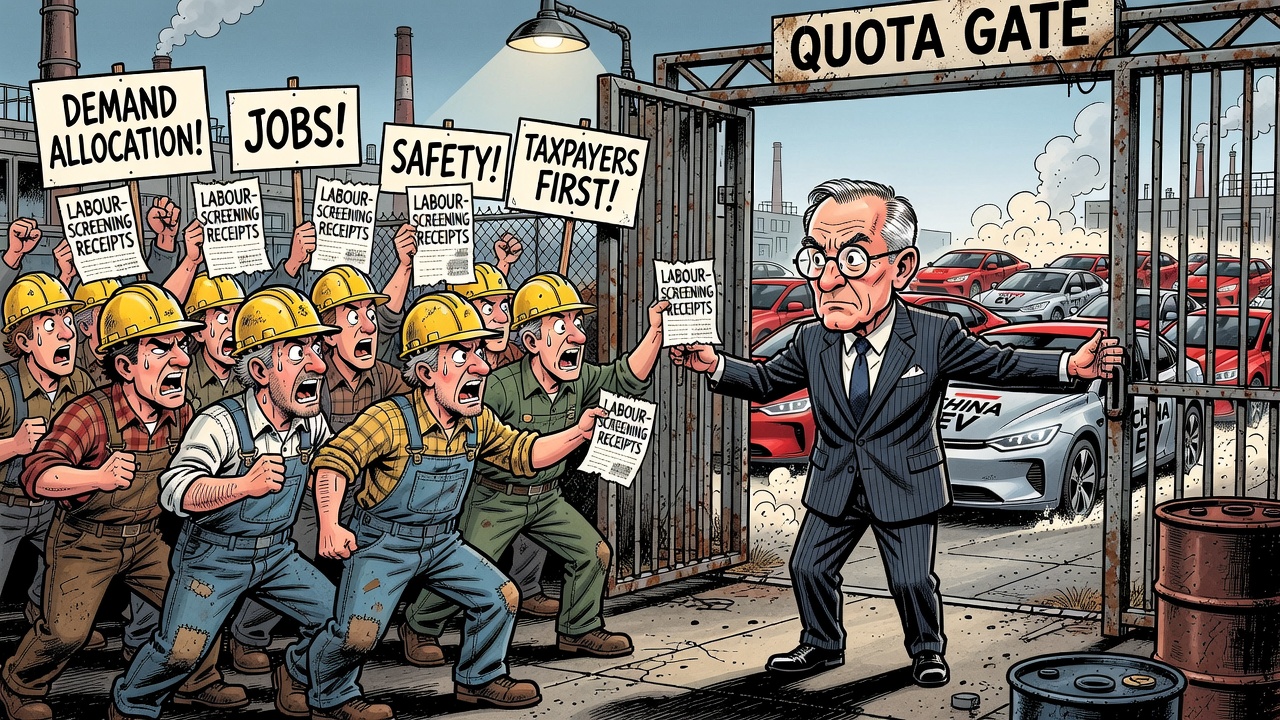
Prime Minister Mark Carney’s China reset has moved from handshake politics to showroom reality. Bloomberg reported in late May that made-in-China electric vehicles had begun arriving in Canada under the arrangement Carney struck with Xi Jinping in January. That matters because this is not a normal tariff tweak. It is a government-created quota gate into the Canadian auto market.
Global Affairs Canada says the quota began March 1, 2026, on a first-come, first-served basis for an initial six-month period. The first-year volume is 49,000 vehicles and rises by 6.5 per cent annually. Ottawa’s Spring Economic Update says those Chinese EVs can enter at the 6.1 per cent most-favoured-nation tariff rate, and that the former 100 per cent surtax was repealed effective March 1.
That is a sharp reversal. In 2024, Ottawa defended the 100 per cent surtax as a measure to protect Canadian workers, EV supply chains and critical industries from unfair Chinese competition. Now the Carney government is opening a capped lane for the same category of vehicles, after China lowered pressure on Canadian agricultural exports. Associated Press reported the deal cut Canada’s tariff on Chinese EVs in return for lower Chinese tariffs on Canadian farm products.
There may be a case for trading tariff relief for canola access. Conservatives should not pretend tradeoffs do not exist. But there is no conservative case for hiding the ledger. If Ottawa is going to exchange auto-sector protection for agricultural relief, Canadians deserve to see who benefits, who pays and what safeguards survive.
Start with allocation. Which importers got access to the March-to-August first-come, first-served quota? How many vehicles has each imported? Were politically connected firms, consultants or former Liberal insiders involved? What happens on September 1, when Global Affairs says a longer-term allocation and administration approach is expected to begin? The government ran a consultation from April 7 to May 1. Publish the submissions, the decision memo and the criteria before the next system locks in.
Then publish the jobs ledger. How many Canadian assembly, parts and dealership jobs does Ottawa expect to gain or lose? What domestic investment commitments, if any, were required from companies using the quota? How will Canada prevent itself from becoming a pass-through market that angers the United States while doing little for Canadian workers?
Finally, show the compliance proof. Chinese EV supply chains raise national-security, data, subsidy and labour-screening questions. If Ottawa believes the quota can manage those risks, it should publish the non-confidential screening standards, enforcement statistics and recall or safety rules tied to these imports.
Carney cut the tariff. Now he owes the receipts. A quota is not accountability. A press release is not a jobs plan. And a China deal that trades one Canadian sector’s protection for another sector’s relief should not run through a black box.
- Bloomberg Law: Made-in-China EVs enter Canada under deal Carney struck with Xi
- Global Affairs Canada: Canada’s allocation and administration of the import quota for electric vehicles from China
- Government of Canada: Spring Economic Update 2026, Annex 1
- Associated Press: Canada-China EV and farm-products tariff dispute context
- Department of Finance Canada: 2024 Chinese EV surtax rationale
This article argues for public, non-confidential transparency around quota allocation, domestic job impacts and compliance safeguards. It does not argue for publication of commercially confidential data or security-sensitive details.