Carney’s France Intelligence Deal Needs Public Receipts
Classified information is not a diplomatic trophy. Before sensitive defence, AI, space and aerospace data starts moving, Ottawa owes Canadians the safeguards it can publish.
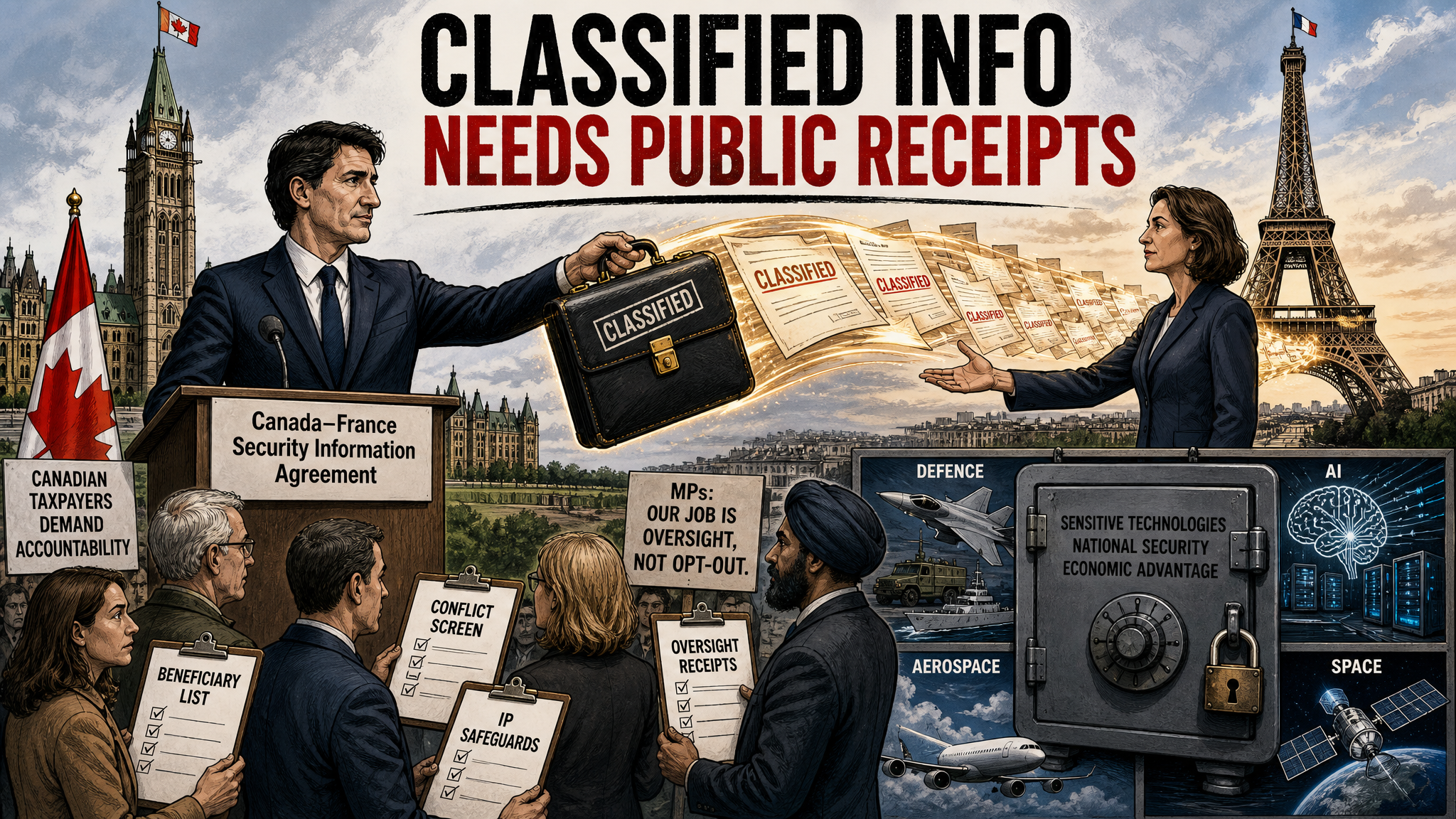
Prime Minister Mark Carney went to Paris and announced that Canada and France will deepen defence and industrial co-operation through a new General Security of Information Agreement. According to the Canadian Press report carried by Global News, Carney said the deal allows classified information to be exchanged between the defence, space, AI and aerospace sectors.
That is a serious file. It is also exactly the kind of file where Liberal press-release language is not enough. The government’s own release says the agreement creates a trusted framework for Canada and France to exchange and protect classified information securely, and that it will help Canadian businesses compete for projects that require sensitive information. Ottawa also says the agreement supports dual-use technologies, including aerospace, space, cybersecurity and advanced communications.
Those facts may describe an opportunity. They also describe risk. Classified information, dual-use technology and defence procurement are not ordinary trade promotion. They involve national security, intellectual property, export controls, foreign access, lobbying pressure and the possibility that a narrow group of well-connected firms benefits first while taxpayers are told to applaud from outside the room.
The procurement angle makes the accountability test even clearer. Global reported that Carney’s office said the France agreement will expand access to French defence-procurement opportunities and make Canadian industry more competitive in France. The same report linked the announcement to Canada’s participation in Europe’s SAFE Instrument. Canada’s own government describes SAFE as a €150-billion EU loan program to support and expedite defence procurement, giving Canadian firms preferential access and treatment to SAFE-financed opportunities.
Conservatives should not oppose allied security co-operation for the sake of opposition. France is a NATO ally. Canada needs reliable partners, especially when defence supply chains are under pressure. But partnership is not a substitute for scrutiny. The more Ottawa wraps procurement, classified information, AI, aerospace and foreign industrial policy into one announcement, the more Parliament needs a non-classified ledger.
Start with eligibility. Which Canadian firms and institutions can participate? What security-clearance standard applies to executives, subcontractors and foreign-owned affiliates? What conflict screens apply to ministers, political staff, lobbyists and former employers with defence or AI interests? What protections exist for Canadian intellectual property when joint research or classified technical data crosses borders? How will small and medium-sized Canadian suppliers know whether they can compete, rather than watching insiders divide the work?
Then publish outcomes. Canadians do not need classified operational details to see basic accountability. Ottawa can release the number of participating firms, contract categories, Canadian-content claims, recusal logs, privacy safeguards, export-control reviews and annual reporting to Parliament. It can tell taxpayers how SAFE-linked procurement benefits Canada without exposing sensitive secrets.
If this agreement strengthens Canada, prove it with public receipts. If it helps Canadian workers, show who gets access and under what rules. If it protects classified information, publish the non-classified safeguards. National security requires discretion. It does not require a black box.
- Global News / Canadian Press: Canada and France to deepen intelligence exchanges
- Public Services and Procurement Canada: Canada and France sign General Security of Information Agreement
- Government of Canada: Canada’s participation under the SAFE Instrument
- Prime Minister of Canada: France, Ireland and G7 travel release
This article argues for non-classified transparency around safeguards, eligibility, conflicts and procurement outcomes. It does not argue for publication of operational secrets.