Four Weeks, $11.1 Billion, and Another Liberal Spending Stopwatch
Parliament is being asked to approve another $11.1 billion. The watchdog’s warning is simple: the clock is short, and the receipts need to be public before the vote.
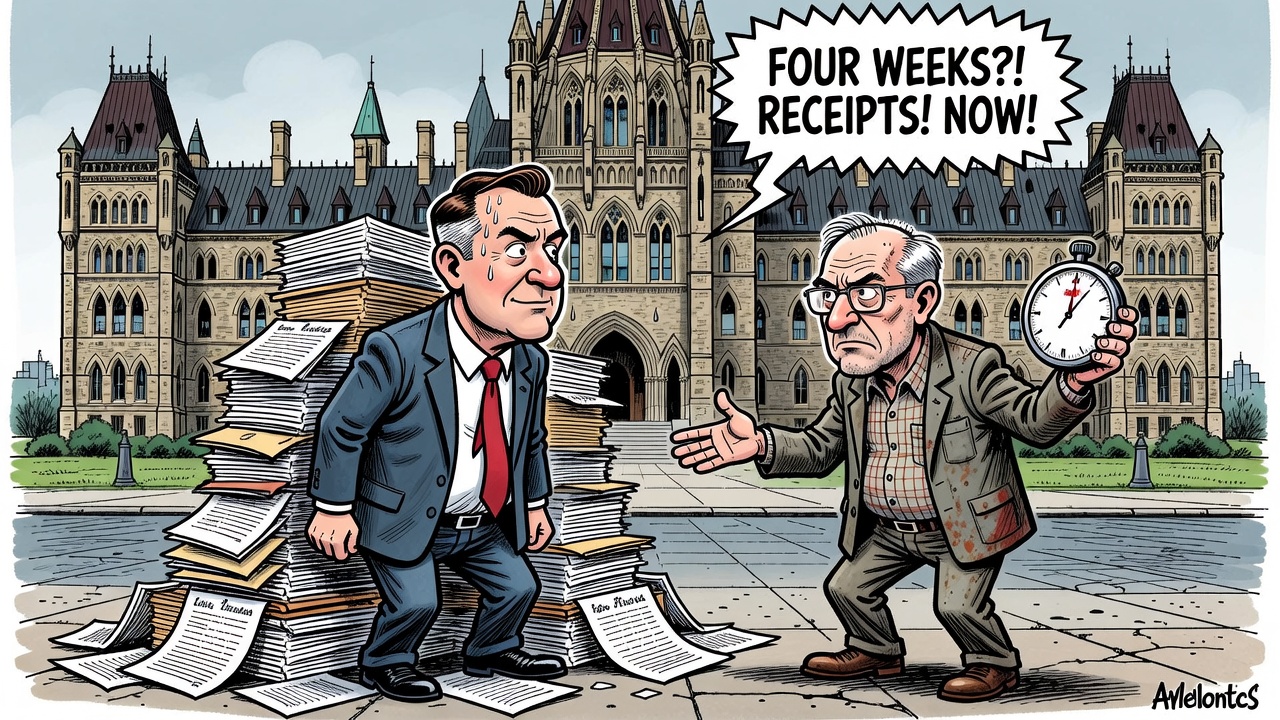
Mark Carney’s Liberals have a familiar habit: announce the virtue, move the money, and hope Parliament catches up. The Parliamentary Budget Officer’s new note on Supplementary Estimates (A), 2026–27 puts a hard number and a hard deadline on that habit.
The request is for $11.1 billion in additional budgetary authorities. The PBO says Parliament’s approval is required for that $11.1 billion, and parliamentarians have approximately four weeks from tabling to the end of the current supply period to approve the government’s financial request. That is not a leisurely audit window. It is a stopwatch.
Treasury Board’s own documents say these Supplementary Estimates, combined with the Main Estimates, bring planned 2026–27 budgetary spending to $513.9 billion: $241.5 billion in voted spending and $272.4 billion in statutory spending already authorized through existing law. In plain English, Ottawa is already operating at a half-trillion-dollar annual spending scale, then asking MPs to add another large block of voted authority before the supply period closes.
Some of the line items are serious and defensible on their face. The Estimates include $837.3 million for Operation REASSURANCE, Canada’s NATO assurance and deterrence mission in Central and Eastern Europe. They include major Indigenous claims and services funding, including $2.7 billion for agricultural benefits claims and mental-wellness supports. Conservative accountability does not mean pretending every expenditure is illegitimate.
It does mean refusing to write blank cheques at Liberal speed.
The housing-and-infrastructure bucket alone deserves scrutiny. The PBO identifies $3.2 billion in major planned housing and infrastructure spending, including $2.3 billion for the Build Communities Strong Fund. Treasury Board says that fund supports infrastructure related to prosperity, housing, education, health, transit and climate adaptation. That is a very wide door. Before approval, taxpayers should see project lists, provincial allocation formulas, administrative costs, and measurable housing-delivery targets.
Then there is Canada Post. The PBO says the Estimates include $673 million for Canada Post to cover revenue shortfalls and support continued operations, carried forward from unspent funding approved for 2025–26. Treasury Board’s table adds a new Canada Post Vote 5 for payments under the Canada Post Corporation Act. If a Crown corporation needs hundreds of millions more available this year, Canadians deserve the turnaround plan, labour-cost assumptions, parcel-market forecasts, and service-level commitments — not just another cash-flow patch.
The politically sensitive items also need daylight. Treasury Board lists $203.2 million for the Assault-Style Firearms Compensation Program, including compensation, collection and disposal costs. Whatever one thinks of the policy, Parliament should not approve hundreds of millions without current unit-cost estimates, participation projections, and implementation milestones.
The test is not whether Liberals can describe spending as compassionate, secure, green, or necessary. The test is whether the House gets enough time and detail to judge it. Four weeks for $11.1 billion is exactly when opposition MPs, committees, and taxpayers should slow down, demand the ledger, and make ministers defend every line before the money moves.
- Parliamentary Budget Officer: Supplementary Estimates (A), 2026–2027
- Treasury Board of Canada Secretariat: Supplementary Estimates (A), 2026–27
- Treasury Board of Canada Secretariat: Government of Canada advances investments for Canadians through Supplementary Estimates (A), 2026–27
This article relies on the PBO note and Treasury Board Estimates documents as primary factual sources.