Bill C-34 Turns Child Safety Into a Trust-Us Internet Regulator Test
Protect children online, yes. But Parliament should not hand blank-cheque internet powers to future cabinet rules and an unelected commission.
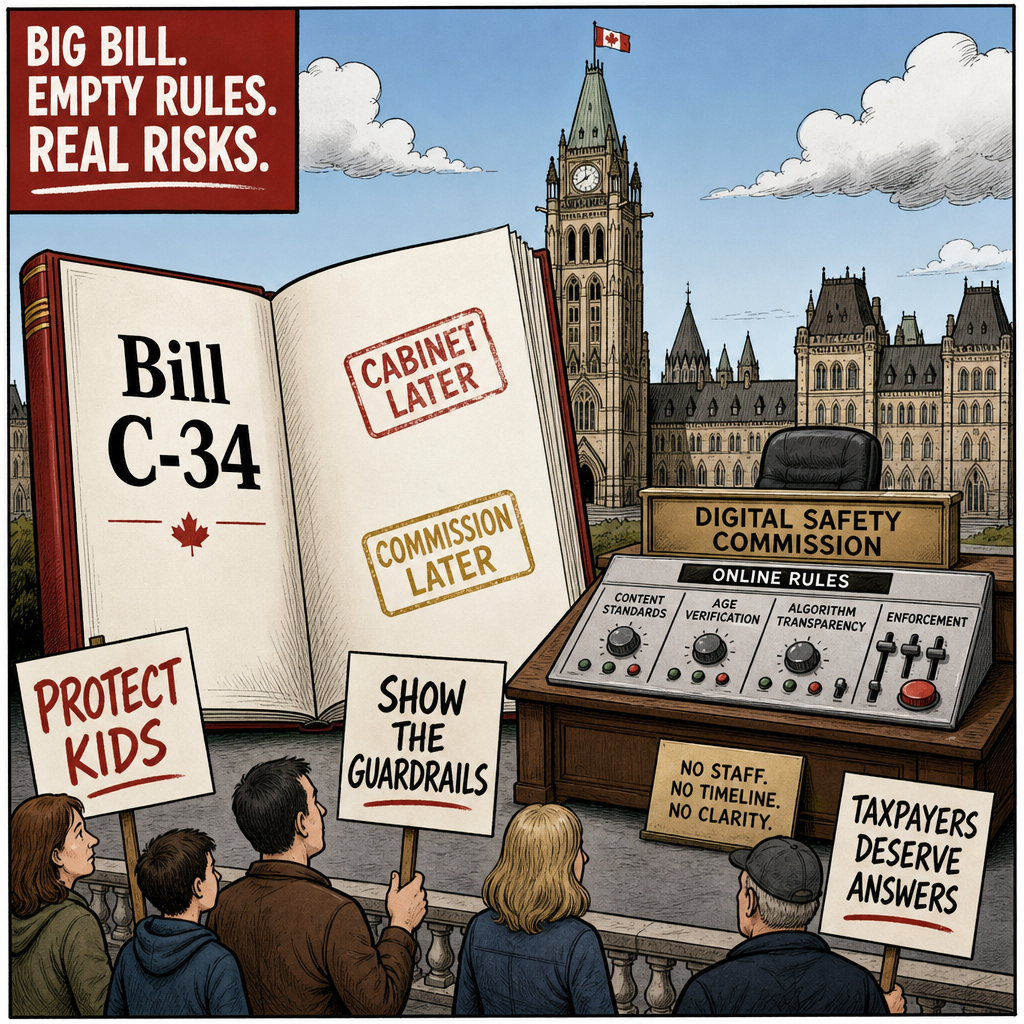
The Liberal government introduced Bill C-34 on June 10 with the politically unbeatable label Safe Social Media Act. Nobody serious dismisses the need to protect children from sexual exploitation, coercive bullying, self-harm content or predatory online design. The accountability problem is what Ottawa is asking Parliament to approve before Canadians can see the full operating manual.
The bill would enact the Digital Safety Act, create a Digital Safety Commission of Canada, regulate social media services and certain AI chatbot services, and set duties around harmful content, child protection, safety plans, transparency, synthetic-content labelling and rapid inaccessibility requirements for the worst categories of material. It also puts the under-16 social-media account restriction into the public debate.
Those goals deserve scrutiny, not slogans. The bill’s own structure leaves major practical decisions to future regulations and regulator decisions: which services are actually covered, what user thresholds apply, what counts as adequate age verification or age estimation, how exemptions work, how far the AI-chatbot regime reaches, and how the new commission exercises enforcement power. That is not a small drafting detail. It is the difference between Parliament making law and Parliament authorizing other people to make the real law later.
University of Ottawa law professor Michael Geist counted 19 decision points reserved for the Governor in Council and 31 separate heads of regulation-making power for the new commission under one section alone. His conclusion is blunt: much of Bill C-34 is a “law to be named later,” with the most consequential parts still dependent on cabinet, consultations, guidelines, appointments and a commission that does not yet exist.
OpenMedia, a digital-rights group that supported a rights-respecting duty-of-care approach, is also warning that Bill C-34 needs major fixes. Its concern is that the bill could push Canadians toward face scans, ID checks or other age-assurance systems across ordinary online services, while potentially sweeping in more than just the biggest social-media platforms.
Conservatives should be clear: child protection is a legitimate government function. Platforms should not get a free pass when they profit from children’s attention. But a child-safety bill should come with statutory limits, privacy minimization, independent audits, clear appeal rights, narrow definitions, no general internet ID system, and a public Charter analysis before MPs vote final approval.
The Liberal pattern is familiar: sell the compassionate headline, bury the power map, then ask Canadians to trust the regulator later. Bill C-34 may contain defensible pieces. But if Ottawa cannot write the guardrails into the bill now, Canadians should not pretend those guardrails are guaranteed later.
- Parliament of Canada: Bill C-34, Safe Social Media Act, first reading
- Government of Canada: Government introduces legislation to make social media services and AI chatbots safer for children
- Associated Press: Canada seeks to ban social media accounts for children under 16
- Michael Geist: The Law to Be Named Later
- OpenMedia: The Safe Social Media Act needs major fixes
This article supports child-protection goals while evaluating the privacy, delegation and implementation risks in Bill C-34.