Bill C-34: Ottawa’s “Safe Social Media” Bill Comes With an Internet ID Problem
Protecting kids online is legitimate. Building an open-ended age-verification regime for ordinary internet use is another matter.
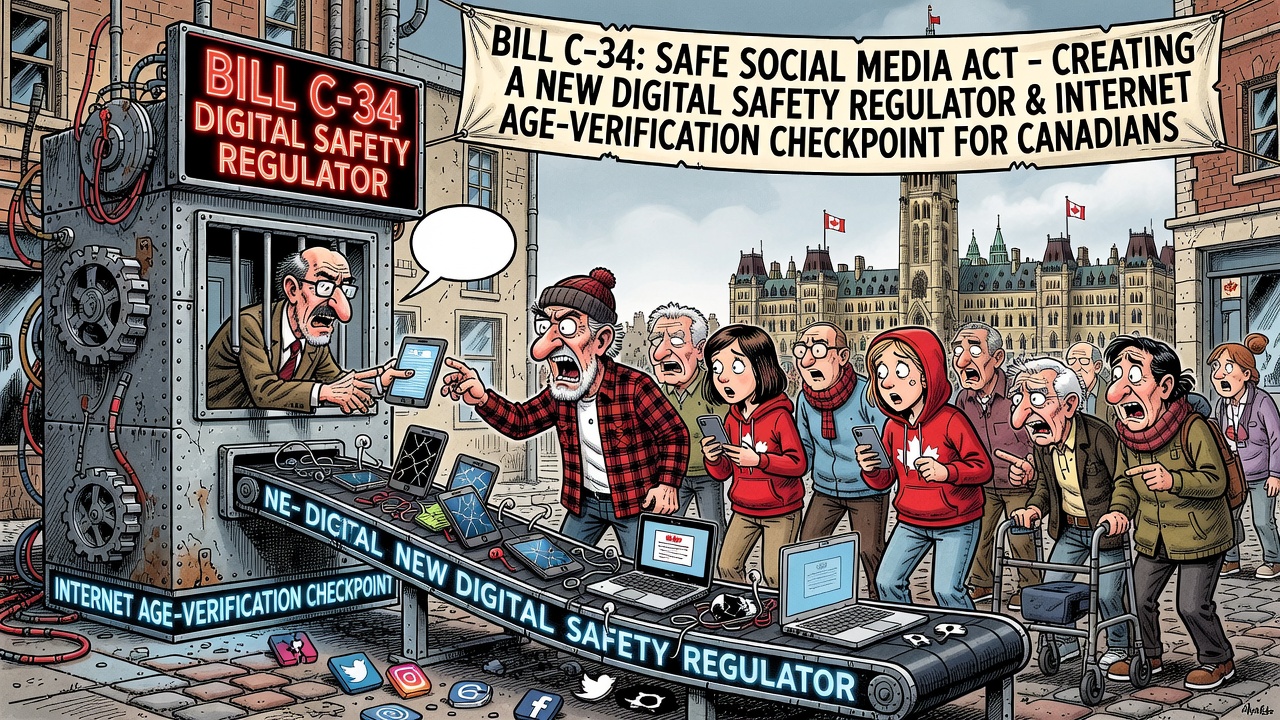
The Liberal government introduced Bill C-34 on June 10 under a name almost no parent wants to oppose: the Safe Social Media Act. Keeping children away from predatory content, coercive algorithms and adult material is a real public duty. But Canadians should read the fine print before accepting another Ottawa solution that turns safety into surveillance.
The bill would enact the Digital Safety Act and create the Digital Safety Commission of Canada. Its summary says regulated services would face duties to protect children, act responsibly, make certain content inaccessible and submit digital safety plans to the new commission. It also authorizes regulations that could extend child-protection and transparency duties to other online services.
That matters because the hard choices are not all written clearly into the bill. The legislation contemplates minimum-age restrictions for access to pornographic content and, if regulations provide, minimum-age restrictions for having an account or registering with regulated social-media services. In plain English: the headline may be “protect kids,” but the operational question becomes, “How does every platform prove the user’s age?”
Canadian Press reported that Culture Minister Marc Miller said the bill does not prescribe a specific age-verification method and that there would be a back-and-forth with platforms about privacy and adequacy. That is exactly where conservatives should demand guardrails now, not later. If the law pressures companies to verify age at scale, Canadians may be pushed toward face scans, identity uploads, third-party age checks or other systems that normalize showing papers to use the internet.
OpenMedia, hardly a conservative shop, warned that the Safe Social Media Act could reach beyond big social networks into services such as gaming, cloud storage and message boards, and could create face-scan or ID-style requirements for everyday online life. University of Ottawa law professor Michael Geist separately warned that a youth social-media ban is likely to require age verification for tens of millions of Canadians and could trigger another Canada-U.S. digital-policy fight.
None of this means Parliament should do nothing. Platforms that profit from children’s attention should face a real duty of care. Illegal sexual exploitation material and non-consensual intimate images should be removed quickly. Chatbots marketed as companions should not be allowed to nudge vulnerable minors toward self-harm. Those are defensible goals.
But Bill C-34 asks Canadians to trust a new regulator, future cabinet regulations and later implementation details with core privacy and speech questions. That is backwards. The government should have to prove that any age-assurance system is narrow, privacy-preserving, independently audited, minimally retentive and never a general internet ID system.
The accountability test is simple: protect children without building a checkpoint for everyone else. If Liberals cannot write that guarantee directly into Bill C-34, Canadians should assume the risk is not accidental. It is the design.
- Parliament of Canada: Bill C-34, Safe Social Media Act, first reading
- Canadian Press via CityNews: Ottawa moves to bar kids under 16 from social media, regulate chatbots
- OpenMedia: The Safe Social Media Act needs major fixes
- Michael Geist: Why a kids’ social media ban could put Canada on a collision course with the U.S.
This article supports child-protection goals while evaluating the privacy, delegation and implementation risks in Bill C-34.