Protect Kids Without Building an Internet ID Checkpoint
A youth safety bill should not become a permanent identity checkpoint for the Canadian internet.
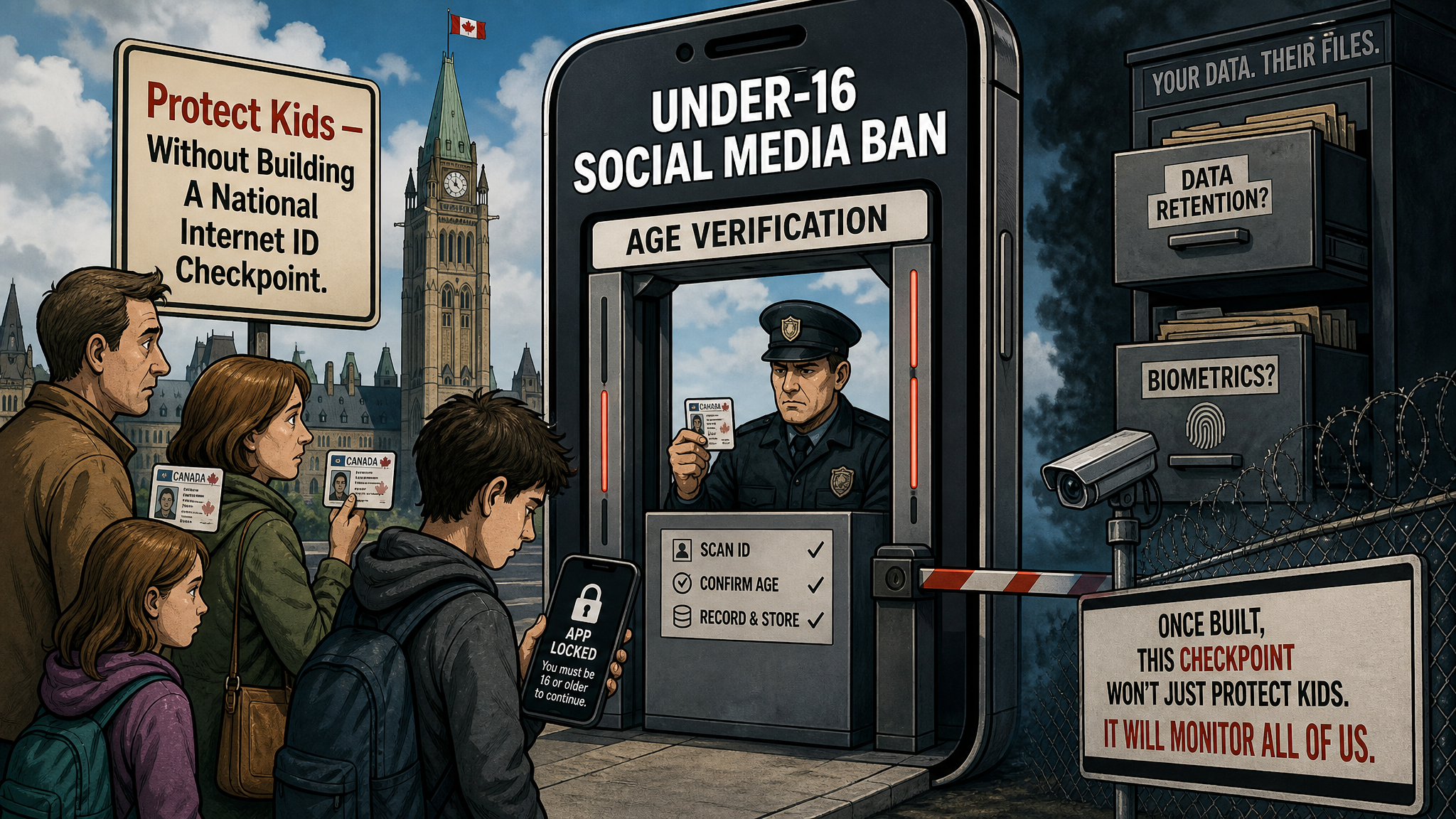
Global News reported Monday, updated Tuesday, that Ottawa plans to include a ban on social media use for children under 16 in the online harms bill expected to be introduced Wednesday, June 10. Culture Minister Marc Miller did not confirm the bill’s contents before tabling, so the honest description today is a reported government plan — not yet enacted law.
The accountability issue is not whether children deserve protection online. They do. Social media companies have earned scrutiny over addictive design, weak moderation, privacy failures and harms to minors. The question is whether the Carney government is about to solve one problem by creating another: a national age-verification infrastructure that could require every user, adult or child, to prove age before using ordinary online services.
That is not a fringe concern. Global’s report says Australia’s model allows platforms to request identification documents, use third-party facial age-estimation tools, or infer age from account data. Michael Geist, the University of Ottawa internet-law professor cited by Global, warned that a real ban would require checks across the user base, not just among teenagers. His point is basic enforcement logic: to know who is under 16, platforms must first sort everyone by age.
Canada’s Privacy Commissioner Philippe Dufresne has already set the standard Ottawa should meet. In May, his office launched age-assurance guidance aimed at making online spaces safer for children “without creating an undue impact on privacy rights.” He also told reporters, according to Global, that the first step need not necessarily be a ban. That is the lane Parliament should stay in: privacy by design, data minimization, clear duties on platforms and real transparency for parents.
If the government believes an under-16 restriction is necessary, it should table it as a clean, standalone bill. Do not bury it inside a broader online harms package with speech regulation, a new digital regulator and future rule-making left to cabinet or agencies. Publish the age-verification method. Ban biometric retention. Ban ID-document retention. Require Canadian data storage or equivalent enforceable protections. Require an independent privacy impact assessment before launch. Sunset the powers unless Parliament renews them after public evidence.
Protecting children is a legitimate goal. But conservative accountability means refusing blank cheques, especially when the cheque is written against the privacy of every Canadian online. Ottawa should target platform harms directly, not build a permanent internet ID checkpoint and ask the public to trust that it will never be expanded.
- Global News: Online harms bill to include social media ban for children under 16: source
- Office of the Privacy Commissioner of Canada: IAPP Canada Privacy Symposium 2026 remarks and age-assurance guidance launch
- Michael Geist: FAQ on age verification and mandated ID
- CityNews Montreal: Quebec petition and policy background
This article relies on mainstream reporting, official privacy-commissioner remarks and legal commentary. It argues for narrow child-safety rules, data minimization and parliamentary accountability before any age-verification mandate is built.