Carney Counts the AI Jobs — But Won’t Publish the Job-Loss Ledger
Carney’s “AI for All” plan promises hundreds of thousands of jobs. The first accountability test is whether Ottawa will publish the displacement modelling before it spends, regulates and centralizes at scale.
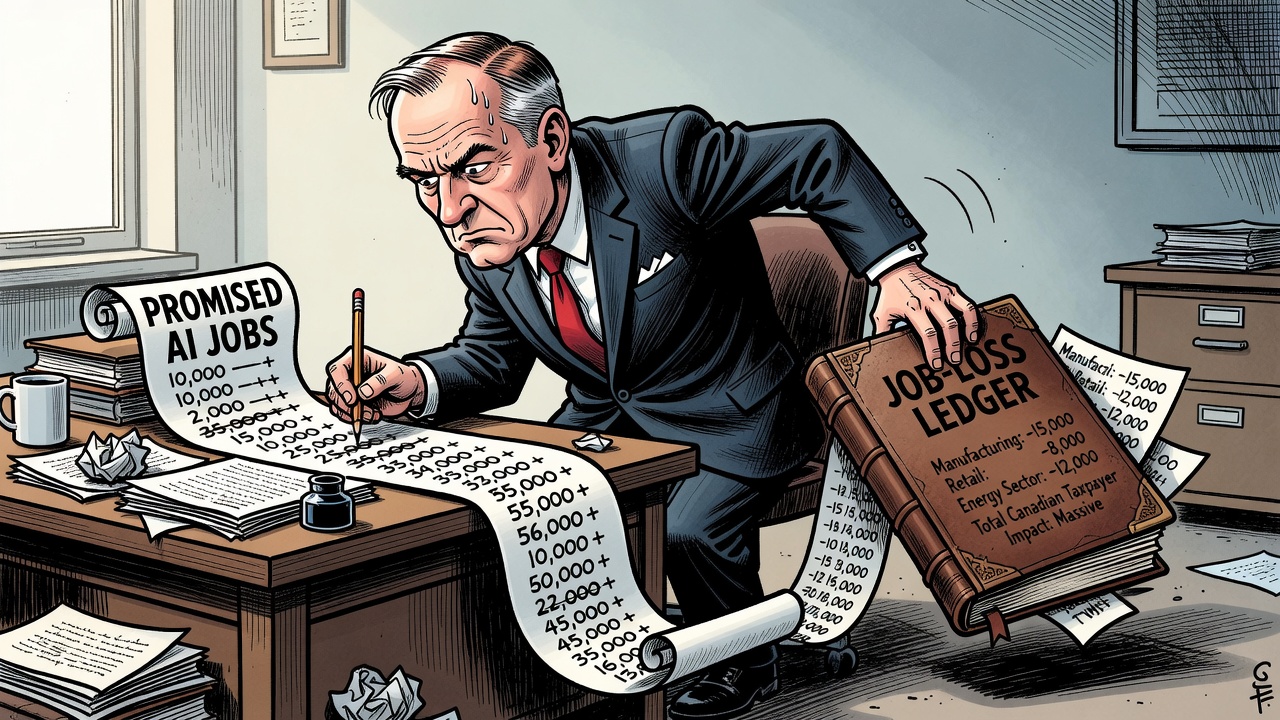
Prime Minister Mark Carney’s new “AI for All” strategy is being sold as protection, productivity and opportunity in one neat package. Ottawa says wider AI adoption could create 250,000 new jobs by 2031, including up to 90,000 AI-related youth jobs or placements. That is the headline the government wants Canadians to remember.
But a serious government cannot count only the jobs it hopes to announce. It also has to count the jobs that may be automated, downgraded, outsourced or squeezed into lower-paid contract work. iPolitics reported that officials did not provide their modelling for potential AI job losses during a technical briefing, even as outside analysis has warned of large displacement under high-adoption scenarios. If the job-growth number is ready for the podium, the job-loss assumptions should be ready for public scrutiny.
The accountability problem is bigger than one statistic. The official release says Ottawa will pursue legislation and programs covering personal-information protection, deepfakes, “surveillance pricing,” social-media and chatbot safety, public AI infrastructure, adoption support and skills pipelines. Some of those goals sound reasonable. Canadians do need protection from fraud, invasive data practices and foreign platform dependence. But broad promises are not guardrails. They are invitations for bureaucrats, consultants and politically connected firms to define the details after the applause fades.
That is why Carney’s AI strategy needs a displacement ledger, a procurement ledger and a rights ledger. The displacement ledger should show, by sector and region, where Ottawa expects AI to create jobs, where it expects losses, what wages are assumed, and what retraining actually costs. The procurement ledger should list vendors, cloud providers, compute contracts, subsidies, pilot projects, conflict screens and data-location rules. The rights ledger should spell out how any online-safety or chatbot regime avoids becoming a speech-control back door dressed up as technological safety.
AP reported Carney warning that foreign AI platforms could be “weaponized” against Canadians because Canadian data, companies and government operations depend heavily on infrastructure outside Canada. That warning may be valid. But sovereignty is not achieved by replacing foreign black boxes with Ottawa black boxes. If the state is going to fund, procure and regulate AI at national scale, Canadians need to see who gets the contracts, whose models are used, where the data sits, and which laws can reach it.
A conservative accountability standard is simple: before Ottawa reorganizes work around AI, publish the receipts. If Carney wants Canadians to trust a five-year AI transformation, he should release the modelling behind the 250,000-job claim, the displacement scenarios, the youth-job assumptions, the procurement plan, and the draft legal safeguards. Competent government does not ask workers to gamble their paycheques on a press release. It shows the math.
- Prime Minister of Canada: Prime Minister Carney launches “AI for All”
- iPolitics: Federal AI strategy counts jobs created but stays silent on ones lost
- Associated Press: Carney and Canada’s AI sovereignty warnings
- Kris Krüg: A skeptical guide to Canada’s AI for All strategy
This article relies on official government claims, mainstream reporting and independent analysis. It argues for publication of modelling, procurement and rights guardrails before Ottawa expands AI spending and regulation.