C-9’s Final Lap: Liberals Accept the Amendment, Ignore the Safeguard
Ottawa is moving Bill C-9 toward final passage with one Senate amendment accepted — while the religious-expression safeguard and postcard transparency questions remain unresolved.
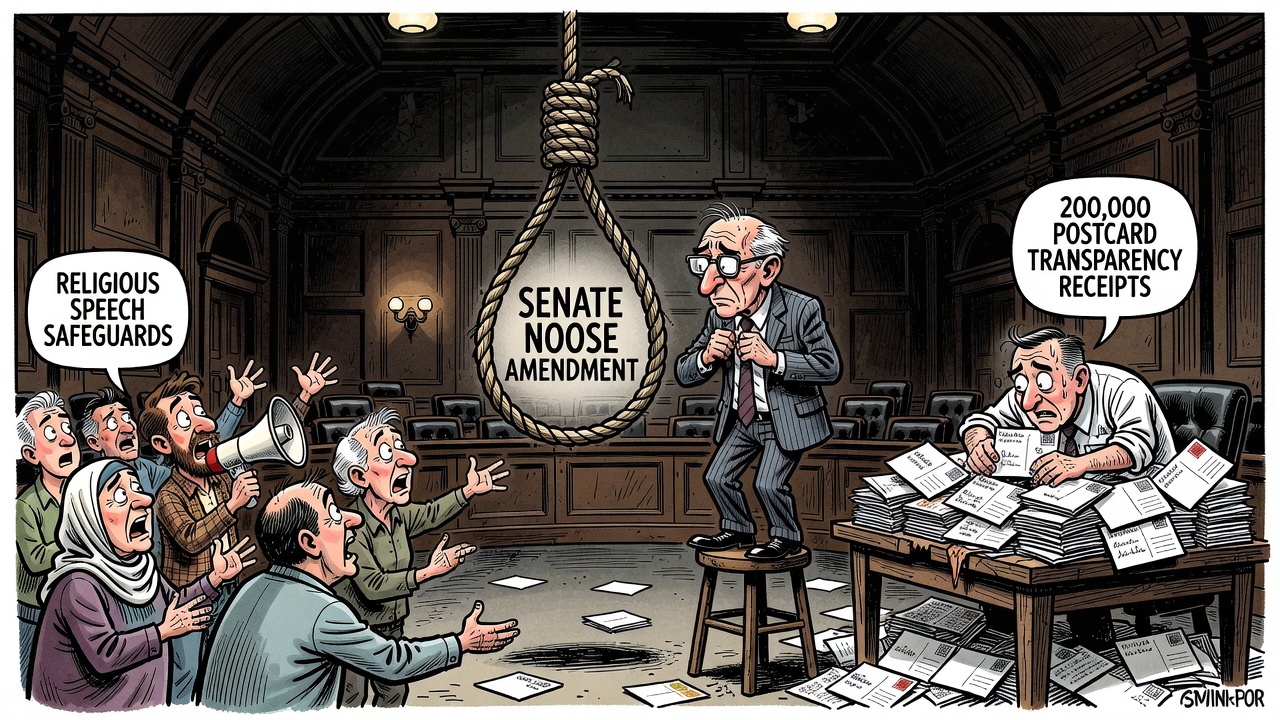
Bill C-9 is now in its final lap. According to iPolitics/Canadian Press reporting on June 8, the Liberal government is prepared to accept the Senate’s single amendment to the anti-hate bill: adding the noose to the bill’s list of prohibited hate symbols. That amendment passed in the Senate on June 4 after Senator Wanda Thomas Bernard argued the noose carries a history of racial terror and intimidation against Black Canadians.
There is a fair case for treating the noose seriously. The Senate record shows the amendment was adopted, and senators heard evidence about nooses appearing at Canadian worksites and other public settings. Conservatives can acknowledge that reality while still asking the harder legislative question: why is Ottawa rushing to accept one fix while leaving other civil-liberties concerns unrepaired?
The unresolved issue is the bill’s treatment of the long-standing “good faith” religious opinion or belief defence in the Criminal Code. Supporters of C-9 argue the Charter and the bill’s wording already protect ordinary religious practice, preaching and debate. But that is not the same as keeping an explicit statutory safeguard in place. Senator Yonah Martin moved an amendment to restore good-faith language for public-interest discussion, publication or debate. The Senate defeated it.
That defeat matters because the government’s answer has largely been: trust us, prosecutors will not misuse it. Trust is not a substitute for clear law. If the Justice Minister is right that ordinary religious practice is not a hate crime, then Parliament should have no problem writing a clean, durable safeguard that says so in plain language. The burden is on the state to draft narrowly when speech, religion and criminal law intersect.
The process problem is just as serious. In a Senate exchange on June 4, Senator Tony Loffreda acknowledged that more than 200,000 Bill C-9 postcards were being kept in a Gatineau warehouse, with samples delivered to senators. He said the administration had initially advised senators of more than 10,000 identical postcards and that the rest were accessible. Opposition senators argued the postcards came from different citizens and should not have been reduced to a sample before senators voted.
That does not prove a conspiracy. It does prove a transparency failure. If Canadians paid to send named, addressed opposition to parliamentarians, the Senate owes a public accounting of how many cards were received, when they arrived, who decided to warehouse them, what senators were told, and whether any senator requested full access before the vote.
Hate crimes are real. Threats against synagogues, mosques, churches, schools and community centres deserve serious law. But serious law must be precise, transparent and trusted. Carney’s Liberals are choosing speed over repair: accept the noose amendment, reject the safeguard, and leave the postcard question hanging. Canadians deserve better than “trust us” legislation on fundamental freedoms.
- iPolitics / Canadian Press: Liberals to accept Senate change to anti-hate bill, paving the way for C-9 to become law — June 8, 2026
- Senate of Canada: Debates, Issue 79 — Bill C-9 third reading and amendments — June 4, 2026
- Senate of Canada: Question Period exchange on Bill C-9 postcards — June 4, 2026
- Western Standard: Senate accused of hiding 200,000 protest postcards opposing Bill C-9 — May 28, 2026
This article does not claim religious texts are banned. The accountability issue is whether Parliament should keep explicit statutory guardrails when expanding hate-speech and hate-symbol offences.