Carney’s Immigration Excuse Exposes the Liberal Growth Mask
Carney says lower immigration helps explain weak topline GDP. That admission exposes how Liberal growth relied on population inflows instead of productivity, housing capacity and private-sector strength.
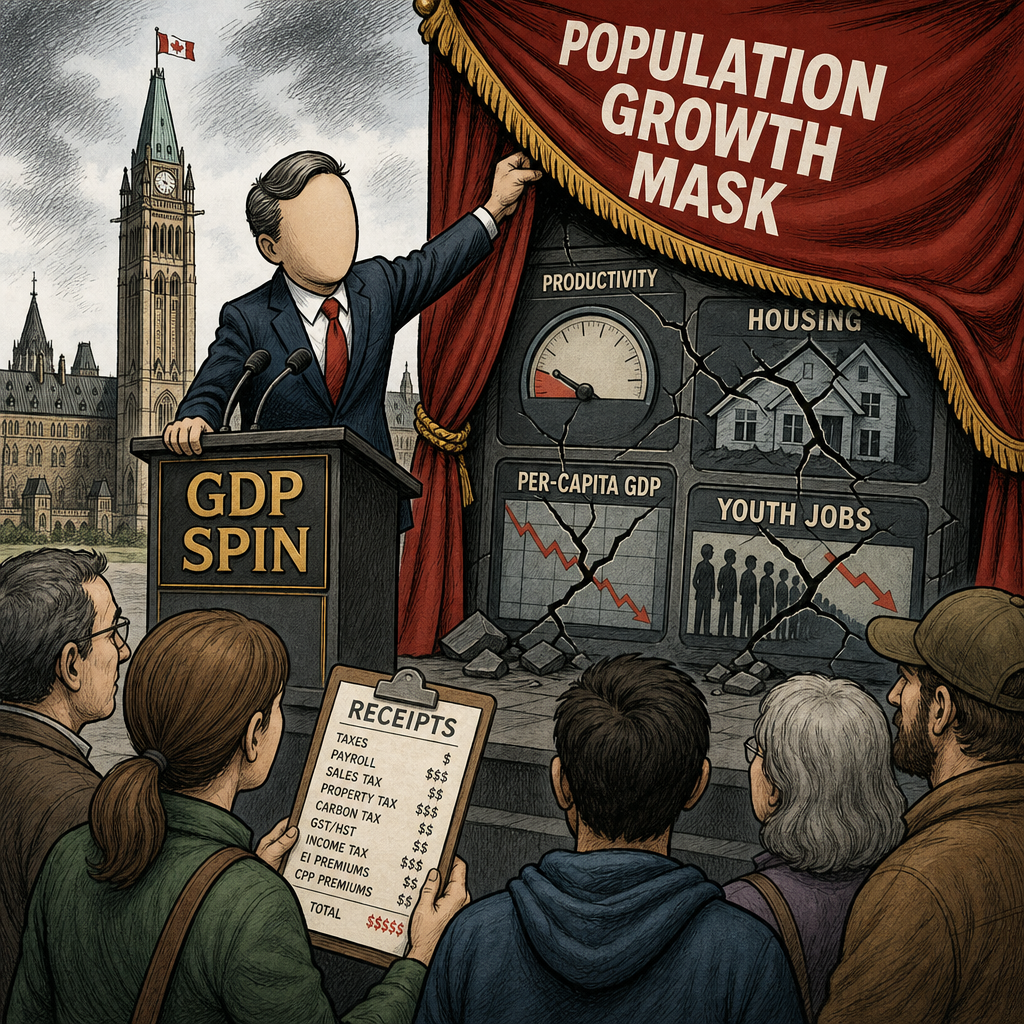
Prime Minister Mark Carney’s newest recession explanation should bother anyone who cares about honest economic accounting. The Canadian Press reported June 4 that Carney said lower immigration under his government helps explain why Canada’s economy has declined for the last two quarters and moved into “recession territory.” He has avoided using the word “recession” himself, while some economists say the broader indicators do not yet justify that label.
Set the label aside. The admission is still revealing. If lower population growth is enough to drag down the headline numbers, then Ottawa’s earlier growth story was weaker than advertised. For years, Liberal governments treated rapid population expansion as proof of economic momentum. More consumers, more renters, more workers and more students could lift total GDP even while ordinary Canadians faced worse housing pressure, weaker per-capita output and a tougher entry-level job market.
The Canadian Press quoted RBC economist Nathan Janzen saying large immigration inflows helped prop up total GDP and employment growth, even as per-capita GDP was declining and unemployment was rising in a way that historically resembled recession conditions. That is the core accountability issue: the headline economy could look “firm” while the kitchen-table economy was already flashing red.
The current data are not comforting. Statistics Canada’s May 29 weekly review said real GDP was unchanged in the first quarter of 2026. Business investment in residential structures fell 2.0 percent, and resale housing activity fell 9.9 percent in the quarter after falling 3.4 percent in 2025 overall. Its March GDP-by-industry release said real GDP edged down 0.1 percent in March, driven by goods-producing industries, while goods output fell 0.8 percent that month.
Meanwhile, Ottawa is now reducing the immigration intake it previously expanded. The government’s 2026–2028 levels plan stabilizes permanent resident admissions at 380,000 a year and sets 2026 temporary-resident arrival targets at 230,000 workers and 155,000 students. CityNews reported those targets mark a major reduction from the earlier 2024 plan, which had projected 500,000 permanent residents in 2026 and did not set a temporary-resident target.
A serious government would treat this as a balance-sheet moment, not a communications problem. If population growth masked structural weakness, Canadians deserve to know what the real engine of growth is supposed to be now: productivity, private investment, exports, housing construction, or another round of government-directed spending. The OECD’s June outlook projects Canada growing 1.2 percent in 2026 and 1.7 percent in 2027, supported in part by household consumption and government defence and infrastructure spending, while warning that downside risks remain.
That is not a plan taxpayers can grade without receipts. Carney should publish a monthly dashboard tracking per-capita GDP, business investment, housing starts, youth unemployment, private-sector job creation, temporary-resident volumes, and infrastructure dollars actually delivered. If lower immigration exposes weakness, the answer is not to blame the adjustment. The answer is to admit the Liberal model leaned too hard on population growth and too little on building an economy Canadians can afford to live in.
- CityNews Toronto / The Canadian Press: How high pandemic-period immigration papered over the cracks in Canada’s economy — June 4, 2026
- ConstructConnect / The Canadian Press: Carney says economic plan “settling in” after Canada enters recession territory — June 3, 2026
- Statistics Canada: The Weekly Review, May 25 to 29, 2026
- Statistics Canada: Gross domestic product by industry, March 2026
- Immigration, Refugees and Citizenship Canada: Supplementary Information for the 2026–2028 Immigration Levels Plan
- OECD: Canada: OECD Economic Outlook, Volume 2026 Issue 1
This article uses “recession territory” as reported by The Canadian Press and distinguishes that from a broad official recession call. The argument is an accountability test based on public comments, official GDP data, immigration targets and OECD projections.