The PBO’s June Reality Check: Higher Deficits, Weaker Growth
Ottawa promised fiscal discipline. The Parliamentary Budget Officer’s new outlook says Canadians should ask for receipts before trusting that story.
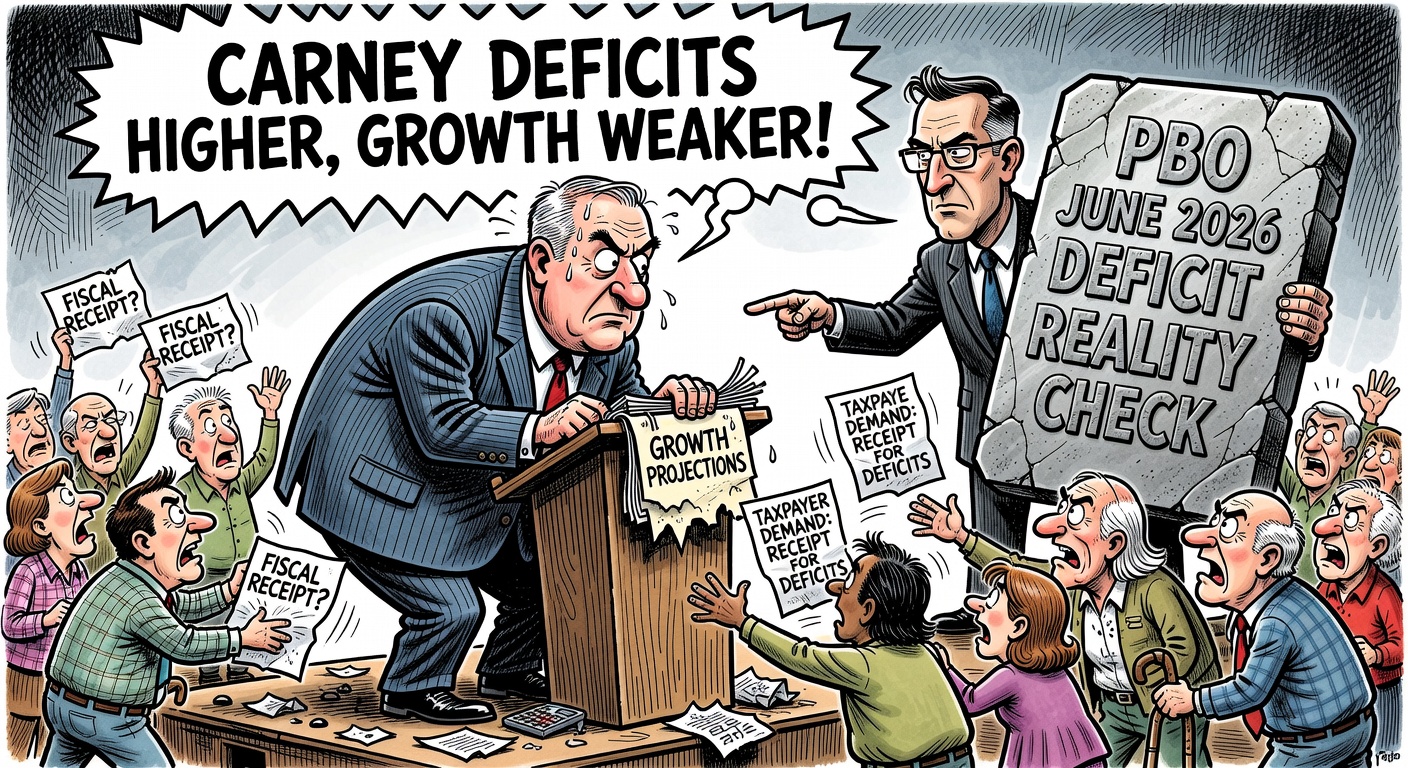
The budget watchdog has handed Prime Minister Mark Carney a simple problem: the numbers do not match the sales pitch.
On June 4, the Parliamentary Budget Officer released its June 2026 Economic and Fiscal Outlook. It is not a partisan memo. It is the office Parliament uses to test federal fiscal claims against economic reality. The headline is hard to spin away: weaker growth, higher deficits, and fiscal anchors that look far less solid once they are stress-tested.
PBO now projects real GDP growth of just 1.1% in 2026 and 1.6% in 2027, assuming the current U.S. tariff environment remains in place. That is not the booming productivity economy Canadians were promised when the Liberals changed leaders and rebranded the same spending instincts as technocratic competence.
That deficit figure matters because Ottawa has spent months telling Canadians that discipline is back. But PBO estimates budgetary deficits will average $4.6 billion per year higher than the government projected in the Spring Economic Update. Canadian Press reported the same point plainly: the budget watchdog sees deeper deficits than Ottawa’s own spring numbers.
The debt-service line is even more revealing. PBO projects public debt charges rising relative to revenues, with the debt service ratio reaching 13.1% by 2030-31. On a per-person basis, debt charges are projected to climb from $1,288 in 2025-26 to $1,885 in 2030-31. That is money unavailable for tax relief, defence readiness, health transfers, housing infrastructure, or basic affordability.
The government’s fiscal anchor is supposed to reassure Canadians that deficits will decline as a share of the economy. PBO’s stress test punctures the comfort. The office estimates the likelihood of the deficit-to-GDP ratio declining in every year from 2026-27 to 2030-31 at less than 1%.
A conservative accountability standard does not require pretending every deficit is identical or every public investment is waste. It requires honesty about trade-offs. If Carney wants to borrow for capital projects, publish the project list, timelines, private-sector risk sharing, and expected returns. If Ottawa claims operating spending will balance with revenues by 2028-29, publish the department-by-department savings plan and the service impacts. If new spending is necessary, stop burying it under branding exercises and show taxpayers what results they are buying.
The June PBO report is a fiscal credibility test. Carney did not inherit a blank page. He inherited a Liberal government addicted to announcements, then added new promises on top. Canadians do not need another lecture about confidence. They need receipts: deficits, debt charges, growth assumptions, and proof that today’s borrowing will not become tomorrow’s tax bill.
- Parliamentary Budget Officer: Economic and Fiscal Outlook – June 2026
- Parliamentary Budget Officer: Updated outlook projects weaker growth and higher deficits
- Canadian Press via CityNews Halifax: Budget watchdog forecasts deeper deficits than Ottawa projected in spring update
This article argues for public fiscal receipts and defensible spending trade-offs. It relies on the Parliamentary Budget Officer’s June 2026 baseline projection and related Canadian Press reporting.