CMHC Just Punctured Carney’s Housing Shortcut
Cutting development charges may help some projects get built. CMHC’s own math says it is not enough — and taxpayers deserve the ledger before Ottawa sells a fee cut as an affordability cure.
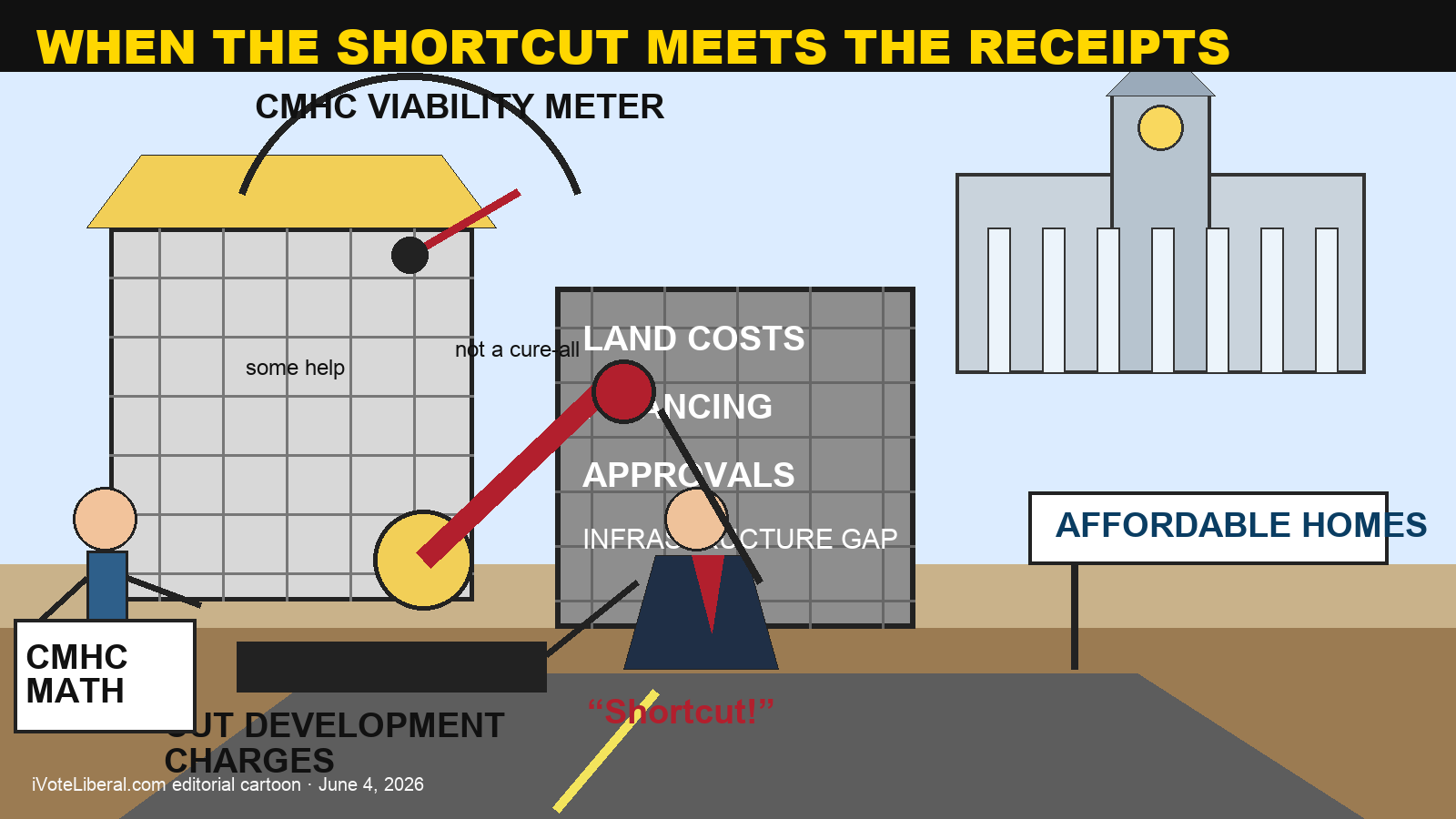
The Carney government has found a housing lever it likes: cut municipal development charges and argue that lower upfront fees will unlock more building. CMHC’s new analysis does not say that lever is useless. It says something more politically inconvenient: the lever is limited, uneven, and nowhere close to a cure-all.
Canadian Press reported on June 3 that the federal government is spending billions to encourage municipalities to cut development fees in half. The sales pitch is simple enough. Development charges get built into new-home costs, so reducing them should make some projects easier to finance and some homes cheaper to deliver.
But CMHC’s official explainer puts numbers around the promise. Development charges can add $40,000 to $100,000 or more to the price of a single home. In some cities, CMHC says they can account for 8% to 16% of a new home’s price. That is real money. It is also not the whole housing crisis.
That distinction matters because Ottawa’s housing politics often treats one headline intervention as if it can substitute for a full plan. Canada does not have a fee-only housing problem. It has land costs, financing costs, approval delays, labour constraints, infrastructure bottlenecks and tax burdens layered on top of each other. If the government wants to claim that fee relief will materially restore affordability, it should publish the city-by-city math.
There is another receipt missing: the municipal infrastructure bill. Development charges are not a random nuisance fee. CMHC notes that they help pay for growth-related infrastructure. If Ottawa pressures cities to cut or eliminate those charges, somebody still has to pay for pipes, roads, transit, sewers, parks and community facilities. If that cost moves from buyers of new homes to federal taxpayers, provincial taxpayers or property-tax payers, Canadians deserve to see the transfer honestly.
A conservative accountability test is straightforward. First, publish how many additional units each dollar of fee relief is expected to make viable in each market. Second, require municipalities and builders to show whether savings are passed through to buyers or absorbed elsewhere in project spreadsheets. Third, identify who fills the infrastructure funding gap before the announcement, not after the ribbon-cutting.
CMHC has not blown up the case for reducing development charges. It has blown up the case for pretending that a fee cut is a magic door to affordability. If Carney wants taxpayers to underwrite this shortcut, he should show the ledger: dollars spent, units unlocked, buyer savings delivered, and infrastructure costs shifted. Anything less is another housing announcement asking Canadians to applaud before they see the bill.
- Canadian Press via CityNews: Slashing development fees is not a cure-all for housing affordability: CMHC
- CMHC: Development charges make new homes more expensive in Canada
- CMHC / CNW: Cutting development charges could make up to 14% more housing projects viable
- Prime Minister of Canada: Canada-Ontario partnership to cut development charges and boost supply
This article argues for public cost, viability and pass-through reporting. It does not argue that development charges are irrelevant; CMHC says they matter, but are not sufficient on their own to restore affordability.