Liberals Won’t Split Bill C-22. That Is the Accountability Story.
After weeks of privacy and encryption warnings, the Carney government is refusing the simplest accountability test: let Parliament vote separately on Bill C-22’s most controversial surveillance powers.
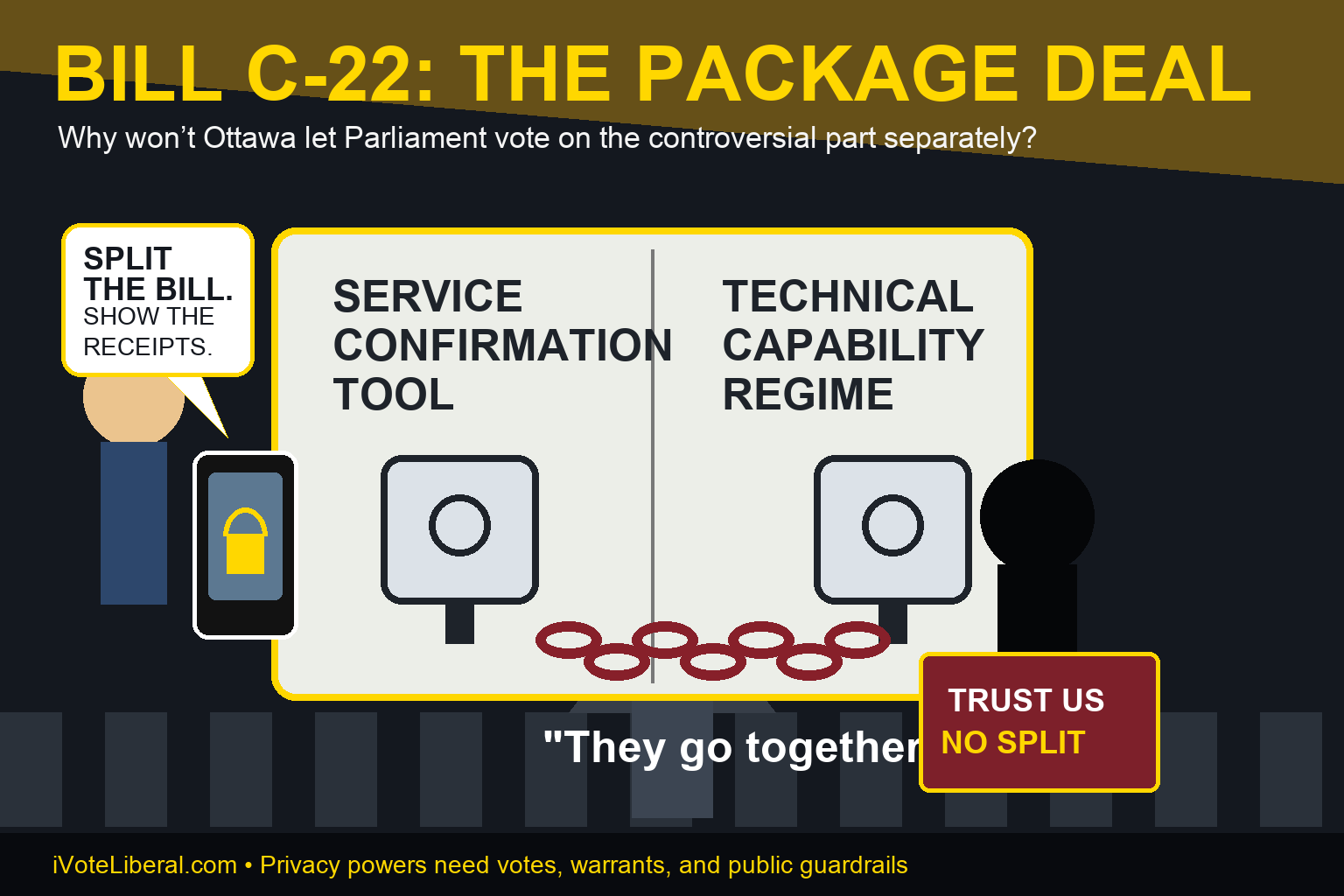
Canadian Press reported on June 3 that Public Safety Minister Gary Anandasangaree rejected a Conservative request to split Bill C-22. His explanation was blunt: the two parts “go together,” and the Liberals are “not prepared to split that bill.” That is the story.
Parliament’s LEGISinfo page lists C-22, the Lawful Access Act, 2026, as a government bill sponsored by the public safety minister and now before a House committee. In plain English, the bill joins two very different political questions. One part would let authorities require telecoms to confirm whether they provide service to a person, account or number of interest. The other would require electronic service providers to maintain technical capabilities so police and CSIS can obtain communications or information when they have legal authority.
The problem is not that police should never get lawful access. Conservatives should be serious about public safety. The problem is that serious lawmaking does not bundle a narrower subscriber-confirmation tool together with a broad technical-capability regime, then tell MPs the package cannot be separated.
That refusal matters because encryption, metadata and compelled technical orders are not small administrative details. CP reported that Meta warned the provisions could force capabilities that weaken encryption or install government spyware. Civil-liberties critics have also warned that the bill needs major narrowing. The government may disagree with those warnings, but disagreement is not a reason to deny Parliament a clean vote.
If the less controversial policing tool is defensible, pass it on its own. If the technical-capability regime is defensible, put it in front of Canadians as its own bill, with explicit encryption protections, strict warrant standards, narrow data definitions, public reporting, sunset clauses and independent audits.
Instead, the Liberals are asking Canadians to trust the same political class that keeps expanding state power first and explaining the guardrails later. That is backwards. Privacy rights should not depend on press-conference reassurance. They should be written into law, tested by committee, and voted on line by line.
Bill C-22 can still be fixed. But the first repair is obvious: split the bill. If Ottawa will not separate policing confirmation from surveillance infrastructure, Canadians should assume the package deal is the point.
- Canadian Press via CityNews: Liberals say they won’t split off controversial section of lawful-access bill
- Parliament of Canada LEGISinfo: Bill C-22, Lawful Access Act, 2026
- Government of Canada: Lawful access explainer
- Canadian Civil Liberties Association: CCLA and Citizen Lab researchers release detailed analysis of Bill C-22’s many flaws
This article argues for separation, statutory guardrails and public accountability. It does not claim Bill C-22 creates warrantless direct access where the government says legal authorization is required.