The $600M Streaming-Tax Retreat
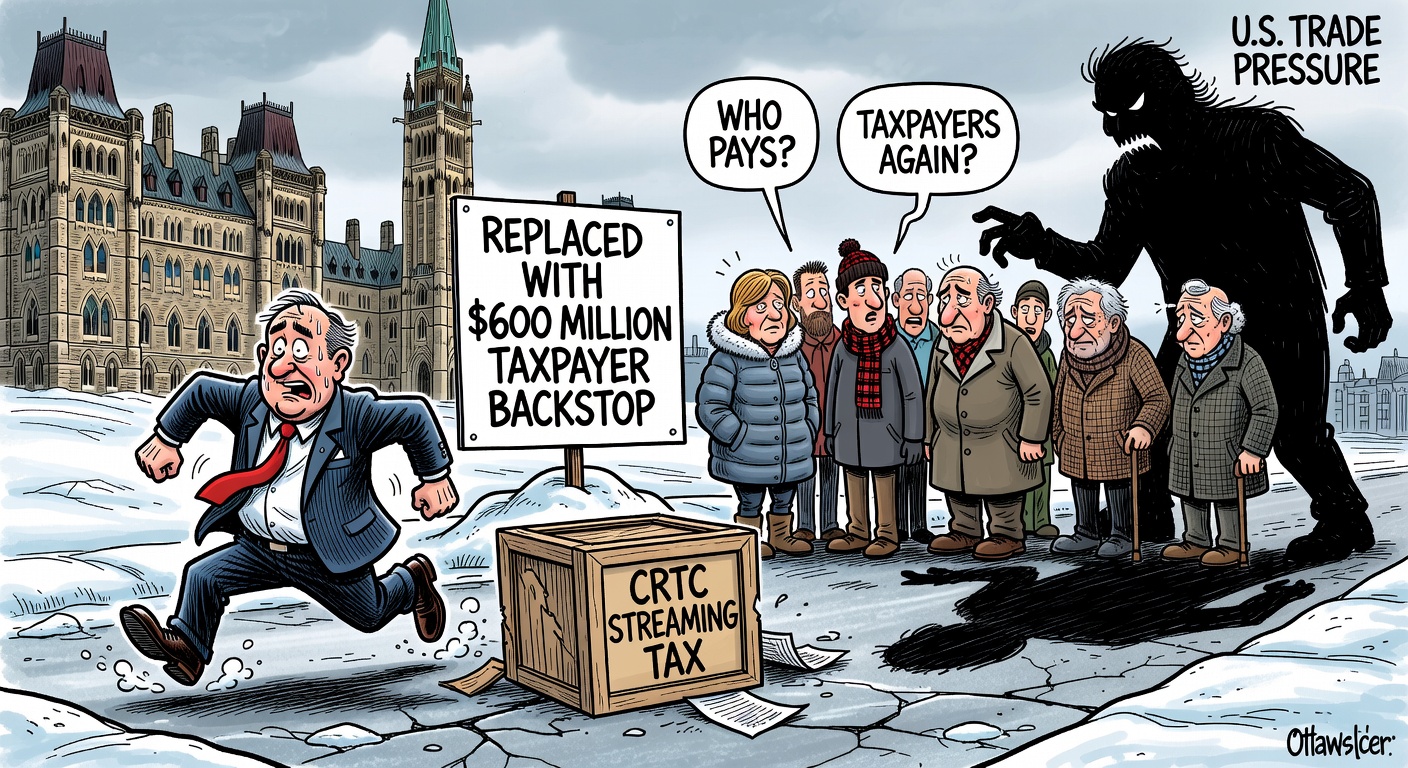
Ottawa is telling the CRTC to rethink a 15 percent streamer contribution rule while replacing the expected money with a taxpayer backstop. Canadians need the ledger.
Jasmin Laine’s June 3 breakdown connects the Commons exchange, the CRTC reversal, and the taxpayer backstop question in one place.
Ottawa’s streaming-tax retreat should not be allowed to disappear into the usual fog of policy language. On June 3, Canadian Press reported that Culture Minister Marc Miller said the government would direct the CRTC to change course on its recent decision increasing large streamers’ required Canadian-content contributions, and would instead put $600 million into the sector.
The problem is not complicated: the Liberal government built the Online Streaming Act machinery, the regulator used that machinery, the cost warning became politically inconvenient, and now taxpayers may be asked to finance the retreat. Prime Minister Mark Carney defended the move as an affordability measure, saying this is not the time to raise costs for Canadians. That is a revealing admission. If the CRTC rule could ultimately flow through to consumer prices, why did Ottawa let the process get this far before hitting the brakes?
The CRTC’s May 21 decision set a modernized Canadian programming expenditure framework. For unaffiliated online streaming services operating in Canada with at least $25 million in annual Canadian broadcasting revenues, the requirement was 15 percent of Canadian broadcasting revenues, including the earlier five percent base contribution. The commission framed it as support for Canadian and Indigenous programming, French-language programming, official-language minority communities, news and other policy goals.
Those goals can be debated. What cannot be waved away is who pays. Streamers do not absorb unlimited regulatory costs out of civic generosity. Costs can be passed to subscribers, pulled from programming budgets, shifted into reduced investment, or converted into a new trade irritant. Canadian Press reported that the Motion Picture Association had called on cabinet to reconsider and that the U.S. ambassador had called for the policy to be rescinded. Miller acknowledged the U.S. trade issue was part of the context, though not the only reason.
So now Ottawa says it wants a more “reasonable” rate and a $600 million annual funding plan, including money for existing funds and a new fund for services of exceptional importance. That may calm some industry players, but it creates a new conservative accountability test: is this actually affordability, or just a transfer from monthly streaming bills to the federal taxpayer?
Canadians need a plain ledger before ministers take a victory lap. Publish the estimated consumer cost of the 15 percent rule. Publish the expected contribution lost by changing course. Publish the source of the $600 million, every recipient fund, every eligibility rule, and every administrative cost. Publish whether cabinet is changing policy because the rule was bad, because consumers noticed, or because Washington noticed.
Carney cannot claim affordability while quietly moving the bill from one pocket to another. If the streaming tax was too costly for subscribers, the replacement subsidy must be justified to taxpayers with the same seriousness. The Liberal government created the system. Now it owes Canadians the receipt for unwinding it.
- Jasmin Laine / YouTube: “I Saved Canada!” — Mark Carney Visibly Rattled as Poilievre Reads the Receipt In Parliament — June 3, 2026
- Global News / Canadian Press: Ottawa orders CRTC review of streamer spending rules, citing consumer cost — June 3, 2026
- Brandon Sun / Canadian Press: Ottawa tells CRTC to change course on increasing streamers' financial contributions — June 3, 2026
- CRTC: Broadcasting Regulatory Policy CRTC 2026-96 — May 21, 2026
This article relies on Canadian Press reporting for Ottawa’s June 3 announcement and the official CRTC decision for the 15 percent Canadian programming expenditure framework.