Carney’s “Settling In” Recession Test
Canada’s economy has slipped into technical-recession territory while Mark Carney says the plan is “settling in.” Canadians deserve receipts, not reassurance.
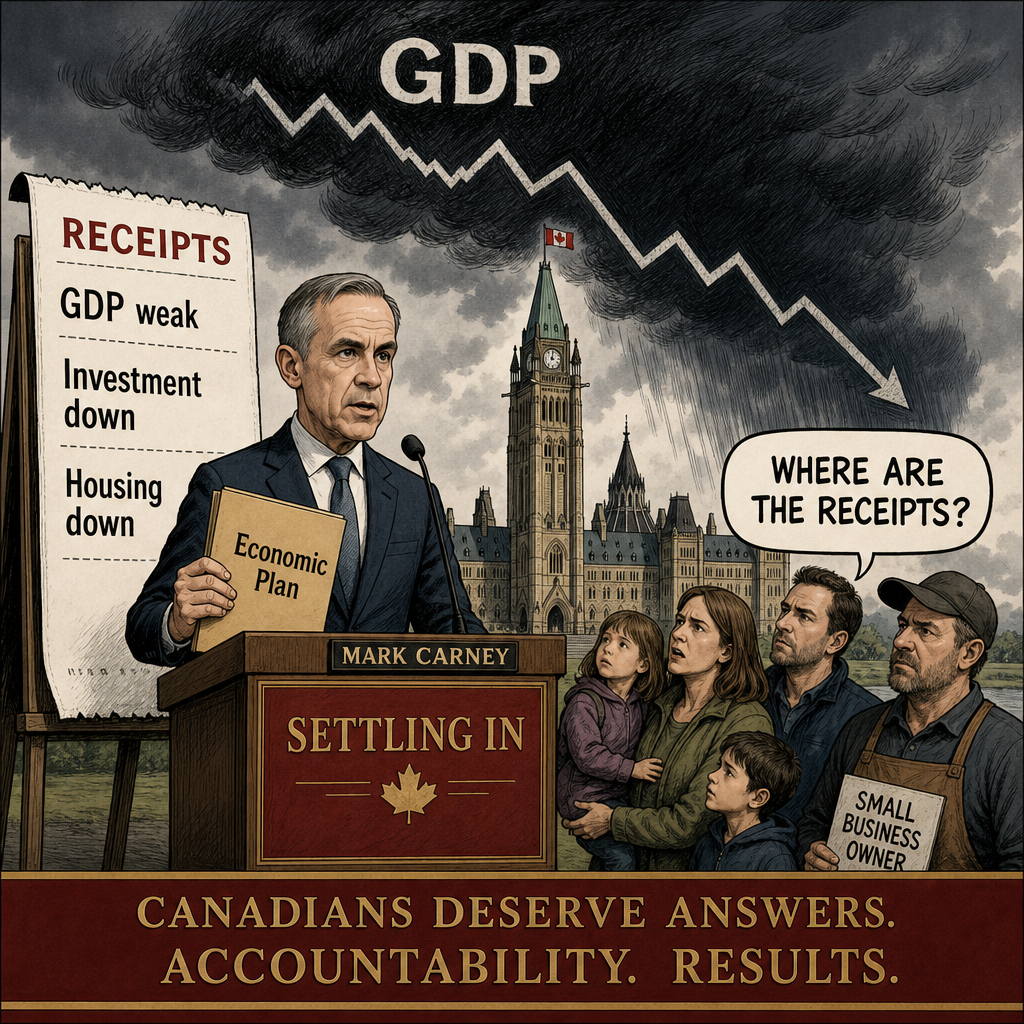
Prime Minister Mark Carney’s first answer to Canada’s latest economic weakness was not a straight yes or no. It was a process answer. After Statistics Canada released first-quarter GDP figures and reporters asked whether Canada was in a recession, Carney said the government’s plan for a stronger and more independent economy was “settling in,” that the data would be “uneven,” and that Ottawa sees “some weakness” partly because of government decisions.
That is the line Canadians should remember. Not because every economist agrees Canada is in a full recession — several have cautioned that the word depends on more than one GDP indicator — but because the government’s own explanation admits policy choices are now weighing on growth. When a prime minister marketed as a crisis manager says weakness is part of the plan settling in, taxpayers are entitled to ask for the receipts.
The official data are not campaign talking points. Statistics Canada reported on May 29 that real GDP by expenditure was unchanged in the first quarter of 2026 after declining 0.2 percent in the fourth quarter of 2025. Business capital investment fell 0.7 percent, marking a fifth consecutive quarterly decline. Residential investment fell 2.0 percent after a 2.4 percent drop in the previous quarter, led by weakness in resale housing activity.
Global News reported the annualized GDP figure contracted 0.1 percent in the first quarter, while the fourth quarter of 2025 was revised to a 1.0 percent decline. That is why the phrase “technical recession” is now in the public debate: two back-to-back quarters of annualized contraction meet one common benchmark, even if central bankers and private economists warn against reducing the whole economy to a single label.
Fine. Then do not argue over the label. Audit the damage. If Ottawa wants credit for reducing immigration levels and trimming government spending, it also has to own the transition costs in jobs, housing, investment and household affordability. For years, Liberal growth strategy leaned heavily on rapid population expansion, federal spending and asset inflation. Now Carney is telling Canadians the pivot will take time and the numbers may be uneven. That is not reassurance. That is an admission that the old model left the country vulnerable.
A conservative accountability test is simple: publish the dashboard. Show quarterly targets for business investment, private-sector job creation, housing starts, resale activity, per-capita GDP, youth unemployment, insolvencies and food-bank demand. Show which weakness comes from deliberate policy choices, which comes from U.S. tariffs, and which comes from years of Ottawa masking low productivity with debt and population growth.
Carney does not need to manufacture panic. But he also should not hide behind technocratic fog while families face higher costs, young workers compete for fewer entry-level openings, and investors pull back. If the plan is merely “settling in,” Canadians deserve to see where it settles: into renewed private-sector growth, or into a government-managed slowdown with a better slogan.
The country does not need recession spin. It needs economic receipts — public, measurable and updated before Ottawa asks Parliament for another round of borrowing, subsidies or emergency-style powers. Competence is not a biography. It is performance under pressure. Right now, the numbers are pressure.
- Statistics Canada: Gross domestic product, income and expenditure, first quarter 2026 — May 29, 2026
- CityNews Toronto / Canadian Press: Carney says economic plan “settling in” after Canada’s economy shrinks — June 2, 2026
- Global News: Is Canada in recession? “We see some weakness,” Carney says — June 2, 2026
This article describes Canada as being in technical-recession territory, not as an officially declared broad-based recession. The accountability test is based on official GDP, investment and housing figures and Carney’s public comments.