Buy Canadian Needs a Receipt Test
Carney sold Buy Canadian as industrial patriotism. New reporting on foreign-owned eligibility means taxpayers need ownership, labour, content and waiver receipts before contracts move.
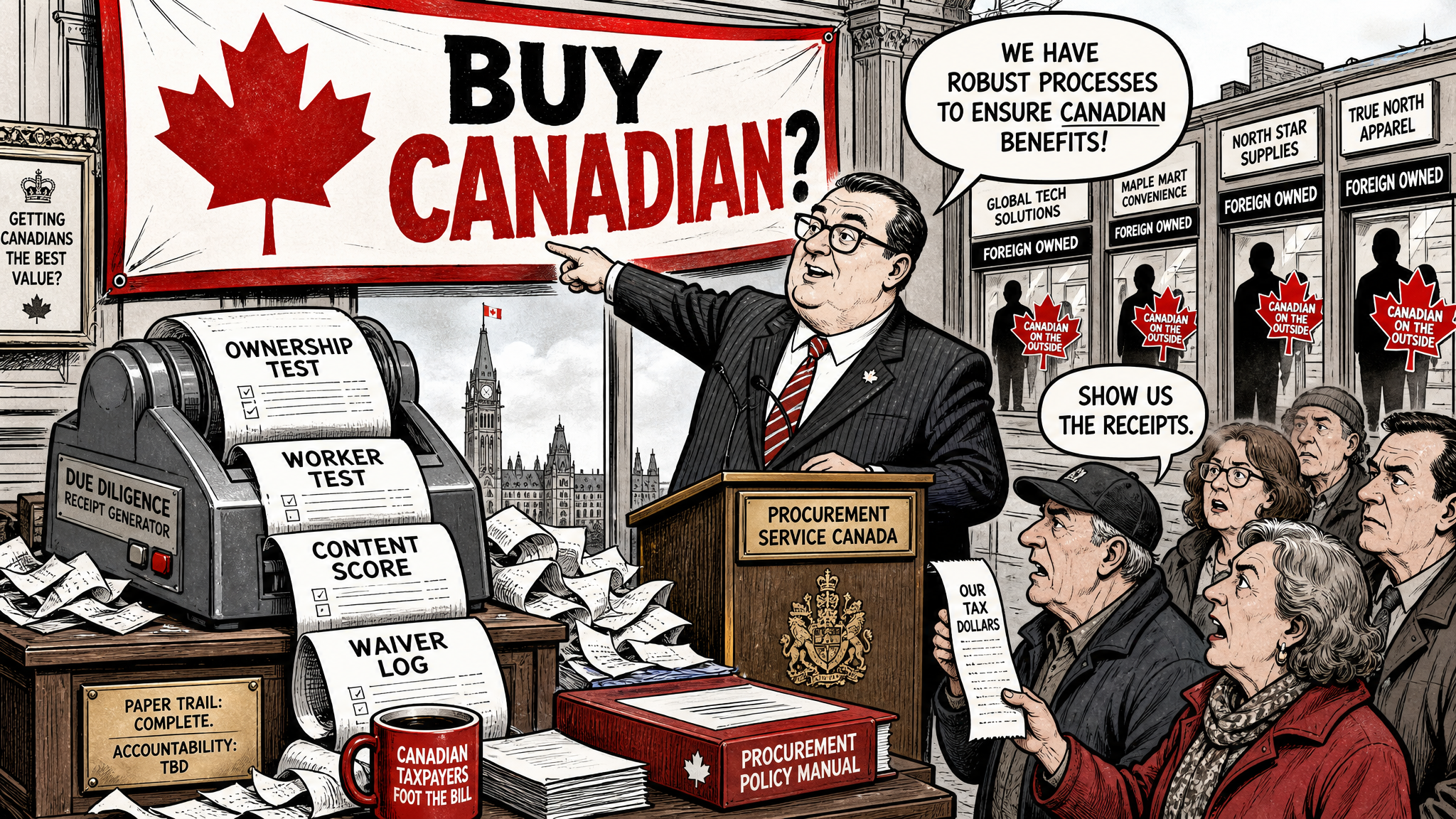
Prime Minister Mark Carney sold Buy Canadian as a promise that federal purchasing would protect Canadian workers, strengthen Canadian industries and build domestic resilience. That is exactly why the definition now matters. A procurement slogan is not an industrial strategy unless taxpayers can see who qualifies, why they qualify and where the money actually goes.
The government’s own baseline is clear. On September 5, 2025, Carney announced a Buy Canadian Policy to ensure Ottawa buys from Canadian suppliers, requires local content when domestic suppliers are unavailable, and extends the approach across federal funding streams and Crown corporations. Public Services and Procurement Canada now says the policy is meant to protect and prioritize Canadian workers and industries, and to strengthen the domestic economy.
CanadaBuys says the framework took effect on December 16, 2025, and is supposed to prioritize Canadian suppliers, materials and content in federal procurement. Its strategic procurement policy defines a Canadian supplier as one with a permanent place of business in Canada, Canadian tax filing, a registered Canadian address and personnel or day-to-day business activity in Canada. It also says contracting authorities must document the rationale and evidence for supplier decisions.
That is the accountability opening. Blacklock’s Reporter reported on May 27 that federal managers confirmed the policy can benefit 100 percent foreign-owned corporations with storefront operations in Canada, and that they could not say whether a company hiring temporary foreign workers would qualify. That public summary does not prove wrongdoing by any contractor. It does prove the policy needs a harder public receipt test before Ottawa markets every qualifying contract as a win for Canadian workers.
Because “Canadian supplier” and “Canadian benefit” are not the same thing. A foreign-owned company can have an office, file taxes, employ some staff and still send profits, strategic control and major supply-chain value elsewhere. A contractor can perform some day-to-day activity in Canada while relying on imported inputs, offshore subcontracting or low-wage temporary labour. Those may sometimes be lawful and even necessary. But they should not be hidden behind a maple-leaf sticker.
The fix is not complicated. Publish the eligibility definition in plain English. Publish a running waiver and exception log. Publish the contract list, supplier ownership, Canadian labour share, Canadian materials or content score, subcontracting plan and temporary-foreign-worker rule. If ministers approve exceptions for cost, public interest, capacity, delay or off-the-shelf products, publish the reason and the approving minister.
Carney’s government wants the political credit for economic nationalism. Fine. Then it must accept the burden of proof. Canadians are not asking Ottawa to buy worse products at any price. They are asking Ottawa not to use patriotic branding to disguise ordinary global procurement, insider contracting or paper-thin storefront compliance.
Buy Canadian should mean measurable Canadian benefit: Canadian workers, Canadian production, Canadian supply chains, Canadian intellectual property, Canadian taxes and transparent exceptions when Ottawa cannot meet that standard. Anything less is not procurement patriotism. It is a slogan looking for a receipt.
- Blacklock’s Reporter: More “Buy Canadian” Waivers — May 27, 2026
- Prime Minister of Canada: Prime Minister Carney launches new measures to protect, build, and transform Canadian strategic industries — September 5, 2025
- Public Services and Procurement Canada: Buy Canadian — updated June 2, 2026
- CanadaBuys: Buy Canadian Procurement Policy Framework
- CanadaBuys: Policy on Prioritizing Canadian Suppliers and Canadian Content in Strategic Federal Procurements
This article relies on the public Blacklock’s summary for the May 27 news hook and government pages for the policy framework, definitions, thresholds and exception requirements.