Show Up for the Receipts: Carney’s Question Period Absence Is the Accountability Story
During economic weakness, the Prime Minister should be in the House answering MPs — not treating Parliament’s central accountability forum as optional.
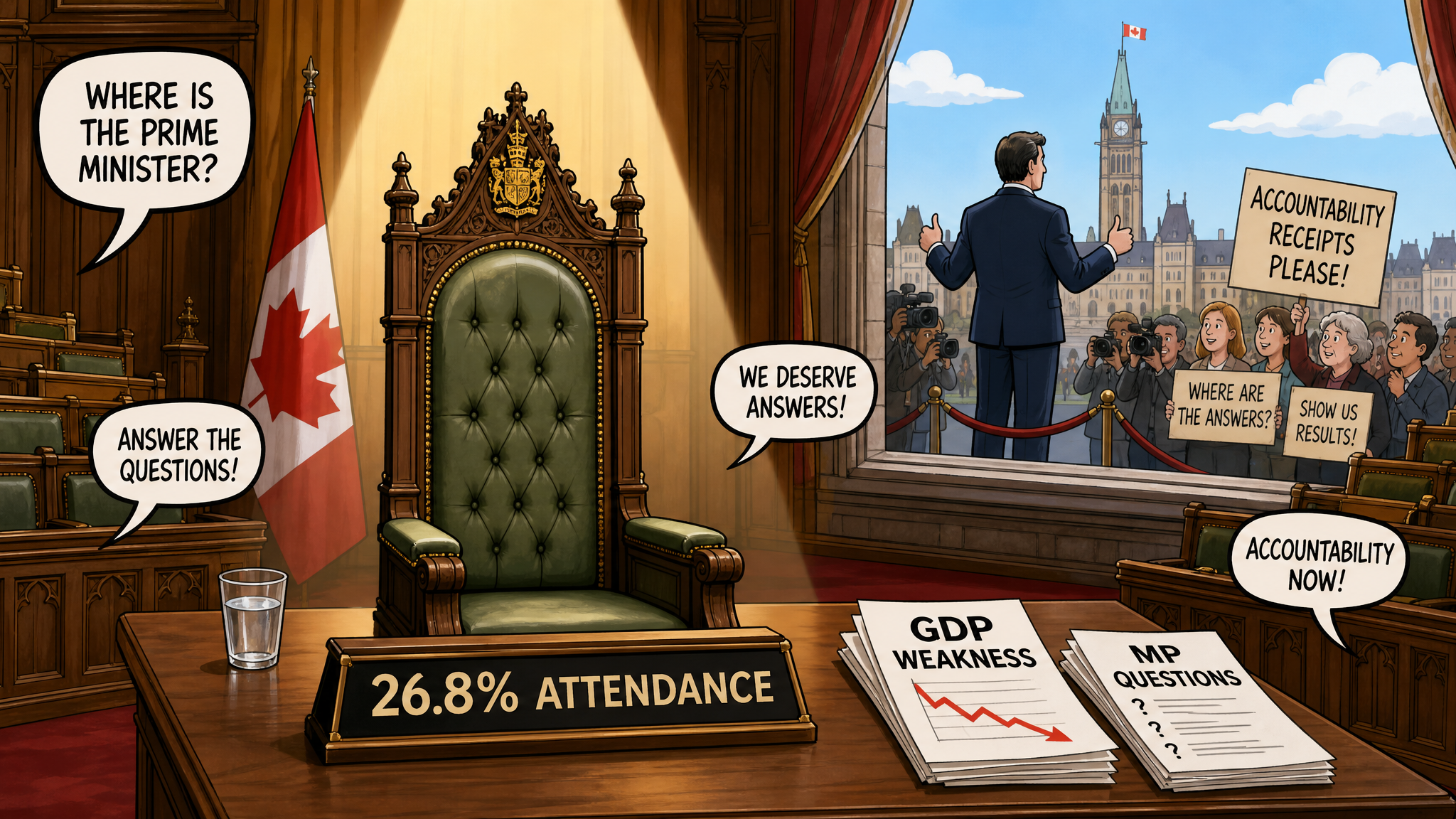
Mark Carney’s defenders can argue that prime ministers have busy schedules. They can say ministers should carry more of the load. They can complain that Question Period is repetitive, theatrical and designed for clips. Some of that may be true. None of it answers the basic accountability problem: the prime minister is supposed to show up when elected MPs question the government.
Global News chief political correspondent David Akin reported on June 1 that Monday’s Question Period was the 123rd of the current Parliament and that Carney had been present for just 33 of them — 26.8 per cent. Akin compared that with Justin Trudeau at 51 of his first 123 question periods, or 41.5 per cent, and Stephen Harper at 80 of 123, or 65 per cent.
The timing makes the absence harder to defend. On Monday, as MPs gathered in the House of Commons, Global News reported Carney was in his riding at a housing-development photo op. That came after Statistics Canada GDP figures showed the economy contracted in the first quarter of 2026 and the previous quarter was revised lower. Economists can debate whether “technical recession” is the right label. Parliament does not need to debate whether the prime minister should answer questions when confidence in the economy is weakening.
Carney’s own explanation has been revealing. Global News quoted him saying on April 22, “I answer questions all the time,” while defending the use of ministers, secretaries of state and parliamentary secretaries to respond. But that is not the same thing as direct prime ministerial accountability. Cabinet government matters, but the prime minister is the person selling the economic plan, asking for trust and setting the direction.
The bigger issue is not only attendance. Akin reported that Carney has generally restricted himself to answering recognized party leaders or proxies in the informal “leader’s round.” That means, according to the analysis, he had not answered a question from an NDP MP because the NDP is not officially recognized. If accurate, that is a choice, not a rule. A prime minister who wants better questions can answer serious questions from any MP and reward substance over theatre.
On Tuesday, Carney told reporters there is “some weakness” in the economy and said government decisions are still settling in. Fine. Then show up for the receipts. Canadians do not need another lecture about process while the prime minister treats the central parliamentary accountability forum as optional.
The conservative accountability test is simple: publish the full Question Period attendance record, commit to a weekly prime minister’s accountability session, answer questions beyond the leaders’ round, and stop using photo ops as a substitute for Parliament. If the economy is merely “uneven,” Carney should be able to defend the plan. If it is worse than that, Canadians need him in the House even more.
A prime minister does not strengthen democracy by avoiding the room built to hold him accountable. He strengthens it by standing there, taking the questions, and putting the receipts on the table.
- Global News analysis: ANALYSIS: In skipping so many question periods, Carney dodges accountability — June 1, 2026
- Global News video: “Where is he anyway?”: Poilievre says Carney not answering questions after Canada hits recession — June 1, 2026
- Global News: Is Canada in recession? “We see some weakness,” Carney says, touts “process” — June 2, 2026
This article relies on Global News reporting and distinguishes the GDP/recession debate from the separate institutional accountability question of whether the Prime Minister should answer MPs directly in Question Period.