Carney’s Buy Canadian Defence Plan Needs Procurement Receipts
If Ottawa is going to redirect defence buying toward preferred domestic firms, Canadians need hard guardrails before the contracts, lobby meetings and subsidy cheques start moving.
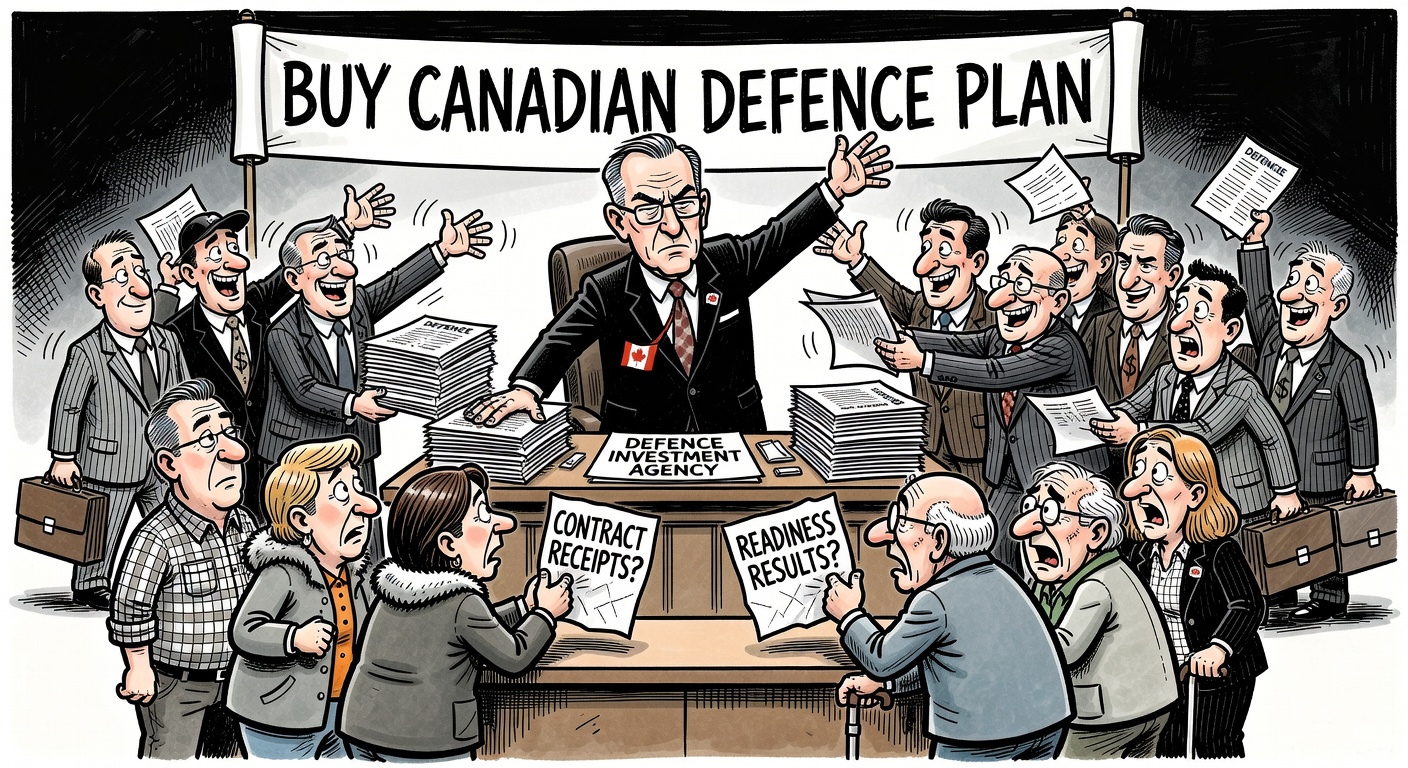
Mark Carney’s new defence pitch has the right words: sovereignty, readiness, Canadian jobs, faster procurement. But after years of Ottawa procurement messes, slogans are not enough. A Buy Canadian defence plan needs a public receipt test before it becomes another insider contracting machine.
The plan is not small. Global News and The Canadian Press reported Carney’s Buy Canadian defence strategy as a $6.6-billion plan to grow Canada’s domestic defence industry, reduce reliance on foreign suppliers, and raise domestic defence procurement from roughly one-third of Canada’s needs to about 70 per cent. The government also says the strategy will increase defence exports by 50 per cent and create up to 125,000 jobs over the next decade.
The official strategy goes further. Ottawa says the new Defence Industrial Strategy will prioritize Canadian suppliers and materials, streamline procurement, and use a “build-partner-buy” framework: build in Canada where possible, partner with allies where useful, and buy abroad only when necessary under conditions that flow benefits back into Canada. The centrepiece is the Defence Investment Agency, meant to cut red tape, coordinate industry engagement and speed delivery to the Canadian Armed Forces.
That may be a necessary shift. Canada cannot defend Arctic sovereignty, rebuild military readiness or protect supply chains if it cannot procure equipment on time. Domestic capacity matters. So do small and medium-sized Canadian firms that have been locked out by slow, complex purchasing systems.
But “faster” is not automatically “cleaner.” A new agency, preferred domestic suppliers, strategic partners and defence-industry forums create exactly the environment where lobbying, sole-source pressure and political favouritism can hide behind national-security language. Conservatives should not oppose stronger defence capacity; they should insist that every dollar is tied to readiness, value and transparent rules.
Ottawa should publish the guardrails now. Canadians should see the eligibility definition for “Canadian” firms, beneficial ownership checks, foreign-control screens, lobbyist meeting logs, conflict-of-interest declarations, contract type, delivery milestones, regional distribution, Indigenous and SME access, and the reasons any sole-source award is justified. If a company is selected as a strategic partner, the scoring criteria and ministerial contacts should be public.
The most important metric is not how many press releases mention jobs. It is whether soldiers, sailors and aviators receive working equipment faster. The strategy itself sets readiness-linked targets, including higher serviceability for maritime, land and aerospace fleets. Those targets should be reported quarterly, beside contract spending and delivery performance.
Buy Canadian can be a serious sovereignty policy, or it can become patriotic branding for politically connected procurement. Carney is asking taxpayers to trust a bigger, faster defence-buying machine. Fine. Then publish the machine’s wiring: who gets access, who gets contracts, who lobbied, what was delivered, when it arrived, and whether it actually made Canada safer.
- Global News / The Canadian Press: Carney unveils “Buy Canadian” defence plan, says security can’t be a “hostage” — February 17, 2026
- Prime Minister of Canada: Prime Minister Carney launches Canada’s first Defence Industrial Strategy — February 17, 2026
- Government of Canada: Security, Sovereignty and Prosperity: Canada’s Defence Industrial Strategy — February 2026
This article argues for defence-procurement transparency. It does not oppose rebuilding Canadian defence capacity; it asks Ottawa to prove value-for-money, readiness outcomes, fair access and conflict safeguards before contracts flow.