The Sovereign AI Receipts Test: Carney’s Cloud Dependence Problem
Before Ottawa sells Canadians another “sovereign AI” strategy, it should publish the vendor, data-location and foreign legal-exposure receipts underneath it.
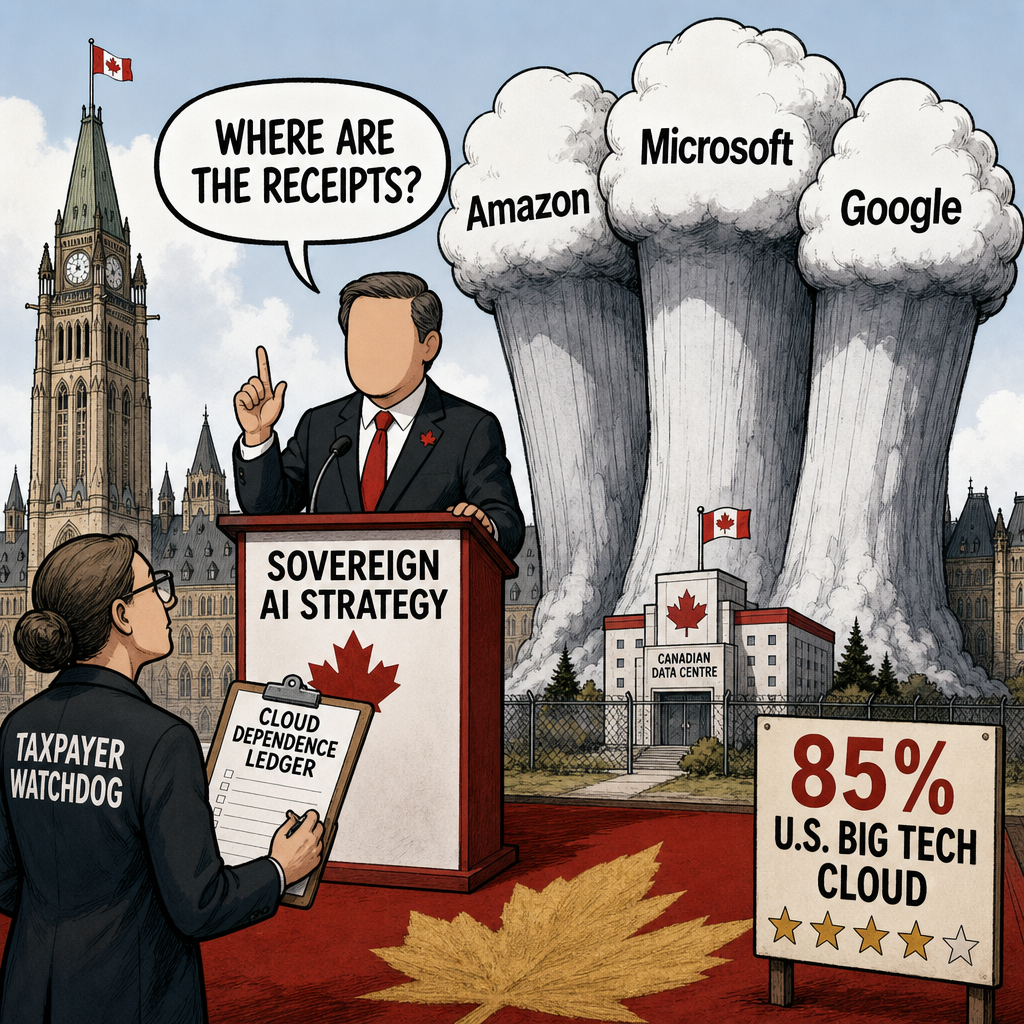
Mark Carney can call the next federal AI strategy “sovereign” if he wants. The receipts say the first question is much simpler: sovereign on whose servers?
The Canadian Press reported Tuesday that Amazon, Microsoft and Google hold 85 per cent of Canada’s public cloud market, citing a Canadian Anti-Monopoly Project report. The same report puts the global figure for those three firms at 66 per cent. In other words, Canada is not merely using U.S. big-tech infrastructure; Canada appears more concentrated in it than the world average.
That matters because Ottawa’s AI promises do not run in a speech. They run on compute, cloud contracts, data centres, procurement rules and legal exposure. CP reported that the federal AI strategy is anticipated this week and is expected to include “Canadian sovereign AI” as one of six pillars. The government’s own Budget 2024 materials also framed public investment around a Canadian Sovereign AI Compute Strategy to help researchers, start-ups and scale-ups access computing power.
There is nothing automatically wrong with buying services from major cloud providers. The accountability problem begins when Ottawa wraps a foreign-dependent stack in domestic branding and asks Canadians to trust the label. If federal departments are training, hosting, testing or scaling AI systems on infrastructure controlled by three U.S. hyperscalers, the public deserves more than a slogan.
The Canadian Anti-Monopoly Project argues this is a competition issue and a sovereignty issue. CP also reported that a draft strategy seen by CBC acknowledged Canadian data-centre and cloud options are mostly foreign-owned, and that major investment would be required to reduce reliance on foreign compute providers. That is not a minor implementation detail. It is the foundation of the policy.
So here is the conservative accountability test for Carney’s AI announcement: publish a public cloud-dependence ledger. List every federal AI and cloud vendor. Show dollar totals by vendor. Identify where data is stored and processed. Disclose what foreign legal regimes may apply. Publish the Canadian alternatives considered and the reason they were accepted or rejected. Set a timetable for reducing dependence where sensitive public data or critical public services are involved.
Canadians should not have to choose between technological progress and national control. They should not have to accept a black box because ministers say the word “sovereign” loudly enough. If Ottawa wants to build AI that Canadians can trust, it needs to prove who owns the infrastructure, who can reach the data, and how taxpayers will know when dependence is going down rather than being rebranded.
A real sovereign AI strategy starts with receipts. Without them, it is just a maple leaf sticker on somebody else’s cloud.
- Global News / Canadian Press: Amazon, Microsoft and Google hold 85% of Canada’s public cloud market, report says — June 2, 2026
- Vancouver CityNews / Canadian Press: U.S. Big Tech holds 85% of Canadian cloud market, report says ahead of AI strategy — June 2, 2026
- Government of Canada, Budget 2024: Canadian Sovereign AI Compute Strategy
- Canadian Anti-Monopoly Project: Publications and report source
This article focuses on cloud/compute accountability and verified public reporting. It does not claim foreign providers have misused Canadian data; it argues Ottawa should publish the procurement and legal-exposure record before branding the strategy sovereign.