Carney’s Recession Receipt Test
If the prime minister wants emergency trust on the economy, he should start with a public dashboard Canadians can verify.
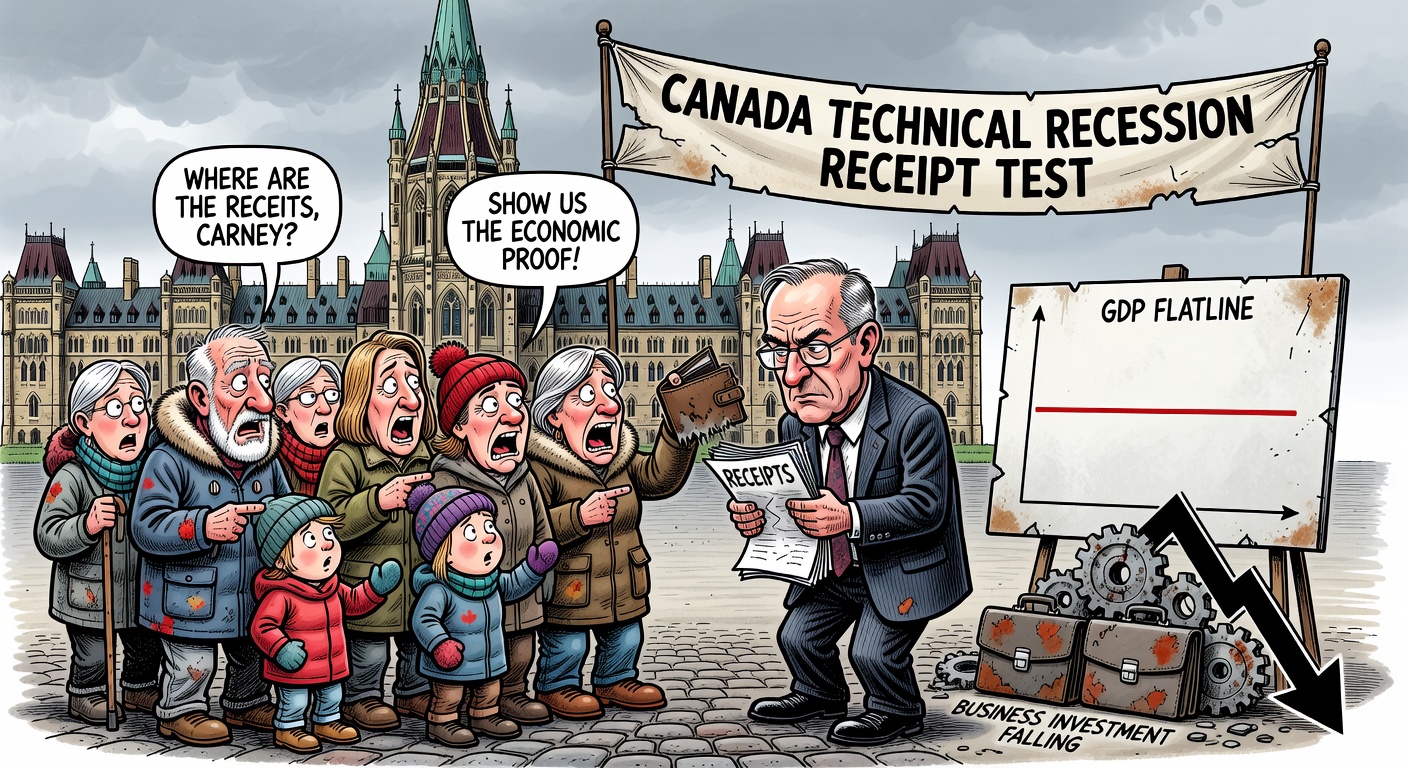
Prime Minister Mark Carney sold himself as the adult in the economic room: the central banker, the crisis manager, the technocrat who could turn Liberal slogans into competence. The latest numbers make that brand a testable claim.
Statistics Canada’s May 29 GDP release says real GDP was unchanged in the first quarter of 2026, after declining 0.2% in the fourth quarter of 2025. Global News, using annualized figures, reported a 0.1% first-quarter decline after a revised 1.0% annualized decline in the previous quarter — enough for Conservative Leader Pierre Poilievre to demand an emergency debate and call it a technical recession.
There is a fair caution here. Some economists told The Canadian Press the picture may not meet the broader, lived definition of a recession. Flat GDP is not a Depression-era breadline, and one headline number never explains a whole economy. But that caveat does not rescue the Liberals from accountability. It sharpens it.
The details underneath the headline are exactly what should worry households. Statistics Canada reported business capital investment fell 0.7% in the first quarter, the fifth straight quarterly decline. Residential-structure investment fell 2.0% after another drop in late 2025, with weak resale activity doing much of the damage. Final domestic demand edged lower. Imports rose faster than exports. The household saving rate slipped to 3.5%, its lowest level in two years.
That is not the portrait of an economy roaring back because Ottawa borrowed, regulated and subsidized brilliantly. It is the portrait of a country where private investment is hesitating, housing remains strained, consumers are stretched, and government still wants Canadians to trust the next spending package on vibes.
Poilievre’s political line — that Carney promised the fastest-growing economy in the G7 and delivered weakness instead — will be argued in the House. Fine. Parliament should argue. But the country needs more than one-liners from either side. It needs receipts.
Before asking MPs to fast-track another budget bill or accept another round of “trust us” economic management, Carney should publish a plain-language recovery dashboard: real GDP and GDP per capita, business investment, residential investment, unemployment, youth unemployment, insolvencies, food-bank reliance, household debt, housing costs, deficit impact and debt-service costs. Update it monthly. Explain what policies are supposed to improve each metric, what they cost, and when Canadians should expect results.
That is the conservative accountability standard: not panic, not spin, not pretending a technical debate over recession labels solves anything. If the economy is healthier than critics say, the data will show it. If it is not, Canadians deserve to know before Ottawa piles on more spending, more regulation and more excuses.
Carney asked to be judged as a serious economic manager. The recession receipt test is simple: publish the ledger, own the results, and stop treating transparency like an opposition stunt.
- Statistics Canada: Gross domestic product, income and expenditure, first quarter 2026 — May 29, 2026
- Global News / The Canadian Press: Poilievre calls for emergency debate as Canada enters technical recession — May 31, 2026
- iPolitics: Liberals aim to fast-track a second budget bill as Poilievre challenges Carney to reverse economic policies — May 31, 2026
This article criticizes federal economic management and parliamentary accountability. It distinguishes Statistics Canada’s quarter-over-quarter figures from annualized news framing and notes that some economists dispute whether the weakness qualifies as a true recession.