Carney Finds $2.6M by Cutting Consumer Watchdogs
If Ottawa says affordability is the priority, the watchdogs who fight junk fees, fraud and abusive market practices should not be the easy cut.
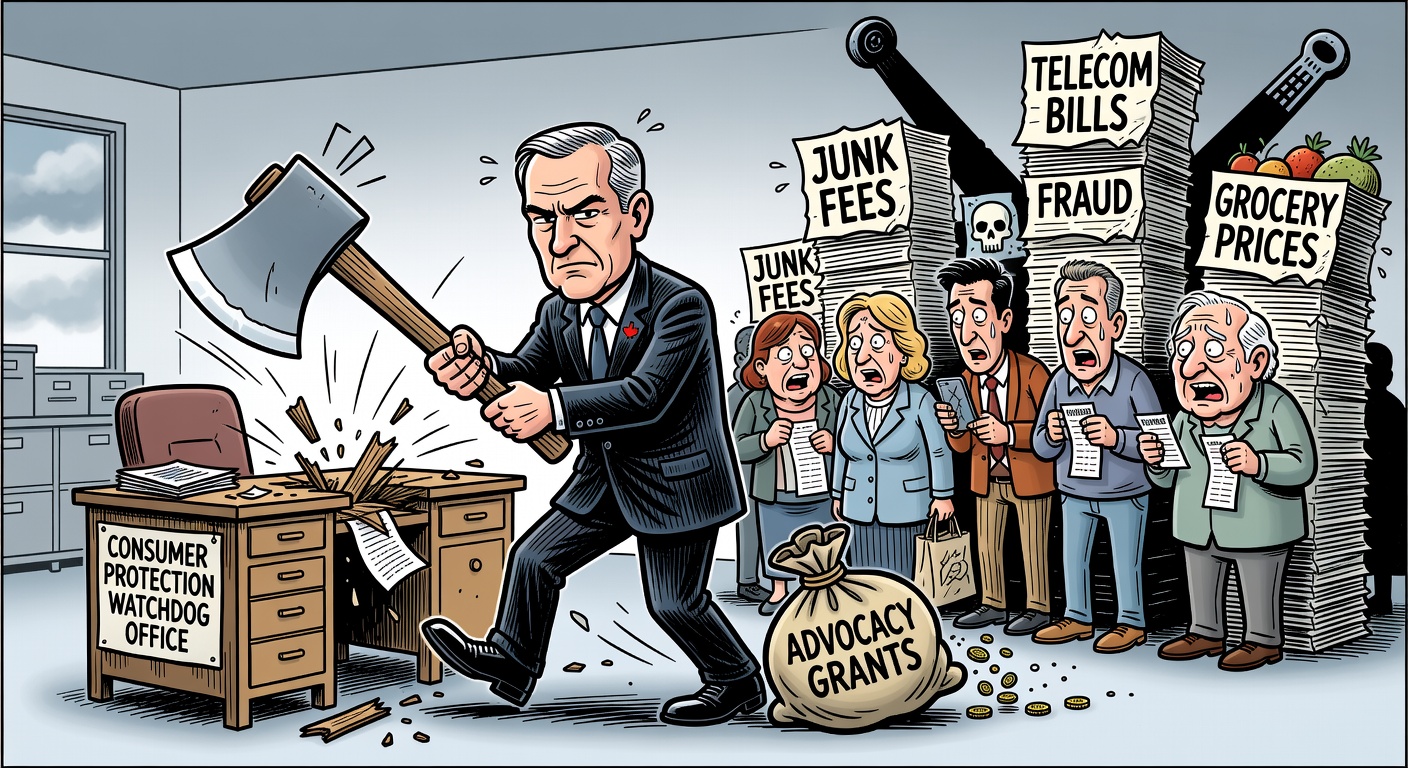
Prime Minister Mark Carney’s spending-review message sounds responsible: find efficiencies, trim waste, prove government can deliver. Fine. Conservatives should support real discipline. But the first test of fiscal seriousness is whether Ottawa cuts bloat or cuts the people standing between consumers and bloat.
Do Not Pass Go reported on May 28 that Innovation, Science and Economic Development Canada is winding down the Office of Consumer Affairs and the Canadian Consumer Protection Initiative by March 31, 2027. The report says the decision was tied to the federal spending review and will save about $2.6 million annually by 2028–29.
Put that number beside the problem. Canadians are living through grocery sticker shock, telecom bills that feel engineered to confuse, subscription traps, fraud calls, hidden charges and “junk fee” creativity across the economy. This is exactly when a federal government should want independent consumer advocates louder, not poorer.
ISED’s own description of the Canadian Consumer Protection Initiative says it supports non-profit consumer organizations through independent research, consumer resources and organizational capacity. Its current awarded-amounts page lists roughly $7.36 million across 2025–27 projects: about $2.54 million for research, $3.21 million for consumer awareness and $1.61 million for organizational development.
Those are not nation-bankrupting sums. They are rounding errors in a federal budget. That is why the cut deserves scrutiny. If a government hunting savings lands on a small office and a modest grant stream used by consumer groups, voters are entitled to ask what larger, better-connected programs survived the knife.
The accountability issue is not that every grant is automatically sacred. It is that Ottawa has not made the trade-off plain. Which projects will disappear? Which organizations will lose capacity? Who will do the independent research on telecom pricing, consumer fraud, food affordability, digital privacy and unfair contract terms when the support dries up? And if the answer is “the market,” Canadians should remember that the market is where many of the abusive practices begin.
There is also a political irony here. Liberals constantly tell Canadians they are fighting for the middle class. But middle-class families do not have lobby teams. Banks, telecom giants, airlines, grocery chains and digital platforms do. Consumer advocacy is one of the few counterweights that can translate everyday frustration into evidence policymakers cannot ignore.
Carney can call this efficiency. Conservatives should call for receipts. Publish the internal rationale. List every affected program and employee. Show the replacement plan for consumer research and advocacy. Then show the bigger spending envelopes that were reviewed and spared.
Fiscal restraint should start with waste, duplication and Liberal vanity projects. It should not start by weakening the watchdogs helping Canadians fight bad bills at the kitchen table.
- Do Not Pass Go: Carney Government Slashes Consumer Protection Groups — May 28, 2026
- Innovation, Science and Economic Development Canada: Canadian Consumer Protection Initiative overview
- Innovation, Science and Economic Development Canada: Awarded amounts, 2025–27 open call
This article criticizes federal spending priorities and consumer-policy choices. It does not allege wrongdoing by any individual public servant or recipient organization.