Bank of Canada Says the Quiet Part on Youth Jobs and Ottawa’s Immigration Surge
If Ottawa wants mass population growth, it owes young Canadians a jobs-and-housing capacity test first.
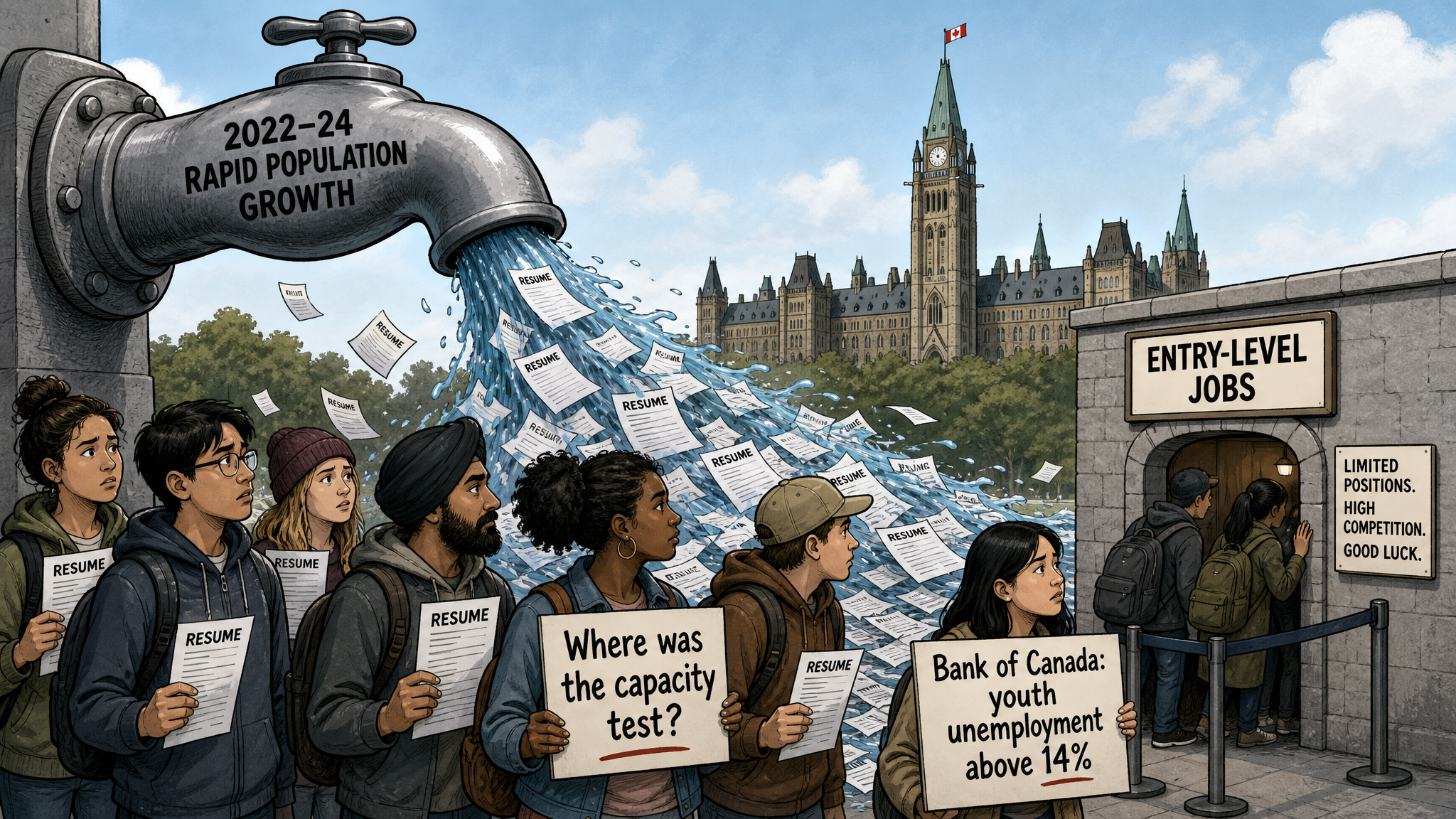
The Bank of Canada has now put official language around what too many young Canadians have been living: the first rung of the job ladder is jammed.
In a May 26 speech, External Deputy Governor Nicolas Vincent said Canada’s labour market is not simply weak in the normal cyclical way. Hiring has slowed sharply. The economy has added about 6,000 jobs per month on average since early 2025, compared with almost 34,000 per month in 2024. That matters because a country cannot invite rapid population growth, underbuild housing and then pretend the entry-level job market is unlimited.
The youth numbers are blunt. Vincent said the unemployment rate for Canadians aged 15 to 24 was about 9% in 2022 and is now above 14%, with teenagers hit hardest. He also said long-term unemployment is elevated: excluding the pandemic, the share of unemployed Canadians looking for work for more than six months has not been higher since the early 2000s.
Then came the sentence Ottawa cannot spin away. Vincent identified demographics as one possible factor and said that between 2022 and 2024, “a large influx of young people from abroad” intensified competition for lower-skill, entry-level jobs. He added that immigration has since been reduced substantially, but the accountability question remains: why did federal policy move faster than the labour market could absorb?
This is not an argument against immigrants. It is an argument against governing by press release. Young newcomers were invited into the same bottleneck as young Canadians: scarce starter housing, strained campuses, expensive transit, and employers with more applicants than openings. The losers are students, apprentices, recent graduates and newcomers themselves, all told to compete harder for jobs Ottawa helped make scarcer.
Conservatives should press the simple capacity test Liberals avoided. Before opening the tap, show the job openings by region, the housing supply, the college and university supports, the wage impact, and the enforcement plan for employers who use labour oversupply to hold down pay. If those receipts are missing, the policy is not compassionate. It is a churn machine.
Vincent also described a “low hire, low fire” labour market: fewer layoffs than a downturn might suggest, but also fewer chances for job seekers to get in. That is exactly where youth suffer. Older workers may keep positions; younger workers wait outside the door.
Ottawa sold rapid population growth as an economic strength. The Bank of Canada’s own analysis now says part of the bill landed on the youngest workers. Those workers deserve more than slogans. They deserve a federal immigration plan tied to real jobs, real homes and real capacity — before the next surge hits the same locked door.
- Bank of Canada: Canada’s labour market between cycles and structural change — Nicolas Vincent speech, May 26, 2026
- Bank of Canada: Diagnosing change in Canada’s labour market — video and summary
This article criticizes federal planning and capacity management. It does not blame individual immigrants or newcomers for labour-market conditions created by government policy.