CSIS Had 22 Charter Red Flags. Why Wasn’t the Minister Formally Told?
Before Ottawa asks Canadians to trust more surveillance power, it should prove existing national-security agencies report Charter-risk conduct fully, promptly and in writing.
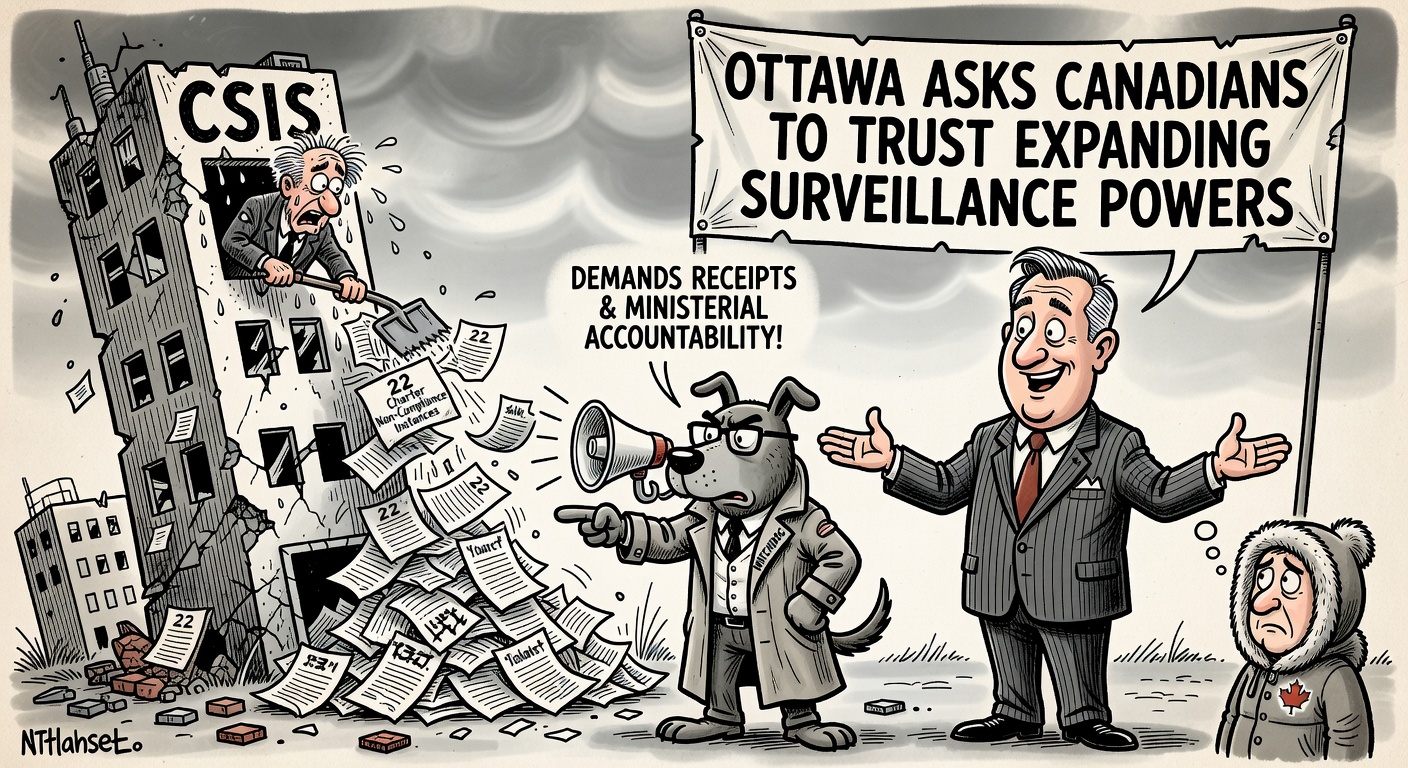
The federal government keeps asking Canadians for trust on national security. Trust us with broader digital tools. Trust us with secret capabilities. Trust us that the safeguards are strong enough behind closed doors.
Then the watchdog report arrives.
Global News reported Friday that Canada’s spy agency admitted 22 instances of Charter “non-compliance” in 2023-24, yet none were formally reported to the federal public safety minister. The underlying details remain secret, so Canadians cannot judge for themselves whether these were technical mistakes, serious rights violations, or something in between. That uncertainty is exactly why formal reporting matters.
NSIRA, the National Security and Intelligence Review Agency, put the issue plainly in its 2024 annual report. It said the CSIS Act’s requirement to report unlawful activity to the minister is a “fundamental accountability mechanism.” The point is not paperwork for paperwork’s sake. The point is democratic control over agencies that operate with extraordinary secrecy and power.
According to Global, CSIS included only a summary list in the director’s classified annual report. NSIRA found that was not enough detail for the minister to understand the context, severity, or corrective actions tied to each incident. In normal government language, that is a process problem. In civil-liberties language, it is a flashing red light: the person politically responsible for the file may not have received the formal, incident-by-incident notice needed to do the job.
Conservatives should be serious about national security. Canada faces foreign interference, terrorism, cyber threats and hostile-state pressure. CSIS needs lawful tools to protect Canadians. But lawful tools are the key phrase. Security agencies do not earn public confidence by asking Parliament for more power while treating rights-related reporting as an internal administrative matter.
The Liberal accountability failure is broader than one agency memo. Ottawa is already debating expanded lawful-access and surveillance powers. Ministers routinely tell Canadians that privacy and Charter rights are protected by oversight. But oversight is only as strong as the information that reaches the responsible minister, Parliament and the watchdogs on time.
Public Safety Minister Gary Anandasangaree’s office reportedly did not answer Global’s repeated question about how many potentially unlawful CSIS activities had been reported to him since a 2025 reporting memo. That is not good enough. The answer can protect classified operations while still giving Canadians basic numbers, timelines and confirmation that the reporting system now works.
The fix is simple: publish anonymized annual counts, require formal ministerial notice for every Charter-risk incident, record corrective actions, and let NSIRA verify compliance publicly. If Ottawa wants trust, it can start with receipts.
- Global News: Spy agency didn’t report unlawful activity, watchdog says
- NSIRA: National Security and Intelligence Review Agency Annual Report 2024
- NSIRA: Review of departmental implementation of accountability mechanisms under the CSIS Act
This article criticizes reporting and ministerial accountability failures. It does not disclose or speculate about classified operations, targets or methods.