The Senate Mailroom Test: Let Senators See the Bill C-9 Postcards
If more than 200,000 Canadians write senators before a speech-law vote, their message should not be reduced to a sample box in a warehouse.
Bill C-9 is already a civil-liberties test. Now it has become a Senate accountability test too.
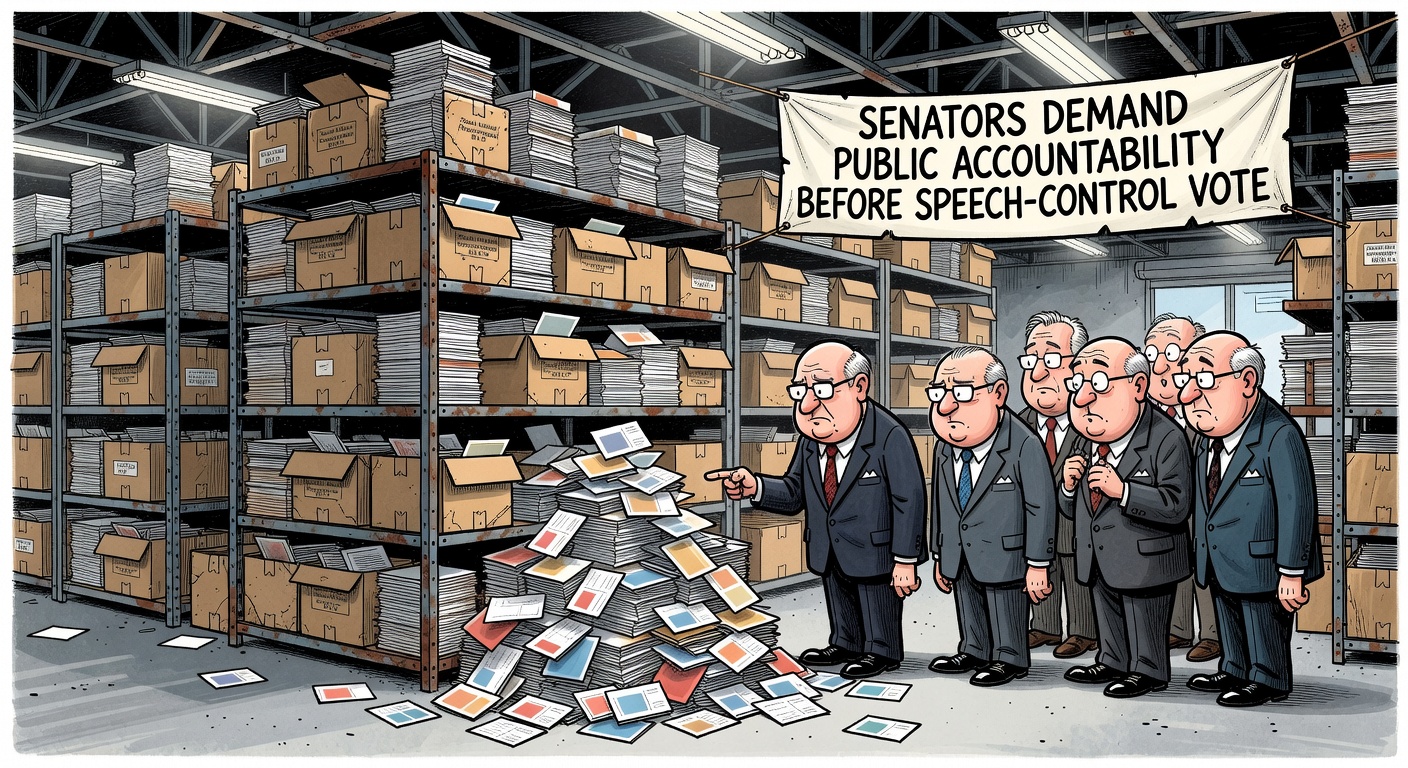
During Senate Question Period on May 27, Senator Denise Batters said 143,000 postcards opposing Bill C-9 were sitting in a Senate mail room in Gatineau and that senators would receive only “a box of postcards.” She told the chamber her own office had received 30 postcards, only one from Saskatchewan, even though each card carried a Canadian’s full name and address. In other words, this was not just anonymous spam. It was named, addressed political participation arriving before a vote on a bill critics see as a speech-control measure.
Senator Tony Loffreda, chair of the Senate internal economy committee and a Liberal appointee, gave the institutional answer. He said senators were advised on May 19 that more than 10,000 identical postcards had arrived, that samples were sent to each senator, and that the remaining postcards had since exceeded 200,000. They were being kept in a Gatineau warehouse for 90 days, he said, and senators could arrange to visit them through administration. Loffreda denied the decision was made to silence anyone.
That denial matters. So does the process. A Parliament that asks Canadians to trust it on speech law should not ask those same Canadians to accept a black-box mailroom rule when their opposition arrives at scale.
There may be practical problems with physically delivering hundreds of thousands of similar cards. Nobody needs Ottawa to pretend paper, staffing and security logistics do not exist. But logistics cannot become a quiet filter between citizens and legislators. If identical postcards are treated differently than individual letters, senators and the public deserve to know the rule before the vote — not after the controversy.
The conservative accountability principle is simple: citizens do not work for Parliament; Parliament works for citizens. When 200,000-plus Canadians take the trouble to put their names and addresses on opposition to a government bill, the institution should bend toward visibility, not convenience.
The Senate should publish the mail-handling decision, the internal economy or steering records behind it, the delivery criteria for mass campaigns, the number of postcards by province where available, the date each senator was notified, and a senator-by-senator access log. If samples were sent, publish exactly what senators received and when. If privacy rules prevent publishing personal details, say so plainly while still reporting aggregate numbers.
This is bigger than one bill. Liberals spent years telling Canadians that new speech rules are harmless because institutions can be trusted to apply them carefully. Trust is earned by sunlight. Before Bill C-9 advances, the Senate should show Canadians that public opposition was counted, accessible and impossible to bury in a warehouse.
- Senate of Canada: Debates, Issue 75, May 27, 2026
- Senate of Canada: Topic intervention page, Bill C-9 postcard exchange context
- Blacklock’s Reporter: May 2026 news index, Bill C-9 postcard lead
This article argues for transparent Senate handling of public correspondence. It does not allege that any senator personally destroyed or suppressed mail; it asks the Senate to publish the records needed to prove public opposition was properly handled.