Carney Calls It Investment. The Debt Meter Says $2.44 Trillion
A new combined federal-provincial debt projection turns Ottawa’s “investment” branding into a basic taxpayer-receipts test.
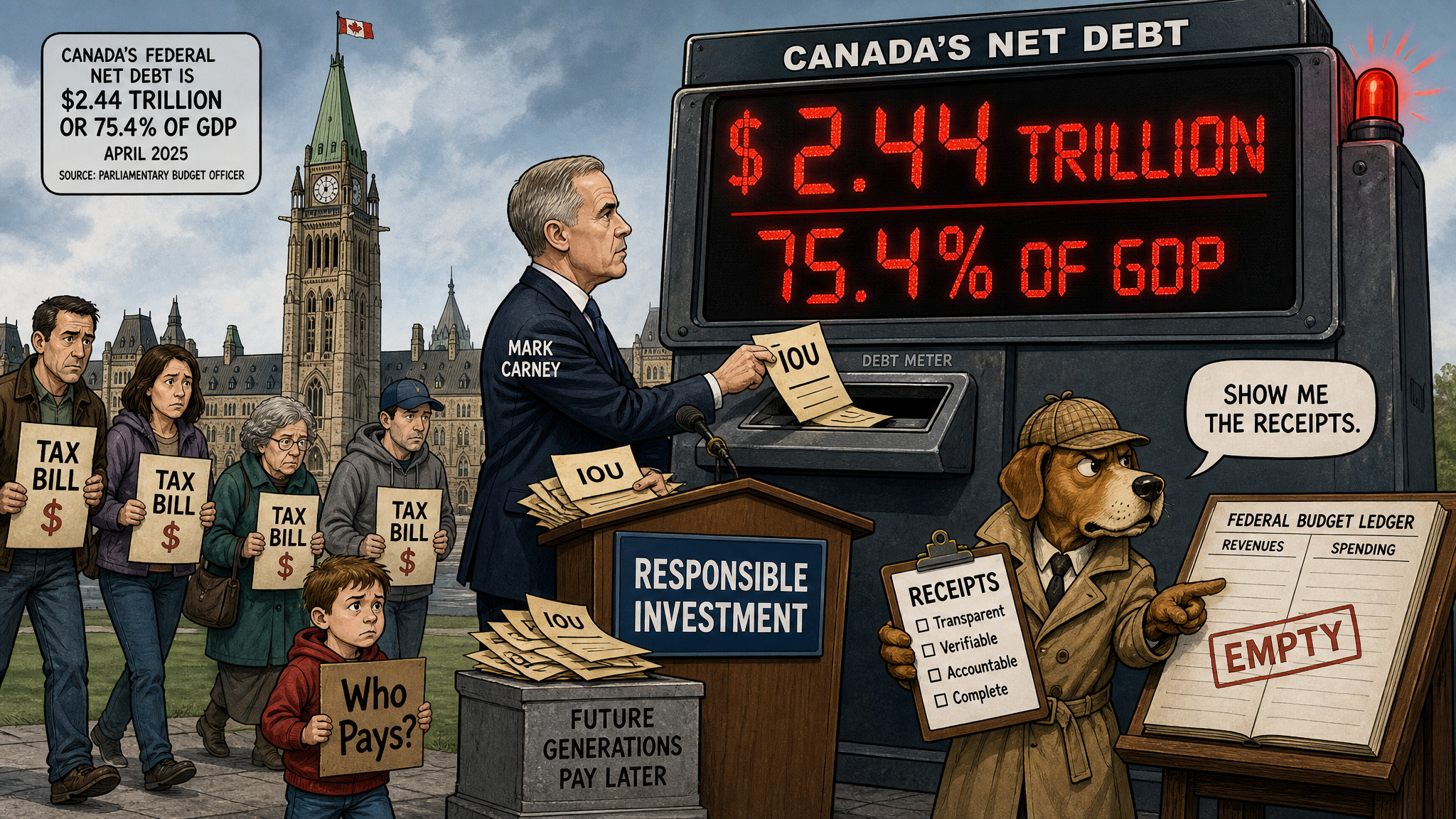
The debt meter just flashed a number Ottawa cannot spin away: $2.44 trillion.
That is the Fraser Institute’s new projection for combined federal and provincial net debt in 2025-26, up from $1.24 trillion in 2007-08. The same release puts the combined burden at 75.4 per cent of GDP, compared with 53.2 per cent before the 2008 financial crisis. It is a warning light, not a partisan slogan.
The distinction matters. This is combined federal-provincial net debt, not Ottawa’s debt alone. Provinces made choices too. But the accountability question still lands heavily on the federal government, because the National Post’s write-up of the study says most of the increase over the 18-year period came from Ottawa: federal net debt rose by a projected $712.7 billion, or 93.7 per cent.
That is the context for Mark Carney’s preferred language of “investment.” Investment can be legitimate when it buys durable assets, improves productivity, and comes with transparent returns. But debt-financed spending does not become responsible because a government relabels it. Canadians deserve a balance sheet, not a slogan.
The provincial numbers make the burden concrete. Fraser says Manitoba has the highest combined federal-provincial debt-to-GDP ratio among provinces at 91.3 per cent in 2025-26. On a per-person basis, the combined burden ranges from $42,368 in Alberta to $71,611 in Newfoundland and Labrador, with Ontario second-highest at $63,574. Those are not abstract ledger entries. They are future tax pressure, service pressure, and interest-rate risk divided across households that are already paying more for mortgages, food, rent, and energy.
Ottawa’s own Spring Economic Update adds the other half of the story. Finance Canada projects federal public debt charges rising from $54.0 billion in 2025-26 to $80.9 billion in 2030-31. The update also projects federal debt at $1.3339 trillion in 2025-26 and $1.6294 trillion by 2030-31. If the government wants to call that manageable, it should show Canadians the stress tests: what happens if growth disappoints, rates stay higher, or new spending arrives before old promises are paid for?
A conservative accountability standard is simple. Before Ottawa launches another “investment” package, it should publish the debt-service table beside every major promise, separate capital spending from operating spending in plain English, and show province-by-province taxpayer exposure. If a project is worth borrowing for, ministers should be able to state the expected return, timeline, risk, and exit plan.
Carney built his brand on financial seriousness. This is the test of whether that brand survives contact with Canada’s books. A country can borrow through a crisis. It cannot keep treating permanent deficits as vision and then act surprised when the interest bill crowds out priorities.
The debt meter says $2.44 trillion. The only responsible answer is receipts.
- Fraser Institute / CNW: Canada’s combined federal-provincial government debt estimated to surpass $2.4 trillion in 2025/26
- National Post via Unpublished.ca: Federal-provincial debt to exceed $2.4 trillion
- Government of Canada: Spring Economic Update 2026, Annex 1
- Government of Canada: Spring Economic Update 2026, Overview
This article distinguishes combined federal-provincial net debt from federal debt alone and focuses on fiscal accountability, debt-service risk and transparency before new spending commitments.