When Ottawa Calls Accountability a Narrative
After Tumbler Ridge, Canadians are not wrong to ask whether warning signs were missed. Ottawa should answer with a timeline, not framing notes.
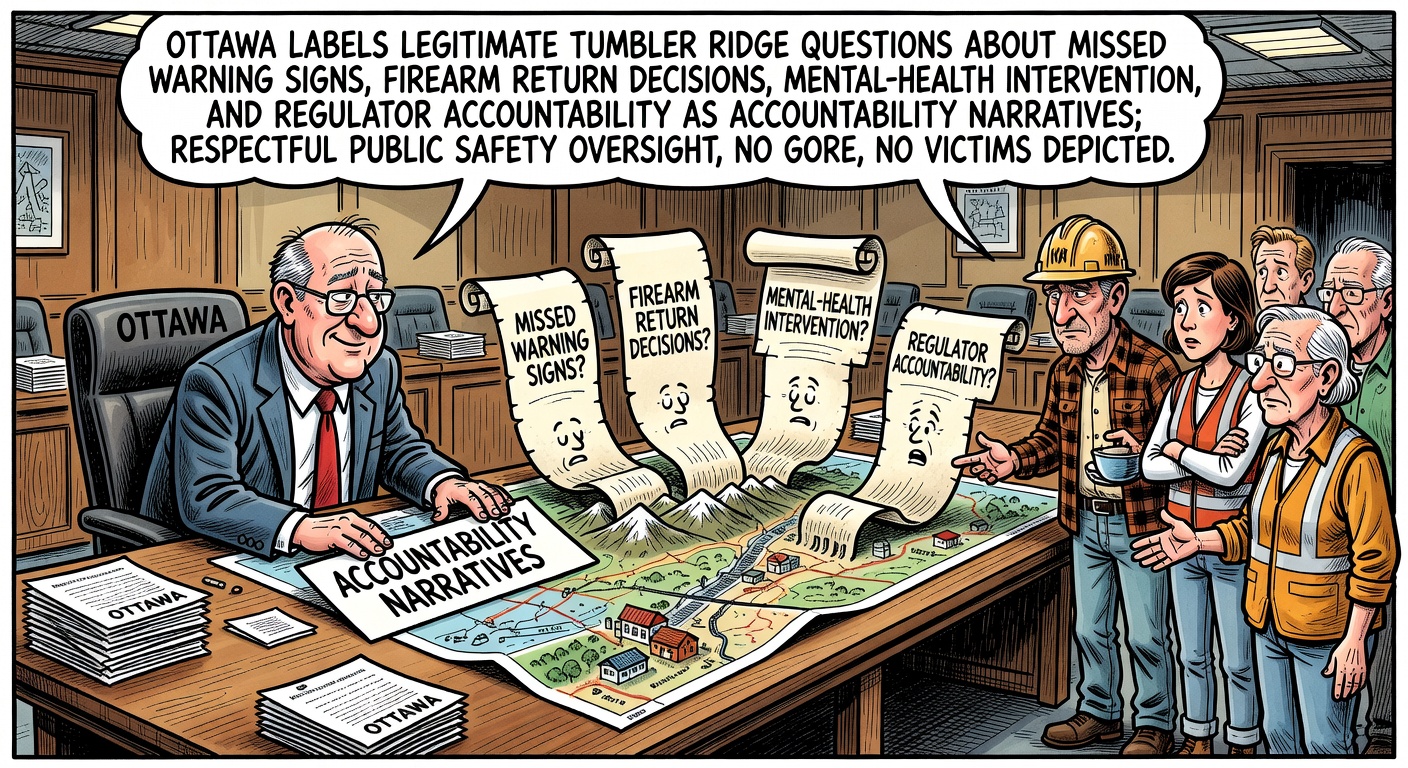
The most important line in the Tumbler Ridge memo is not a policy answer. It is a phrase. Three days after the February mass shooting in northeastern British Columbia, Privy Council Office officials warned Prime Minister Mark Carney that public discussion was moving toward “emerging accountability narratives.”
That is bureaucratic language, but it says a lot. According to The Canadian Press, the questions officials flagged included mental-health intervention, firearms access, and whether warning signs had been missed. Those are not fringe distractions. They are exactly the questions a serious government should expect after nine people are killed and more than two dozen are injured.
There is a respectful way to do this. Do not exploit victims. Do not turn a grieving community into a partisan prop. Do not rush ahead of the police investigation. But respect for victims cannot become a shield against scrutiny of systems that may have failed before the first shot was fired.
The known facts already justify hard questions. CP reported that RCMP had visited the home over mental-health concerns in previous years. Guns had been seized at least once and later returned. The shooter’s OpenAI account had reportedly been shut down over troubling posts, including posts describing gun-violence scenarios. Each fact points to a different public-safety handoff: police, firearms decision-makers, mental-health intervention, digital-warning escalation, and federal briefing channels.
Canadians deserve a clear timeline. When were concerns first reported? Who assessed risk? What legal test allowed seized firearms to be returned? Were provincial and federal officials notified of any pattern? Did any agency connect online warning signs with real-world access to weapons? What did Carney know before attending the February 13 vigil, and what has his government done since?
The memo was obtained through access-to-information law, with several passages redacted. That matters. If the government’s internal priority was simply to understand grief, misinformation and polarization, then publish the non-sensitive record. If officials were also tracking institutional exposure, then Canadians should not have to rely on blacked-out pages to learn how Ottawa understood the risk.
Conservatives should be careful here. This is not a call for instant scapegoats or blanket gun-control theatre. It is a call for measurable accountability: the firearm-seizure and return process, mental-health response gaps, information-sharing rules, and regulator performance. Public safety is not improved by slogans from either side.
Carney’s government can still do the right thing. Release a fuller timeline. Explain what was redacted and why. Commit to an independent after-action review that protects legitimate investigative details while identifying policy failures. And stop treating citizens’ demand for answers as a “narrative.” In a democracy, accountability after tragedy is not a communications problem. It is the job.
- CityNews / The Canadian Press: Memo warned PM of public anxiety about mental health, firearms after B.C. shootings
This article argues for public-safety accountability and transparency. It does not allege wrongdoing by any named individual beyond the facts reported by The Canadian Press, and it does not prejudge the ongoing police investigation.