Carney’s Appointment Power Needs Published Guardrails
Vice-regal and Senate appointments are not ribbon-cutting trivia. They are constitutional power, and Canadians deserve the process receipts.
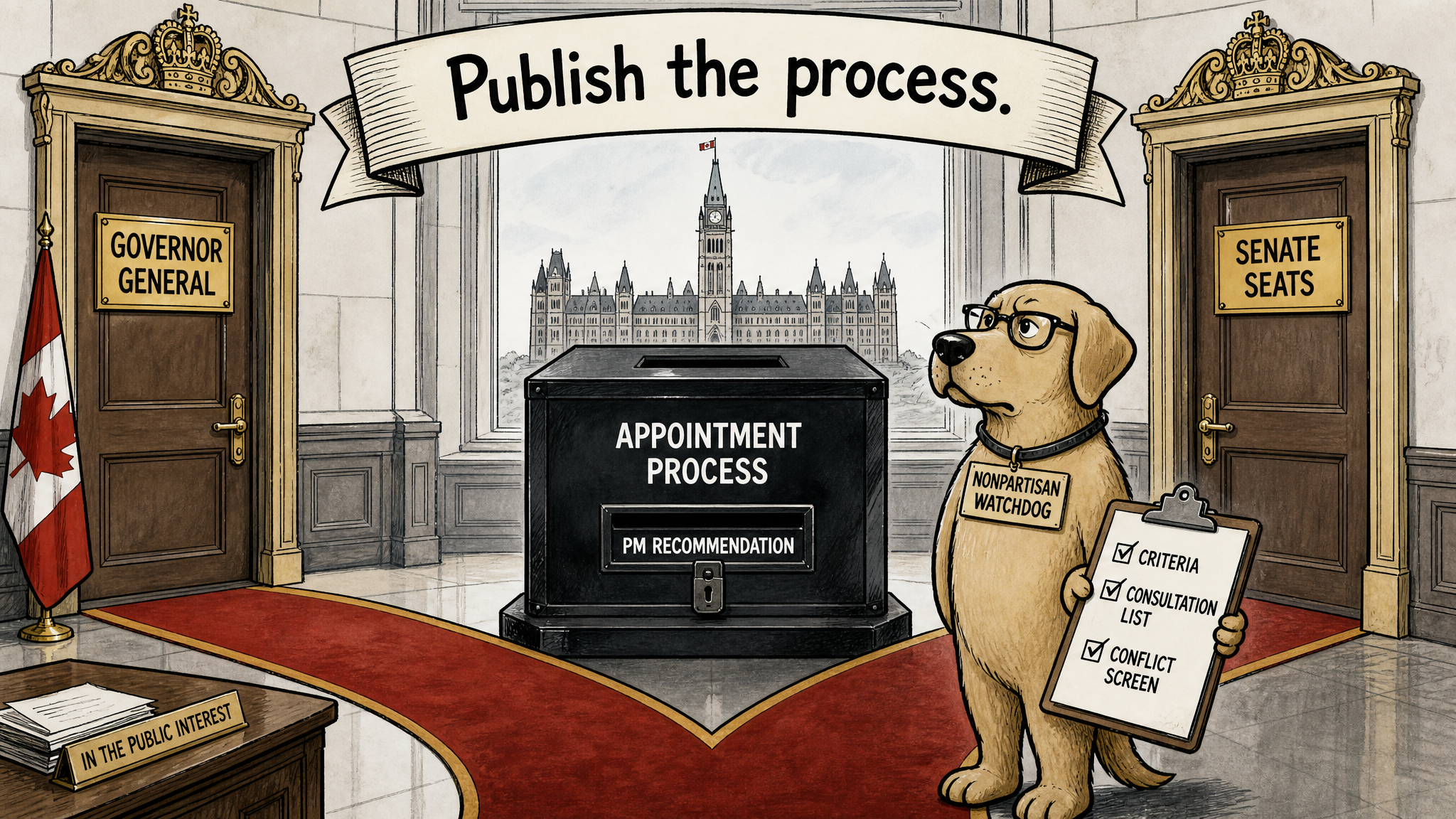
Mark Carney’s first big appointment test is not really about Louise Arbour. It is about whether Canada’s new Prime Minister will treat constitutional appointments as public trust or private prime-ministerial property.
On May 5, the Prime Minister’s Office announced that King Charles III had approved Arbour as Canada’s next Governor General, on Carney’s recommendation. The release highlighted Arbour’s résumé: former Supreme Court of Canada justice, former UN High Commissioner for Human Rights, and former chief prosecutor for the Rwanda and former Yugoslavia international tribunals.
Those credentials are serious. Conservatives do not need to pretend otherwise. The accountability question is different: what process produced the recommendation, who was consulted, what alternatives were considered, and what conflict or partisan-screening test was applied before the Prime Minister sent the name to the King?
The Governor General is often described as ceremonial, but the office is not meaningless. The Governor General’s own constitutional-duties page lists responsibilities that include ensuring Canada has a prime minister and government with Parliament’s confidence, summoning or dissolving Parliament, delivering the Speech from the Throne, and granting Royal Assent. In normal times, those powers run quietly. In a parliamentary crisis, they matter.
That is why the appointment process should not be a black box. If a government wants Canadians to trust an office that sits above day-to-day party politics, it should be willing to publish the guardrails around the selection: the criteria, the consultation map, the short-list process, the conflict screen, and the reason a final candidate met the standard.
The same test is now staring at Senate appointments. CityNews, citing The Canadian Press, reported that Carney said he would consult the advisory process created under Justin Trudeau for Senate picks. That process was sold as an anti-patronage reform after the Senate expenses scandal. Fine. Then show Canadians how it is being used now.
For years, Liberals have claimed to be cleaning up appointments by moving them away from pure partisan reward. But the public still sees the result after the fact, not the full machinery before the decision. A prime minister can praise independence while still controlling the final choice. The safeguard is transparency.
This is not an argument against Arbour personally, or against qualified people serving the Crown. It is an argument against asking Canadians to accept “trust us” as the appointment standard.
Carney came to office promising competence and seriousness. Here is a simple way to prove it: publish the vice-regal appointment process, commit to the same disclosure standard for Senate vacancies, and release enough information for Parliament and the public to see that merit beat patronage. If the process is clean, daylight will help him. If it is not, Canadians deserve to know before more names quietly move from the Prime Minister’s desk into constitutional office.
- Prime Minister of Canada: May 5, 2026 announcement of Louise Arbour as Canada’s next Governor General
- Governor General of Canada: Constitutional duties of the Governor General
- CityNews / Canadian Press: Carney says he will consult Trudeau’s Senate-appointments advisory process
- AP News: International report on Carney’s Governor General appointment announcement
This article argues for appointment-process transparency. It does not allege personal wrongdoing by Louise Arbour or claim the appointment was unlawful.